
Alert Triage and Automation
Triage every alert with the expertise of your best analyst
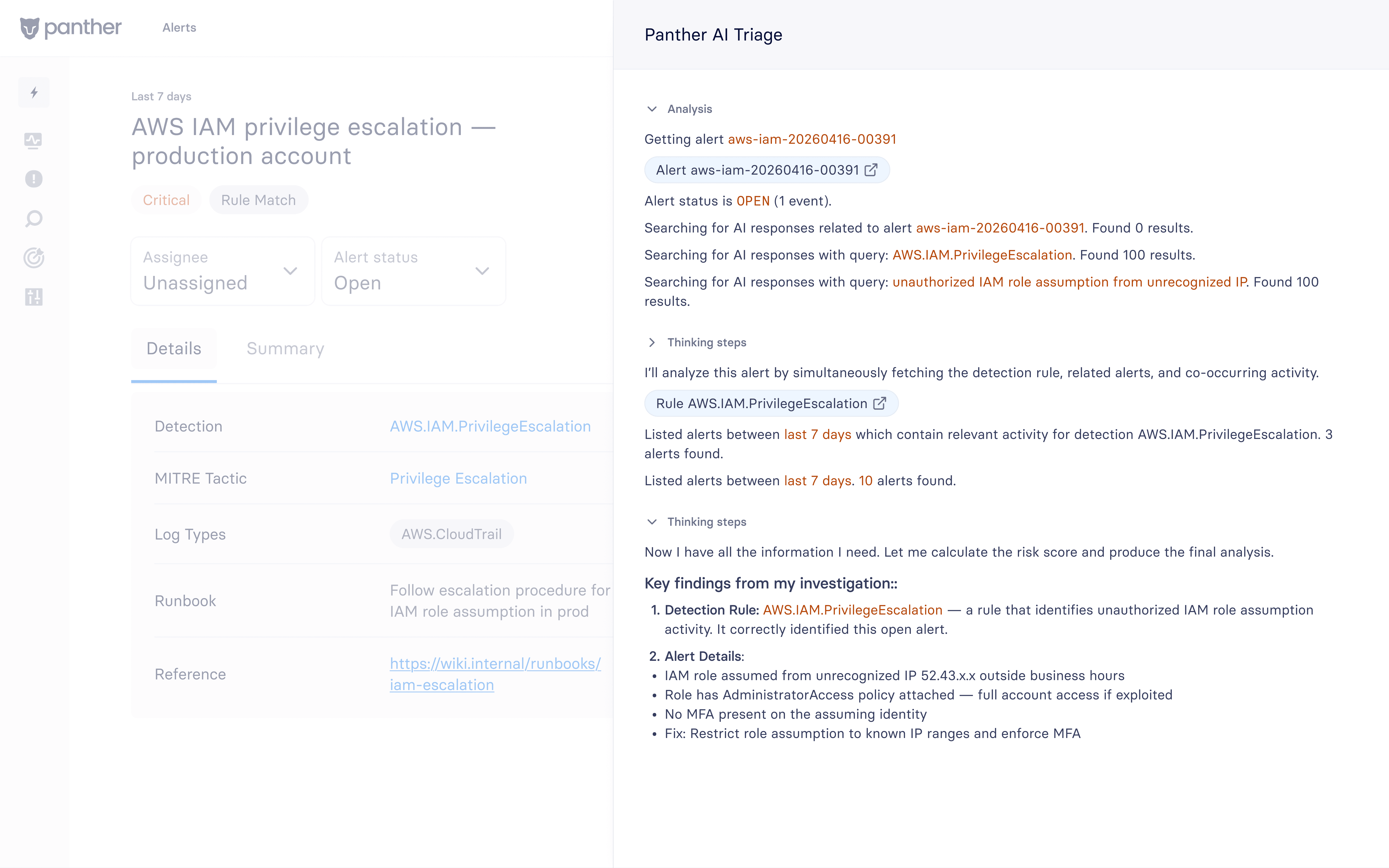
Panther doesn't summarize alerts and wait for instructions — it investigates.
Trusted by top security teams






Autonomous investigation. Complete context. Panther gathers evidence the way your best analyst would on every alert, every time, in minutes.
Autonomous investigation. Complete context. Panther gathers evidence the way your best analyst would on every alert, every time, in minutes.

Definitive risk classification. Every alert gets a clear verdict with specific evidence attached. When you confirm or override the classification, that feedback sharpens future scoring.
Definitive risk classification. Every alert gets a clear verdict with specific evidence attached. When you confirm or override the classification, that feedback sharpens future scoring.

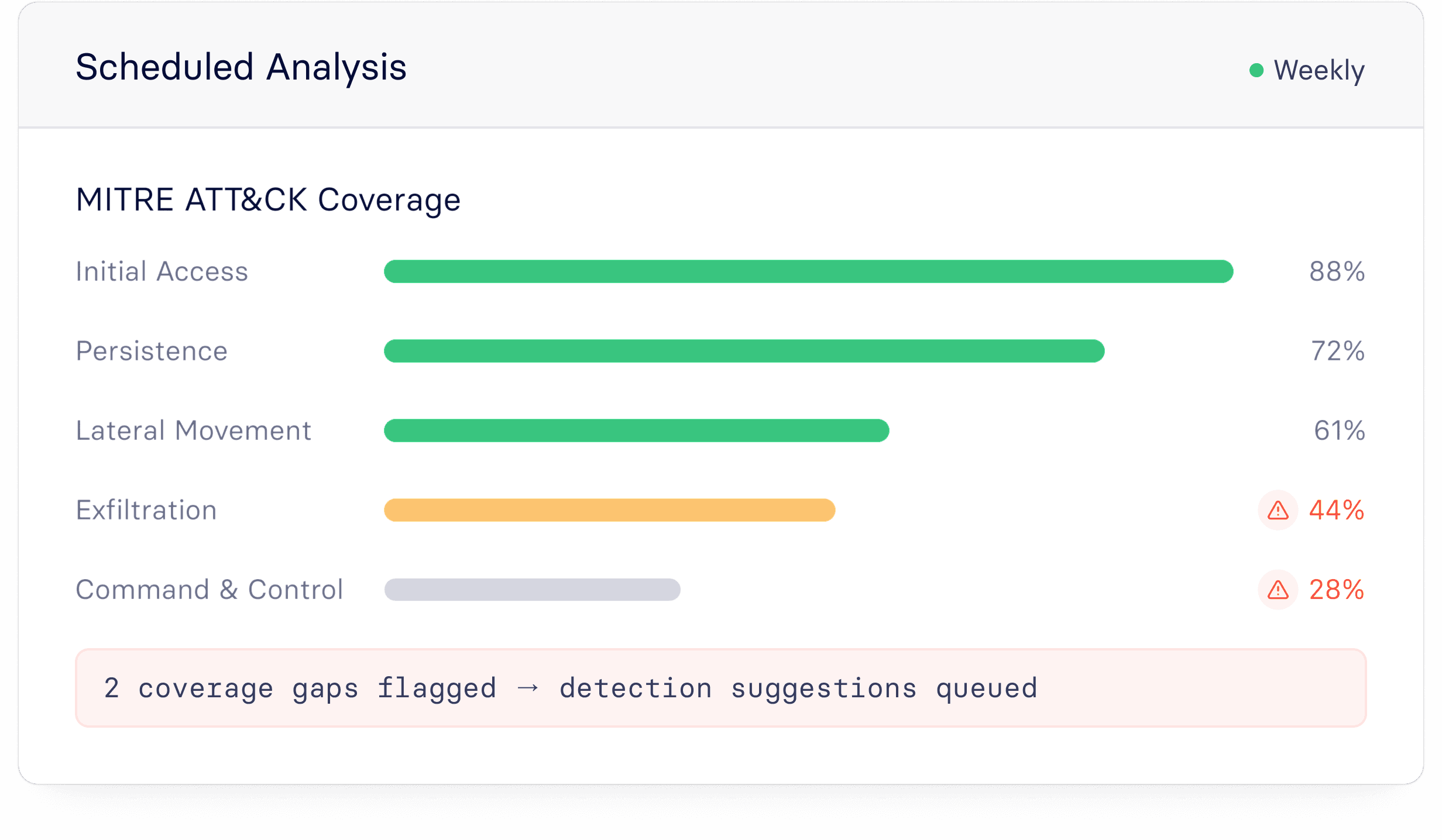
Proactive, expanding coverage. Scheduled AI runs analyze alert patterns and hunt for threats across your telemetry. Coverage gaps get flagged before they become incidents.
Proactive, expanding coverage. Scheduled AI runs analyze alert patterns and hunt for threats across your telemetry. Coverage gaps get flagged before they become incidents.
Complete Context
Alert quality improves automatically as your team works
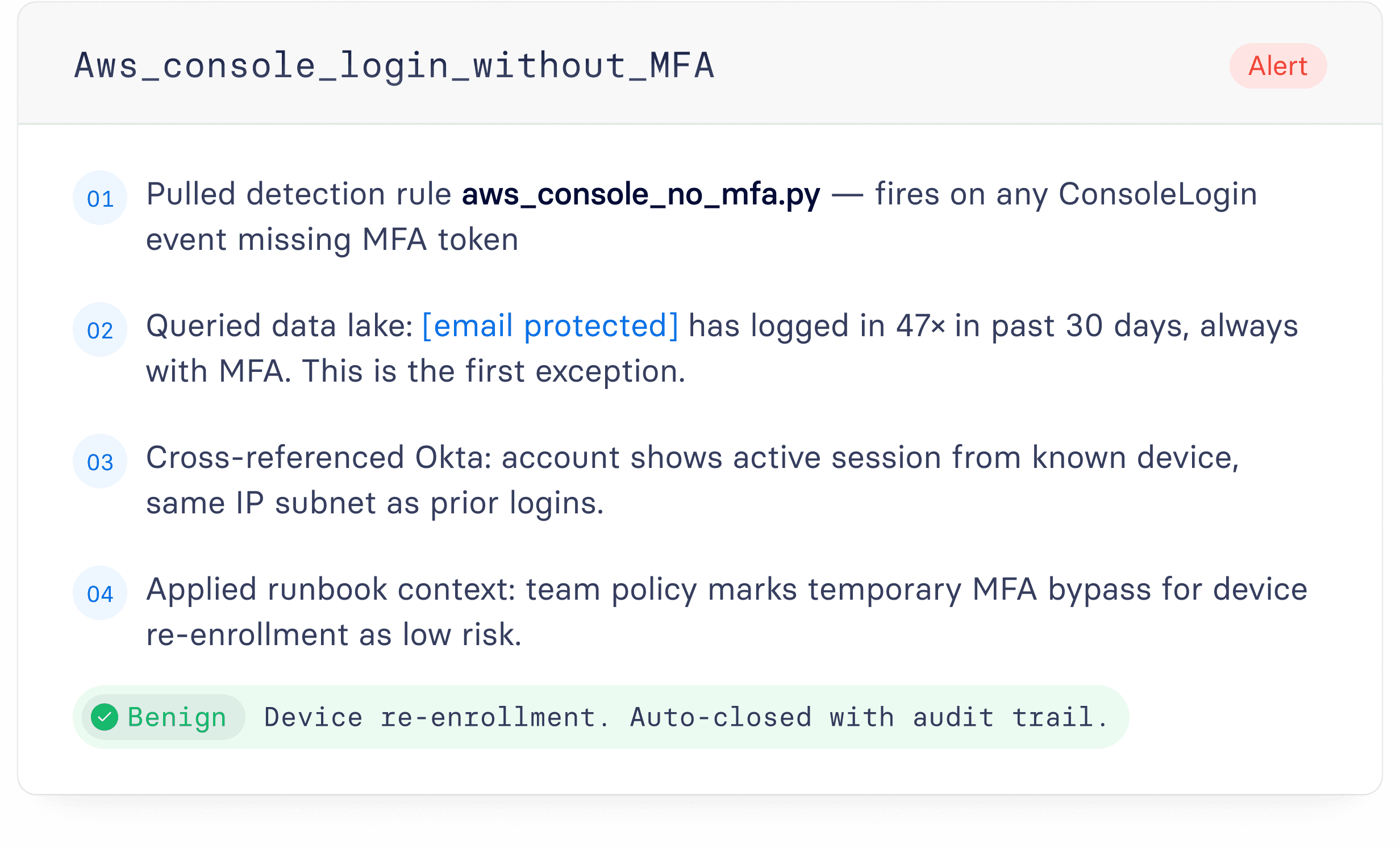
Most AI triage tools work from the alert alone. Panther has full-stack access. When agents work from the same context your best analysts use, they investigate with the same depth and act with the same confidence.

Compounding Intelligence
Every triage outcome makes the next one more accurate
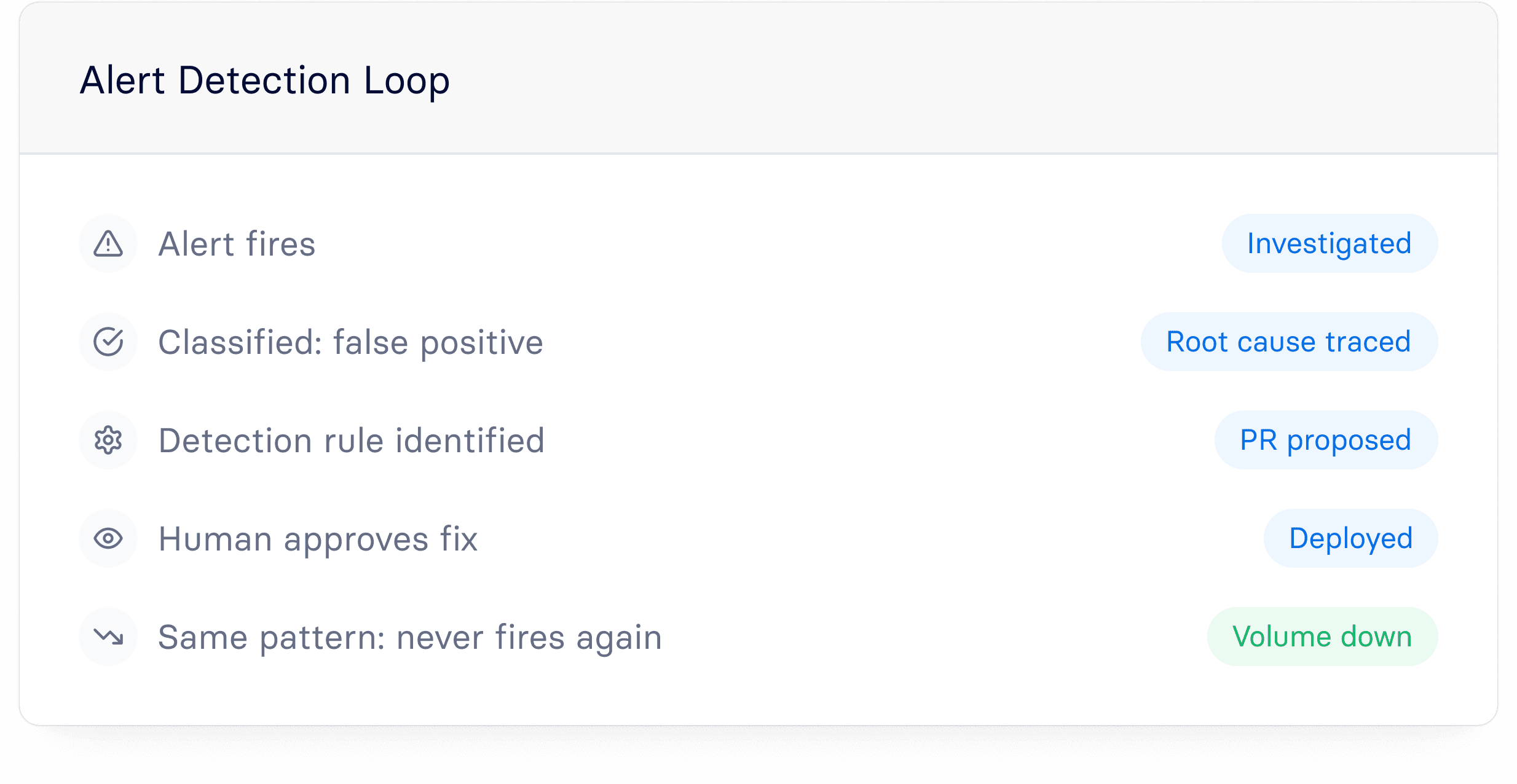
When Panther identifies a false positive, it doesn’t just close the alert — it traces back to the specific detection rule that fired and proposes a targeted code fix. Alert volume decreases not because you’re ignoring things, but because the detections themselves keep improving.

Autonomous Action
Auto-close the benign. Escalate the real.
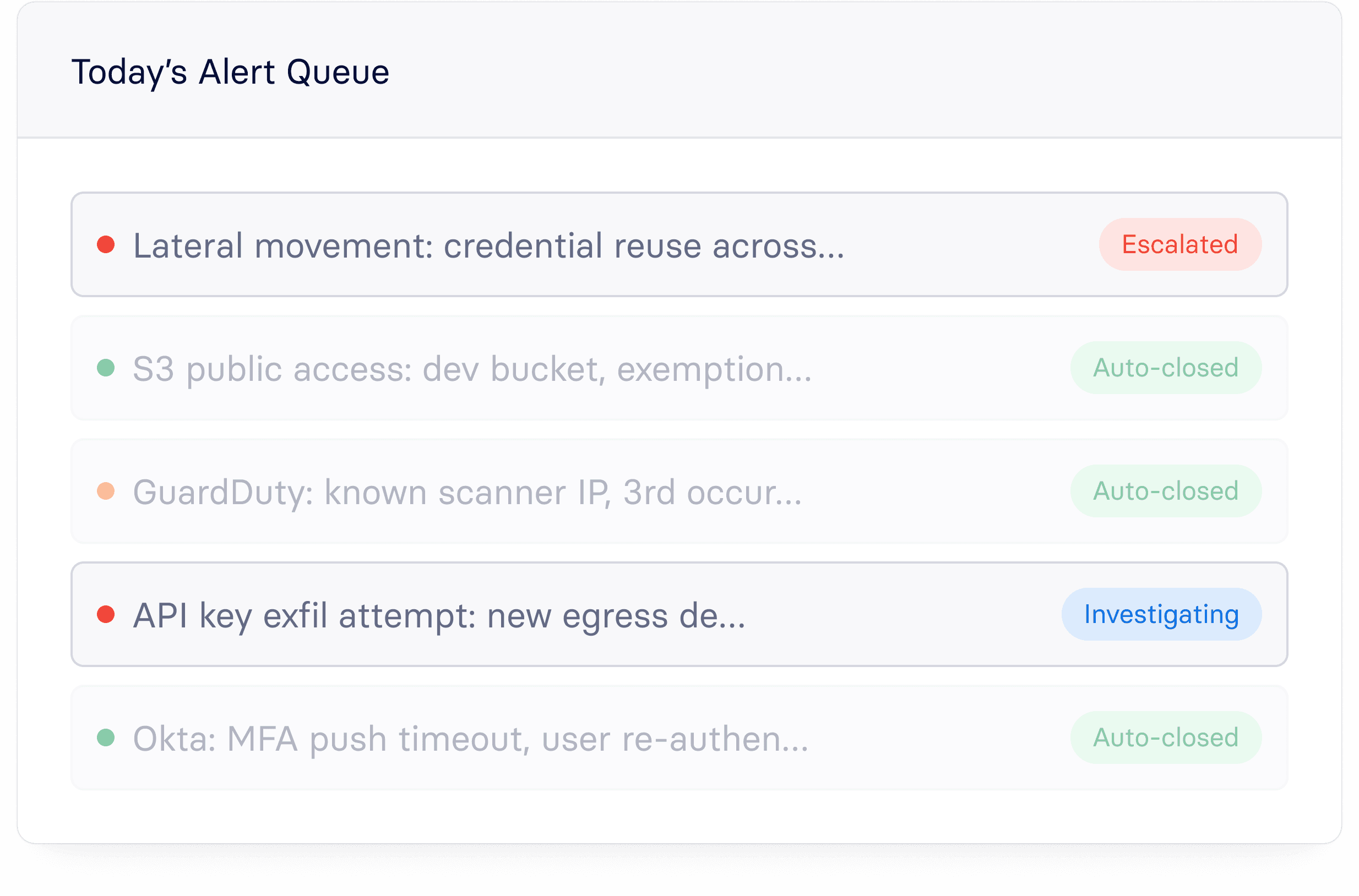
When AI confidence meets your configured threshold, benign alerts close automatically with full audit trails and documented reasoning. Analysts are only pulled in when there’s genuine ambiguity or a confirmed threat.

Proactive Coverage
Coverage gaps surfaced before they become incidents
Panther runs scheduled analyses across your alert patterns and telemetry, surfacing noisy detections and coverage blind spots before your team encounters them in a live incident.

How it works
How it works
Conversational Intelligence
Risk Scoring and Classification
Detection Runbooks
AI Prompts
Auto-close Alerts
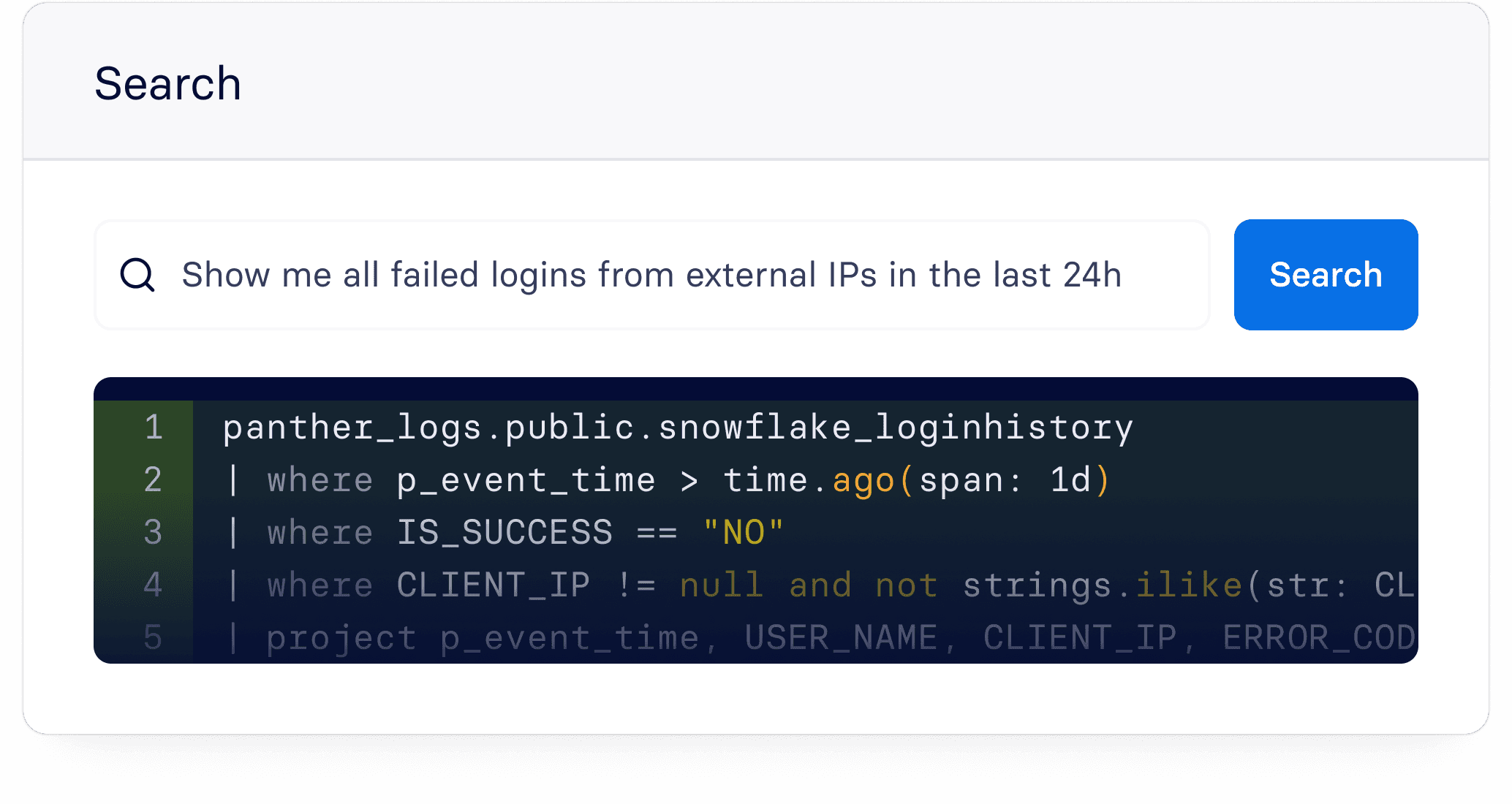
Ask a question. Get an investigation.
Instead of opening tickets and switching between tools, analysts interact with Panther directly in natural language. It's not a chatbot layered on top of your SIEM, it’s natively connected to your detection logic, alert history, and organizational context.

Ask a question. Get an investigation.
Instead of opening tickets and switching between tools, analysts interact with Panther directly in natural language. It's not a chatbot layered on top of your SIEM, it’s natively connected to your detection logic, alert history, and organizational context.
Ask a question. Get an investigation.
Instead of opening tickets and switching between tools, analysts interact with Panther directly in natural language. It's not a chatbot layered on top of your SIEM, it’s natively connected to your detection logic, alert history, and organizational context.
" height="24.544924369551808px" id="Vjp77CJ9j" transform="translate(6.637 7.31)" width="27px"/></svg>)
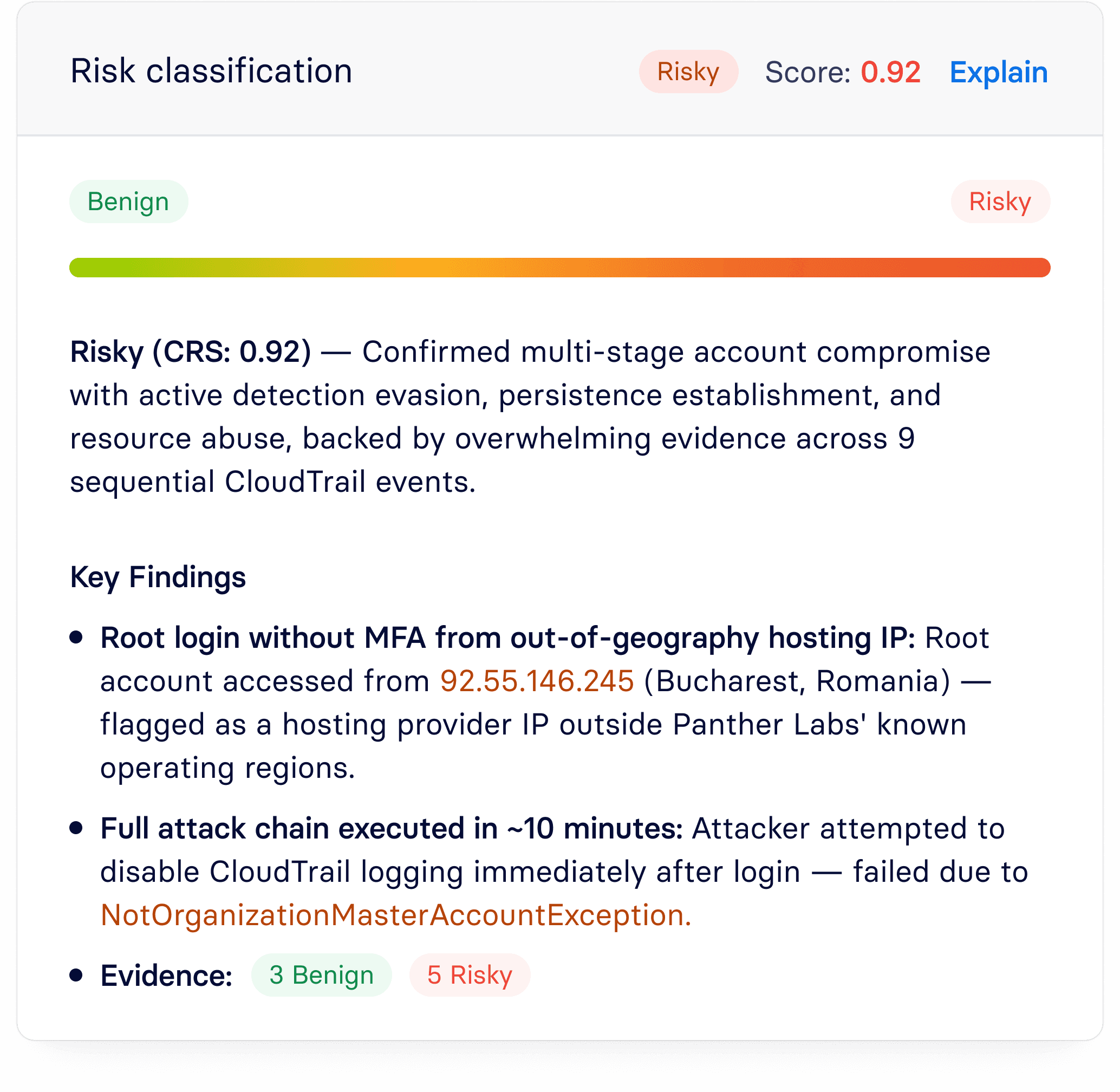
Definitive classifications that get sharper over time
Panther assigns every alert a confirmed verdict with specific supporting evidence. When analysts confirm or override a classification, that feedback improves future scoring accuracy for the same alert patterns.
Definitive classifications that get sharper over time
Panther assigns every alert a confirmed verdict with specific supporting evidence. When analysts confirm or override a classification, that feedback improves future scoring accuracy for the same alert patterns.
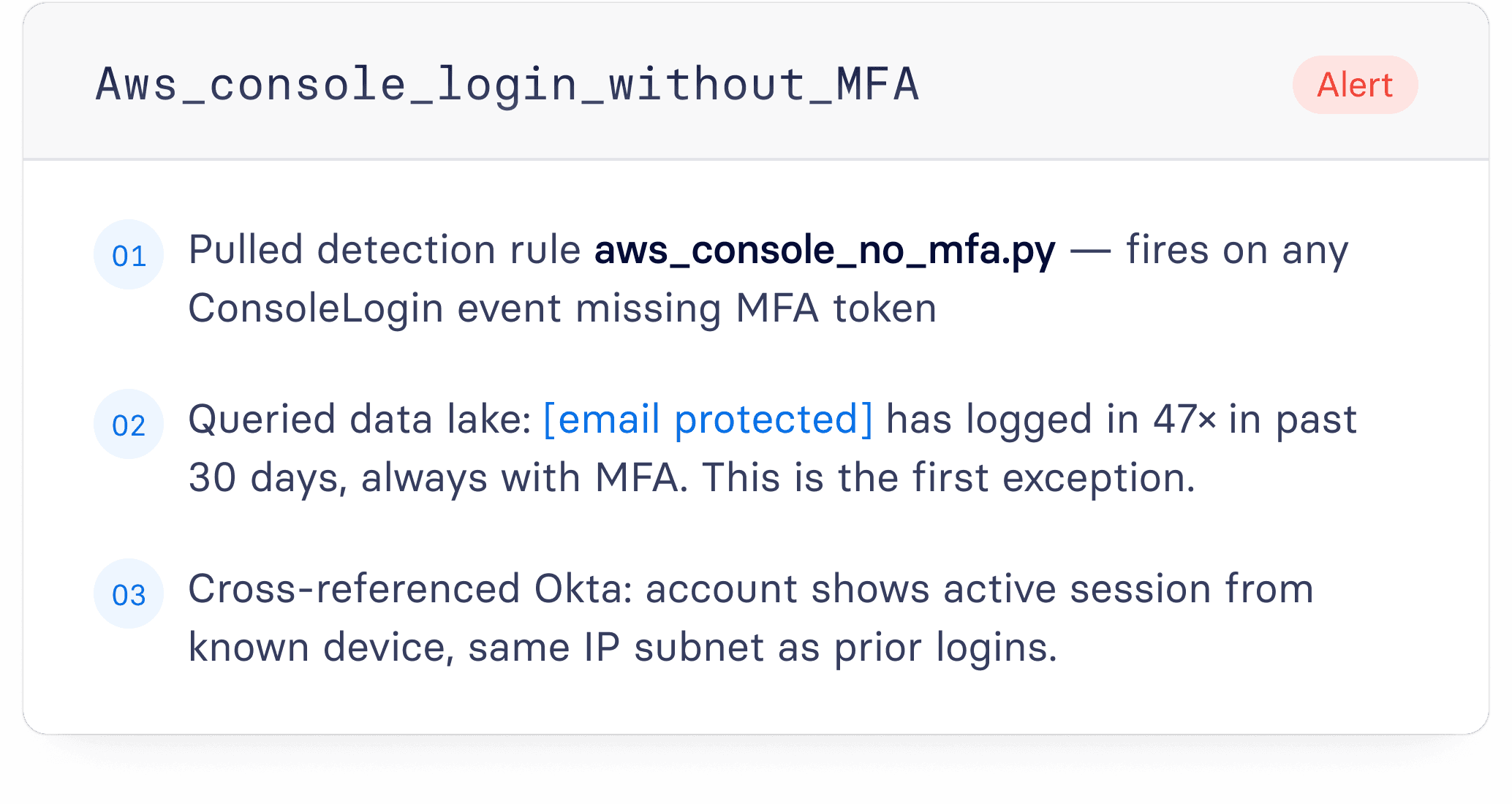
Institutional knowledge encoded, not locked in people’s heads
Runbooks lets you encode what’s normal for your environment and how your team evaluates specific alert types. When AI investigates, it applies this context consistently — the same judgment call a senior analyst would make, applied to every alert regardless of who’s on shift.
Institutional knowledge encoded, not locked in people’s heads
Runbooks lets you encode what’s normal for your environment and how your team evaluates specific alert types. When AI investigates, it applies this context consistently — the same judgment call a senior analyst would make, applied to every alert regardless of who’s on shift.
Purpose-built prompts for every stage of an investigation
Analysts can run these prompts against any alert or time window without writing queries or knowing the underlying data schema.
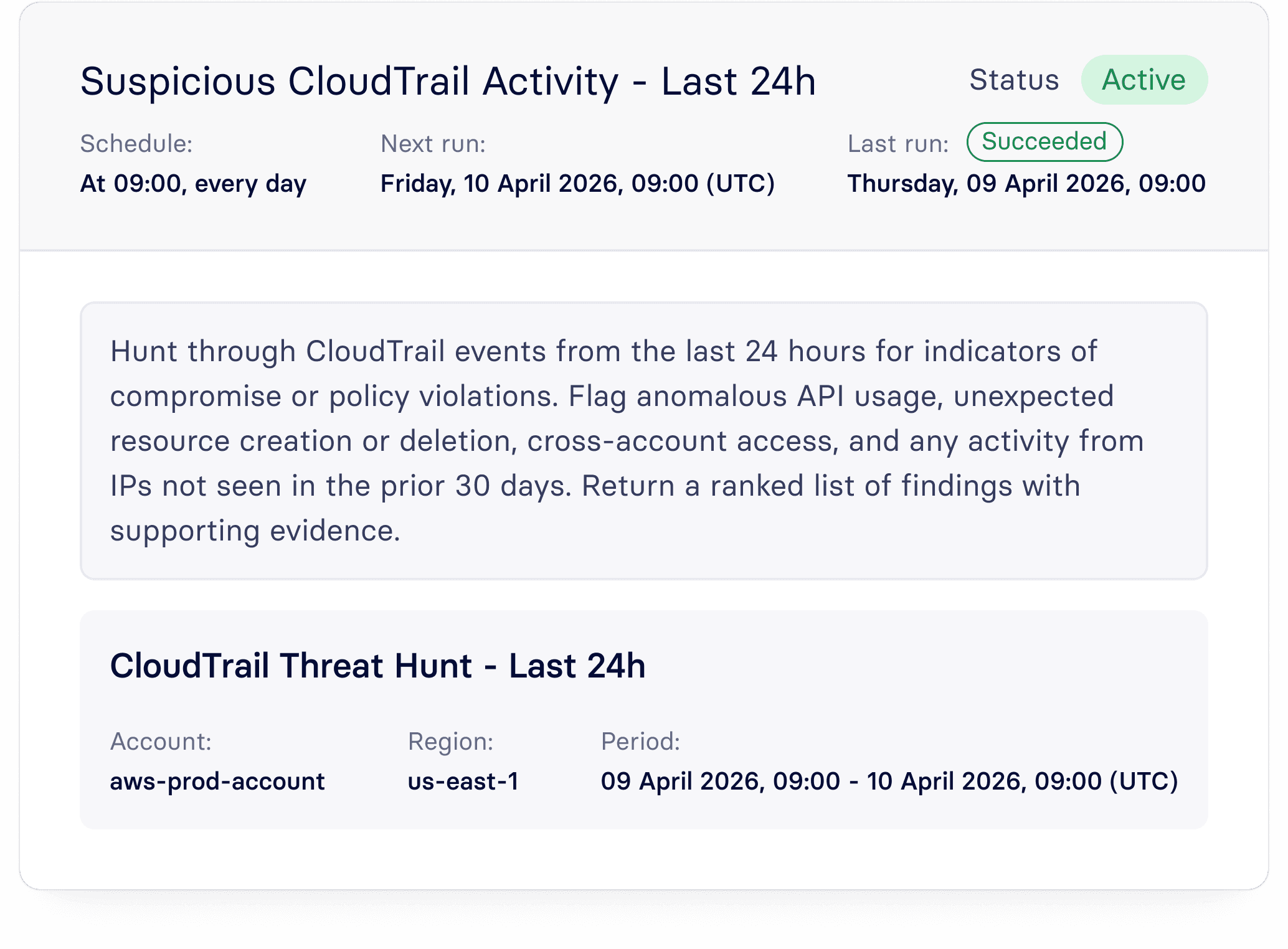
Purpose-built prompts for every stage of an investigation
Analysts can run these prompts against any alert or time window without writing queries or knowing the underlying data schema.
Automated closure with configurable thresholds
Configure confidence thresholds per alert severity and detection type. When AI confidence meets your threshold, benign alerts close automatically with a full audit trail.
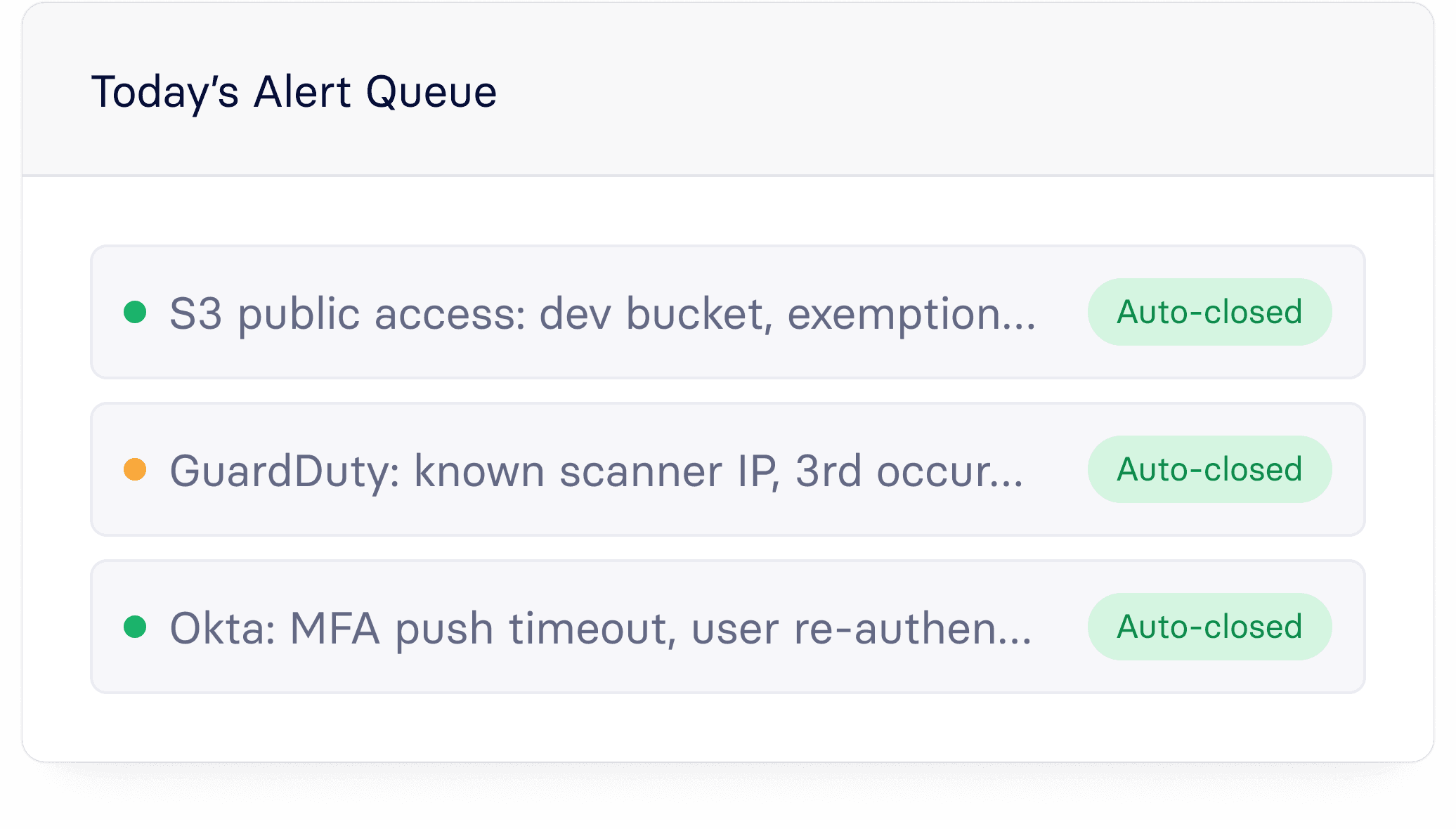
Automated closure with configurable thresholds
Configure confidence thresholds per alert severity and detection type. When AI confidence meets your threshold, benign alerts close automatically with a full audit trail.
90% reduction in investigation time. That's triage automation in production.
90% reduction in investigation time. That's triage automation in production.

With Panther’s SIEM and AI SOC, we were able to stand up a fully deployed, in-house enterprise SOC in a matter of weeks. The AI SOC agents provide a high degree of efficacy on triage, hunting, and detection refinement.”
Spencer McGalliard
AVP, Cyber Defense & Engineering
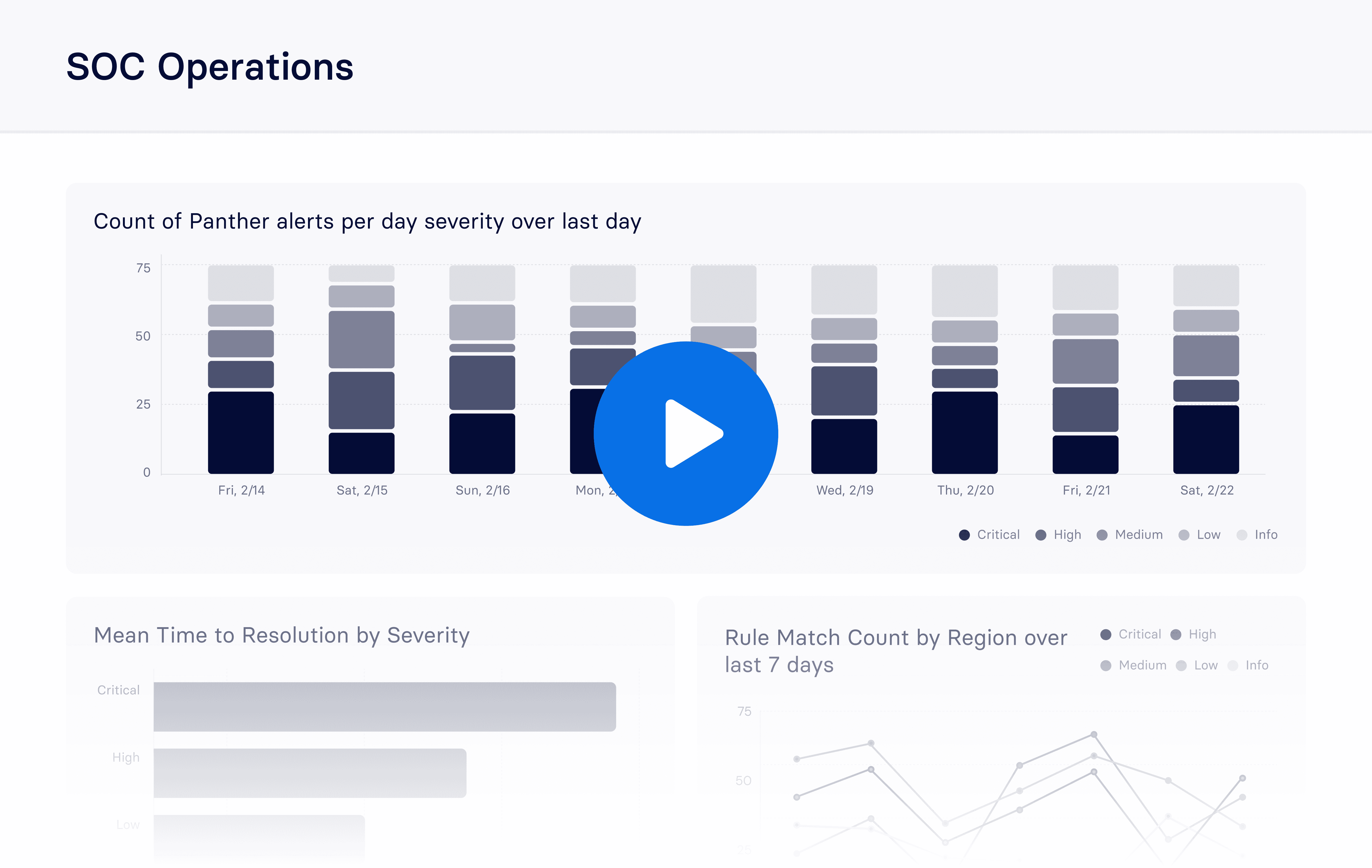

Proof from teams
who’ve been there.
Proof from teams
who’ve been there.
85%
Reduction in total alert volume

85%
Reduction in total alert volume
“When you look at the thinking steps of the AI in the platform, it’s doing all of the things that a sophisticated engineer would do on their best day, and it’s doing that on every alert, every time, 24 hours a day, no fatigue.”

“When you look at the thinking steps of the AI in the platform, it’s doing all of the things that a sophisticated engineer would do on their best day, and it’s doing that on every alert, every time, 24 hours a day, no fatigue.”
80%
of alerts resolved automatically

80%
of alerts resolved automatically
“Beyond the time-saving benefits, the fact that even less experienced members can conduct incident investigations using natural language provides us with greater flexibility and options as we scale the team in the future.”

50%
Faster alert triage and investigation

50%
Faster alert triage and investigation
"Panther AI gives investigators a roadmap to investigate alerts, eliminating guesswork and accelerating resolution.”

85%
Reduction in total alert volume
“When you look at the thinking steps of the AI in the platform, it’s doing all of the things that a sophisticated engineer would do on their best day, and it’s doing that on every alert, every time, 24 hours a day, no fatigue.”
80%
of alerts resolved automatically
“Beyond the time-saving benefits, the fact that even less experienced members can conduct incident investigations using natural language provides us with greater flexibility and options as we scale the team in the future.”
50%
Faster alert triage and investigation
"Panther AI gives investigators a roadmap to investigate alerts, eliminating guesswork and accelerating resolution.”
Learn more about Panther
Learn more about Panther


Explore the Platform


Alert Triage & Automation
Panther doesn't summarize alerts and wait for instructions — it investigates.


Detection Engine
Native access to your detection logic means every triage outcome feeds back into the rules that fire.


AI SOC Agent
An agent that runs on a schedule, responds to natural language queries, and takes action with complete context.


Analytics & Reporting
Built-in dashboards and MITRE ATT&CK mapping, from alert trends to program maturity.


Data Pipeline
All your security data, in one place.
Explore the Platform
Alert Triage & Automation
Panther doesn't summarize alerts and wait for instructions — it investigates.
Detection Engine
Native access to your detection logic means every triage outcome feeds back into the rules that fire.
AI SOC Agent
An agent that runs on a schedule, responds to natural language queries, and takes action with complete context.
Analytics & Reporting
Built-in dashboards and MITRE ATT&CK mapping, from alert trends to program maturity.
Data Pipeline
All your security data, in one place.
Explore the Platform
Alert Triage & Automation
Panther doesn't summarize alerts and wait for instructions — it investigates.
Detection Engine
Native access to your detection logic means every triage outcome feeds back into the rules that fire.
AI SOC Agent
An agent that runs on a schedule, responds to natural language queries, and takes action with complete context.
Analytics & Reporting
Built-in dashboards and MITRE ATT&CK mapping, from alert trends to program maturity.
Data Pipeline
All your security data, in one place.
Explore the Platform
Alert Triage & Automation
Panther doesn't summarize alerts and wait for instructions — it investigates.
Detection Engine
Native access to your detection logic means every triage outcome feeds back into the rules that fire.
AI SOC Agent
An agent that runs on a schedule, responds to natural language queries, and takes action with complete context.
Analytics & Reporting
Built-in dashboards and MITRE ATT&CK mapping, from alert trends to program maturity.
Data Pipeline
All your security data, in one place.

Frequently asked questions
How should security teams think about the tradeoff between automation and analyst oversight in triage?
The right model is configurable thresholds, not binary automation. Panther lets teams set confidence thresholds per detection type and severity level, so low-severity, high-confidence benign patterns can close automatically while anything ambiguous or high-severity always routes to an analyst. Most teams start conservatively on a narrow set of well-understood detection types, validate accuracy over a few weeks, then expand. Loglass reached a point where approximately 80% of alerts resolve automatically, with their team's attention focused on the investigations that genuinely need it.
How should security teams think about the tradeoff between automation and analyst oversight in triage?
The right model is configurable thresholds, not binary automation. Panther lets teams set confidence thresholds per detection type and severity level, so low-severity, high-confidence benign patterns can close automatically while anything ambiguous or high-severity always routes to an analyst. Most teams start conservatively on a narrow set of well-understood detection types, validate accuracy over a few weeks, then expand. Loglass reached a point where approximately 80% of alerts resolve automatically, with their team's attention focused on the investigations that genuinely need it.
What context does Panther use during an investigation that other AI triage tools don't have access to?
Most AI triage tools work from the alert payload and whatever enrichment they can pull from external APIs. Panther has native access to your full data lake, your detection library, your alert history, and your organizational context encoded in Runbooks. That means an investigation can reference whether this same user triggered this same detection last month, what the detection rule was designed to catch, and how your team has previously classified similar patterns. The depth of context is what makes the classification trustworthy enough to act on rather than just review.
What context does Panther use during an investigation that other AI triage tools don't have access to?
Most AI triage tools work from the alert payload and whatever enrichment they can pull from external APIs. Panther has native access to your full data lake, your detection library, your alert history, and your organizational context encoded in Runbooks. That means an investigation can reference whether this same user triggered this same detection last month, what the detection rule was designed to catch, and how your team has previously classified similar patterns. The depth of context is what makes the classification trustworthy enough to act on rather than just review.
How does Panther produce audit trails for automated triage decisions?
Every auto-resolved alert includes a complete record of the investigation: the evidence gathered, the sources queried, the reasoning behind the classification, and the threshold it met to trigger automated closure. Nothing closes silently. For SOC 2, PCI-DSS, and ISO 27001 requirements, this means automated triage doesn't create a compliance gap. Infoblox achieved 50% faster alert triage and investigation without sacrificing the documentation their audit process requires.
How does Panther produce audit trails for automated triage decisions?
Every auto-resolved alert includes a complete record of the investigation: the evidence gathered, the sources queried, the reasoning behind the classification, and the threshold it met to trigger automated closure. Nothing closes silently. For SOC 2, PCI-DSS, and ISO 27001 requirements, this means automated triage doesn't create a compliance gap. Infoblox achieved 50% faster alert triage and investigation without sacrificing the documentation their audit process requires.
How does Panther handle alert triage outside business hours?
Panther runs investigations continuously without analyst initiation, so overnight alerts receive the same depth of investigation as daytime ones. When auto-resolve thresholds are configured, benign alerts close automatically with full audit trails during off-hours. Alerts that exceed confidence thresholds for escalation surface immediately for on-call review. Teams using Panther have moved to effective 24/7 coverage without hiring additional overnight staff by letting the system carry L1 and most L2 triage volume autonomously.
How does Panther handle alert triage outside business hours?
Panther runs investigations continuously without analyst initiation, so overnight alerts receive the same depth of investigation as daytime ones. When auto-resolve thresholds are configured, benign alerts close automatically with full audit trails during off-hours. Alerts that exceed confidence thresholds for escalation surface immediately for on-call review. Teams using Panther have moved to effective 24/7 coverage without hiring additional overnight staff by letting the system carry L1 and most L2 triage volume autonomously.
How do Detection Runbooks work, and what problem do they solve?
Runbooks let you encode what's normal for your environment and how your team evaluates specific alert types: which user populations trigger expected behavior, which asset classes carry higher risk, which alert patterns your team has already investigated and resolved. When Panther investigates an alert, it applies that context consistently to every investigation, not just the ones a senior analyst happens to handle. Institutional knowledge stops living in people's heads and starts shaping every triage outcome regardless of who's on shift.
How do Detection Runbooks work, and what problem do they solve?
Runbooks let you encode what's normal for your environment and how your team evaluates specific alert types: which user populations trigger expected behavior, which asset classes carry higher risk, which alert patterns your team has already investigated and resolved. When Panther investigates an alert, it applies that context consistently to every investigation, not just the ones a senior analyst happens to handle. Institutional knowledge stops living in people's heads and starts shaping every triage outcome regardless of who's on shift.
What is a definitive risk classification, and why does it matter more than a probability score?
A probability score tells you how confident the system is. A definitive classification tells you what the system found. Panther assigns every alert a confirmed verdict — benign, suspicious, or critical — with the specific evidence that supports it. Analysts can confirm or override the classification, and that feedback sharpens future scoring accuracy for the same alert patterns. The result is a system that gets more accurate on the hard cases over time rather than maintaining a static confidence threshold.
What is a definitive risk classification, and why does it matter more than a probability score?
A probability score tells you how confident the system is. A definitive classification tells you what the system found. Panther assigns every alert a confirmed verdict — benign, suspicious, or critical — with the specific evidence that supports it. Analysts can confirm or override the classification, and that feedback sharpens future scoring accuracy for the same alert patterns. The result is a system that gets more accurate on the hard cases over time rather than maintaining a static confidence threshold.
What does AI alert triage actually do, and how is it different from an alert summary?
An alert summary tells an analyst what fired. AI triage investigates why it fired. Panther queries your data lake for surrounding activity, checks the detection logic that triggered the alert, pulls enrichment from connected tools, and delivers a complete investigation with a definitive risk classification and the evidence behind it. The analyst receives a finished investigation, not a starting point for one. HealthEquity cut Tier 1 and Tier 2 triage time from 30 to 45 minutes down to under 5 minutes using this workflow.
What does AI alert triage actually do, and how is it different from an alert summary?
An alert summary tells an analyst what fired. AI triage investigates why it fired. Panther queries your data lake for surrounding activity, checks the detection logic that triggered the alert, pulls enrichment from connected tools, and delivers a complete investigation with a definitive risk classification and the evidence behind it. The analyst receives a finished investigation, not a starting point for one. HealthEquity cut Tier 1 and Tier 2 triage time from 30 to 45 minutes down to under 5 minutes using this workflow.
Bolt-on AI closes alerts. Panther closes the loop.
See how Panther compounds intelligence across the SOC.

Bolt-on AI closes alerts. Panther closes the loop.
See how Panther compounds intelligence across the SOC.
Bolt-on AI closes alerts. Panther closes the loop.
See how Panther compounds intelligence across the SOC.
Bolt-on AI closes alerts. Panther closes the loop.
See how Panther compounds intelligence across the SOC.



Detect, investigate, and respond to threats at cloud scale — powered by code and AI.
Platform
Solutions
All rights reserved © 2026 Panther, Inc
Detect, investigate, and respond to threats at cloud scale — powered by code and AI.
Platform
All rights reserved © 2026 Panther, Inc
Detect, investigate, and respond to threats at cloud scale — powered by code and AI.
Platform
All rights reserved © 2026 Panther, Inc