
Introduction
Between April 6 and April 9, 2026, our npm scanner identified a cluster of obfuscated malicious packages published by multiple throwaway accounts. Our analysis revealed these packages to be variants of the OtterCookie infostealer, a credential theft and backdoor toolchain attributed to North Korean threat actors.
The packages use a two-layer distribution strategy: a benign wrapper packages that clones legitimate libraries,big.js in our case, which pulls in a malicious dependency containing the actual payload, ensuring the malicious code is one dependency layer deeper. To date we have identified 5 malicious packages.
Each payload package contains two obfuscated JavaScript files: a loader (test.js) and a secondary-stage stealer/backdoor (index.js). On install, the postinstall hook triggers the loader, which imports and executes the main exfiltration and persistence logic. The malware steals files and credentials and exfiltrates them to attacker-controlled Vercel-hosted C2. As the last step, it installs an SSH public key backdoor on Linux systems.
This campaign overlaps directly with infrastructure documented by Walmart Global Tech in their April 2026 analysis of OtterCookie infrastructure, sharing the same C2 domains and behavioral patterns.
Campaign Overview
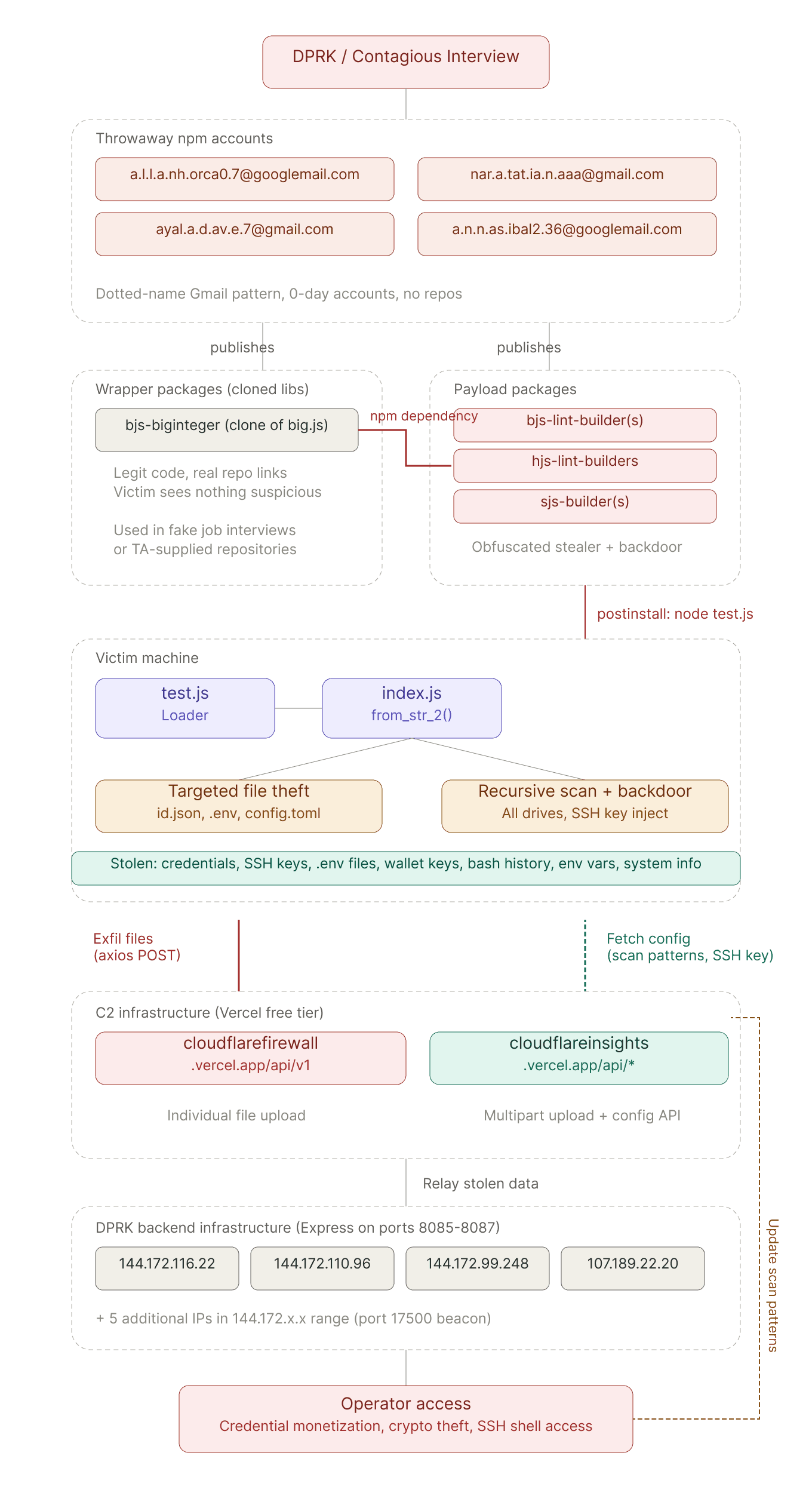
The diagram below traces the full campaign lifecycle from operator to impact. Throwaway npm accounts publish both benign wrapper packages and obfuscated payload packages, which reach victims through dependency chaining and trigger file exfiltration and SSH backdoor installation on the victim's machine.
Stolen data flows through Vercel-hosted C2 domains which double as configuration servers, allowing operators to dynamically retarget what files are stolen before being relayed to backend DPRK infrastructure.
Infection chain
The attack uses a two-layer package distribution strategy. The victim encounters a wrapper package — such as bjs-biginteger, which is a clone of the legitimate big.js library, complete with repository and homepage fields pointing at the real github.com/MikeMcl/big.js.
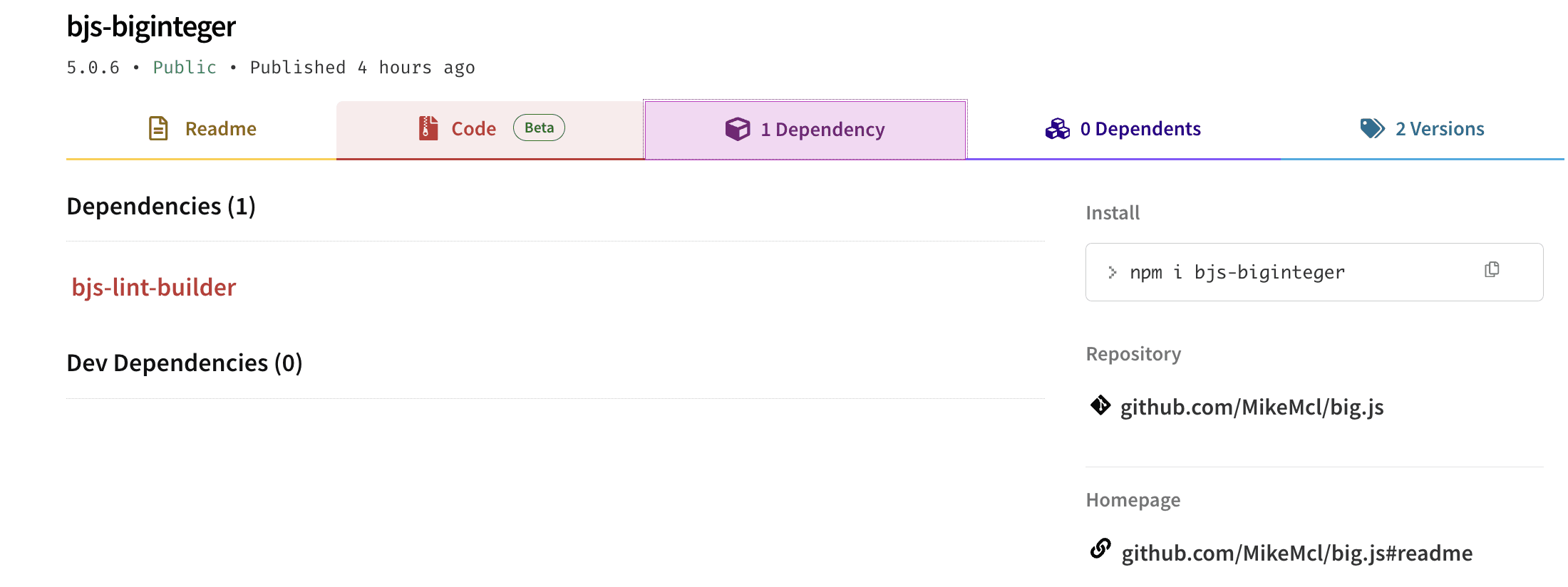
The wrapper's source code is entirely benign; the only modification is the addition of a payload package (e.g., bjs-lint-builder) as a dependency. When the victim runs npm install, npm resolves and installs the payload automatically.
Technical Analysis
Both test.js and index.js use a custom base91-like string encoding scheme. Each function scope uses a different alphabet, so the same encoded string produces entirely different output depending on which decoder processes it.
The main payload contained in index.js runs two attack chains in parallel.
The first is a quick targeted pass that searches the current working directory for high-value files — Solana wallet keypairs, Rust configuration, and environment files containing secrets — reads each one, prepends the victim's username, and uploads it to cloudflarefirewall[.]vercel[.]app/api/v1 as a raw octet stream.
The second chain is more comprehensive: it fetches dynamic configuration from cloudflareinsights[.]vercel[.]app — a list of file extensions to target, directories to exclude, and an SSH public key — then recursively walks the victim's filesystem, matching files against the fetched scan patterns. All matches are batch-uploaded as a multipart form POST to cloudflareinsights[.]vercel[.]app/api/v1 alongside metadata including the victim's username, platform, and public IP.
On Linux, the malware also installs a persistent SSH backdoor by appending the fetched public key to ~/.ssh/authorized_keys, creating the directory if needed, fixing ownership with chown, and opening port 22 through the firewall with ufw.
Attribution
This campaign is attributed with high confidence to DPRK / FAMOUS CHOLLIMA. The evidence rests on direct infrastructure, tradecraft, and operational overlaps with two documented campaigns: Contagious Interview and Contagious Trader.
The packages in this report are the latest iteration of the Contagious Trader campaign documented by kmsec in March 2026.
The cloudflareinsights[.]vercel[.]app domain decoded from our obfuscated samples is the same exfiltration server used by at least six other Contagious Trader packages dating back to February 2026. The API endpoint structure is identical across all variants.
The two-layer distribution pattern is the same: a benign wrapper impersonating big.js pulls in a malicious payload with a lint/builder naming theme. Our bjs-biginteger pulling bjs-lint-builder mirrors pairs like bignum-ts → ts-lint-builder and big-nunber → lint-builder.
The dotted Gmail addresses used by our operators match the pattern documented by kmsec. Gmail ignores dots, making these throwaway accounts generated via emailinator, a previously documented FAMOUS CHOLLIMA preference.
Even the OPSEC failures are shared: kmsec notes that npm-builders v1.0.8 was published unobfuscated, and we independently found the same mistake in bjs-lint-builders v1.0.4. The two plaintext samples are functionally identical.
The broader campaign connects back to FAMOUS CHOLLIMA through ReversingLabs' attribution of the big.js vibe-squatting pattern to Contagious Interview (dubbed "graphalgo"), the shared use of *.vercel.app C2 staging across both campaigns, and Walmart Global Tech's independent identification of the same cloudflareinsights[.]vercel[.]app infrastructure as OtterCookie, a known DPRK infostealer alongside BeaverTail and InvisibleFerret.
Conclusion
This campaign demonstrates the continued evolution of North Korean software supply chain attacks targeting developers. The custom base91 encoding with per-function alphabet rotation represents a notable advancement over the obfuscator.io techniques used in earlier campaigns like BeaverTail and Koalemos. It defeats static string extraction entirely and requires analysts to identify the correct decoder context for each function scope. The two-layer package distribution strategy (benign wrapper + malicious dependency) adds another obstacle to manual review.
The packages identified here are not isolated. They are the April 2026 iteration of a campaign that has been running since at least February, rotating through dozens of throwaway accounts and package names while keeping the same C2 infrastructure, the same malware, and the same SSH backdoor logic.
See it in action
Most AI closes the alert. Panther closes the loop.

MITRE ATT&CK Mapping
Technique ID | Name | Usage |
|---|---|---|
T1195.002 | Supply Chain Compromise: Compromise Software Supply Chain | Distribution through malicious npm packages with dependency chaining |
T1059.007 | Command and Scripting Interpreter: JavaScript | Stealer implemented in Node.js |
T1071.001 | Application Layer Protocol: Web Protocols | HTTPS C2 via Vercel-hosted endpoints |
T1082 | System Information Discovery | Username, hostname, platform, CPU count, environment variables |
T1083 | File and Directory Discovery | Recursive filesystem scan with pattern matching |
T1005 | Data from Local System | Reading files matching target extensions |
T1041 | Exfiltration Over C2 Channel | File upload via axios POST to C2 endpoints |
T1027 | Obfuscated Files or Information | Custom base91 encoding with per-function alphabets |
T1098.004 | Account Manipulation: SSH Authorized Keys | Appending attacker's SSH key to ~/.ssh/authorized_keys |
T1059.004 | Command and Scripting Interpreter: Unix Shell |
|
T1036.005 | Masquerading: Match Legitimate Name or Location | C2 domains impersonating Cloudflare services |
T1656 | Impersonation | Wrapper packages cloning legitimate npm libraries |
Detection
YARA Rules
IoCs
Behavioral Indicators
postinstallhook executingnode test.jsin packages with no stated functionalityDependencies on
axios,form-data,child_process, andosas npm packagesOutbound HTTPS connections to
.vercel.appdomains from Node.js processesModifications to
~/.ssh/authorized_keysby non-interactive processessudo ufw allow 22/tcpexecuted by non-root Node.js processeswmic logicaldisk get nameexecuted by Node.js on Windows
Malicious Packages
Package | Version(s) | Account | |
|---|---|---|---|
bjs-lint-builders | 1.0.4, 1.0.5, 1.1.0 | a.l.l.a.nh.orca0.7 | a.l.l.a.nh.orca0.7[@]googlemail.com |
bjs-lint-builder | 1.0.5 | a.l.l.a.nh.orca0.7 | a.l.l.a.nh.orca0.7[@]googlemail.com |
bjs-biginteger | 5.0.6 | a.l.l.a.nh.orca0.7 | a.l.l.a.nh.orca0.7[@]googlemail.com |
hjs-lint-builders | 1.0.4 | nar.a.tat.ia.n.aaa | nar.a.tat.ia.n.aaa[@]gmail.com |
sjs-builders | 1.0.4 | ayal.a.d.av.e.7 | ayal.a.d.av.e.7[@]gmail.com |
sjs-builder | 1.0.4 | a.n.n.as.ibal2.36 | a.n.n.as.ibal2.36[@]googlemail.com |
npm-doc-builder | 1.0.5 |
C2 Infrastructure
Category | Indicator | Description |
|---|---|---|
C2 Domain | cloudflareinsights[.]vercel[.]app | Primary C2 — config fetch and multipart upload |
C2 Domain | cloudflarefirewall[.]vercel[.]app | Secondary C2 — individual file upload |
C2 Domain | cloudflaresecurity[.]vercel[.]app | Legacy C2 — observed in unobfuscated v1.0.4 |
C2 Endpoint | /api/ssh-key | SSH public key retrieval |
C2 Endpoint | /api/scan-patterns | File extension targeting config |
C2 Endpoint | /api/block-patterns | Directory exclusion config |
C2 Endpoint | /api/v1 | File exfiltration upload |
Targeted Files
Pattern | Context |
|---|---|
| Solana wallet keypairs |
| Cargo and application config |
| Environment variable files with secrets |
| Shell command history |
| PowerShell command history |
| SSH key injection target |
Related Infrastructure
IP Address | Notes |
|---|---|
144.172.116[.]22 | OtterCookie backend (ports 8085-8087) |
144.172.110[.]96 | Related infrastructure |
144.172.110[.]228 | Related infrastructure |
144.172.99[.]248 | Related infrastructure |
107.189.22[.]20 | Related infrastructure |
144.172.110[.]132 | Related infrastructure |
144.172.99[.]81 | Related infrastructure |
144.172.93[.]169 | Related infrastructure |
144.172.93[.]253 | Related infrastructure |
References
Jason Reaves, Mapping Ottercookie Infrastructure, Walmart Global Tech Blog, April 2026
Microsoft Security Blog, Contagious Interview malware delivered through fake developer job interviews, March 2026
KMSec, Contagious Trader
Enki, Contagious Interview Campaign Abusing VSCode Distributed on GitHub
Panther Labs, No Fool's Errand: The Koalemos RAT Campaign, January 2026
Share:
Threat Research
RESOURCES