
BLOG
Best SIEM Tools (2026): Detection, Deployment Options & Real Trade-offs
Michelle
Dufty
Your SIEM contract costs hundreds of thousands of dollars annually, leadership wants you to double log ingestion, and you're evaluating whether to migrate platforms. The market has consolidated dramatically over the past two years, with platforms now focusing on cloud-native architecture and AI-powered detection.
With so much at stake, choosing the wrong platform means wasted budget, prolonged migrations, and detection gaps that leave your organization exposed. This guide evaluates the top SIEM tools on the market based on their detection capabilities, verified pricing data, real customer outcomes, and honest trade-offs for each platform.
Key Takeaways
SIEM tools aggregate and analyze security data across your infrastructure, converting millions of disparate log entries into actionable alerts.
A well-implemented SIEM shifts your team from reactive to proactive and reduces alert fatigue, allowing analysts to focus on genuine threats.
When evaluating SIEM tools, consider how detection rules are created and maintained, whether the platform scales without proportional cost increases, and how much infrastructure management falls on your team.
What Are SIEM Tools?
SIEM tools aggregate and analyze security data from across your infrastructure to detect threats. They convert millions of disparate log entries into actionable alerts, enabling your security team to detect threats, investigate incidents, and maintain compliance from a single platform.
SIEM platforms fall into several deployment categories, each with distinct trade-offs between control, complexity, and operational overhead. Your choice depends on infrastructure maturity, compliance requirements, and team capacity.
Cloud-native SIEMs — Built for SaaS delivery with elastic scaling and real-time stream processing. Platforms like Panther, Microsoft Sentinel, and Google Security Operations eliminate infrastructure management and scale automatically with data volume.
On-premises SIEMs — Traditional platforms deployed on physical or virtual appliances within your data center. They offer complete data control for strict compliance requirements but require dedicated infrastructure teams.
Hybrid SIEMs — Combine on-premises data collection with cloud-based analytics and storage. Useful for organizations transitioning to the cloud or with data residency requirements.
Benefits of SIEM Tools
A well-implemented SIEM repositions your security operations from reactive firefighting to proactive threat management.
Centralized visibility — Aggregate security data from hundreds of sources into a single pane of glass, eliminating blind spots across your environment.
Real-time threat detection — Correlate events across your infrastructure to identify attacks as they happen, not days later in a forensic review.
Faster incident response — Provide analysts with context-rich alerts and investigation workflows that reduce mean time to detect (MTTD) and me an time to respond (MTTR).
Compliance automation — Generate audit-ready reports for SOC 2, HIPAA, PCI DSS, and other frameworks without manual log reviews.
Reduced alert fatigue — Use correlation rules and AI/ML to prioritize genuine threats over noise, helping your team focus on what matters.
Historical forensics — Retain and search months or years of security data to investigate breaches and understand attacker tactics.
Selection Criteria for SIEM Tools
When selecting a SIEM tool, choose the one that best meets your needs. Think through:
Size of your team / learning curve: How many analysts and security engineers do you have to create and modify directions, learn new detection languages, triage and investigate alerts, run playbooks, and proactively hunt for new threats? Even with larger teams, in order to respond to attacks at the speed of AI, you need to leverage AI in your SIEM/SOC to respond quickly.
Deployment model: Are most of your logs on prem or in the cloud? What type of attack surface are you monitoring? Does your SIEM run on a data lake to support the level of scale you require?
Cost: Does the cost of your SIEM continue to grow while your budget does not? Are you limiting ingestion to stay within budget, which makes you susceptible to more threats? Do you risk vendor lock in?
Top 10 SIEM Tools in 2026
We evaluated the leading SIEM tools and highlighted each platform's strengths, trade-offs, and ideal use cases.
SIEM Platform Comparison Chart
Platform | Deployment | Detection Approach | Key Differentiator | Learning Curve | Best For
|
|---|---|---|---|---|---|
Panther | Cloud-native (customer-owned AWS + Snowflake/Databricks) | Detection-as-code (Python, SQL, YAML); real-time + scheduled | Git-versioned, unit-testable detection rules; no vendor lock-in on scaling | Moderate (Python required for advanced rules; AI builder for non-coders) | Engineering-led SOCs; AWS-heavy environments; high-volume cloud-native data |
Splunk Enterprise Security | Cloud (Splunk Cloud) or on-premises | SPL correlation rules; Detection Studio; AI triage | Largest ecosystem; deep third-party integrations; ESCU content library | High (SPL takes 3–6 months to master) | Large enterprises with dedicated Splunk admins |
Microsoft Sentinel | Cloud-native (Azure) | KQL analytics rules; Security Copilot AI; SOAR automation | Native Microsoft/Azure ecosystem integration; combined SIEM + SOAR | Moderate (KQL required; intuitive for Microsoft shops) | Microsoft/Azure-centric organizations |
Google Security Operations | Cloud-native (Google Cloud) | YARA-L rules; UDM normalized schema; retroactive enrichment | Google-scale infrastructure for petabyte data volumes | Moderate (YARA-L and UDM have learning curve) | Petabyte-scale environments; GCP-committed organizations |
Elastic Security | Cloud (Elastic Cloud) or self-hosted | EQL rules; ML jobs; kernel-level endpoint telemetry | Open-source foundation; unified observability + security stack | High (requires Elastic Stack expertise) | Teams with existing Elastic investments |
IBM QRadar | On-premises, hybrid, or QRadar on Cloud | Correlation rules; flow-based analytics; X-Force threat intel | Network flow ingestion alongside logs; deep compliance framework coverage | High (complex setup; dedicated admin typically required) | Large regulated enterprises; network-heavy security programs |
Exabeam | Cloud-native (SaaS) | UEBA behavioral analytics; Smart Timeline; AI-driven investigation | Smart Timeline reconstructs attacker sessions automatically | Low-to-moderate (intuitive UI; baselines take weeks to stabilize) | Identity-centric SOCs; insider threat programs |
Sumo Logic | Cloud-native (SaaS) | Cloud SIEM correlation; UEBA; Global Intelligence benchmarking | Unified DevOps observability + security on one platform | Moderate (proprietary query language has learning curve) | DevSecOps teams; cloud-native organizations avoiding tool sprawl |
Securonix | Cloud-native (customer-owned Snowflake) | ML-powered UEBA; Threat Chain correlation; Open XDR | 365-day hot data in customer-owned Snowflake; strong behavioral ML | High (complex deployment; tuning requires expertise) | Regulated industries; enterprises needing long data retention |
Rapid7 InsightIDR | Cloud-native (SaaS) | Pre-built ATT&CK-mapped rules; UEBA; deception (honeypots) | Bundled EDR + SIEM + UEBA + deception in a single per-asset subscription | Low-to-moderate (intuitive UI; strong out-of-the-box coverage) | Mid-market SOCs; teams consolidating SIEM + EDR |
1. Panther
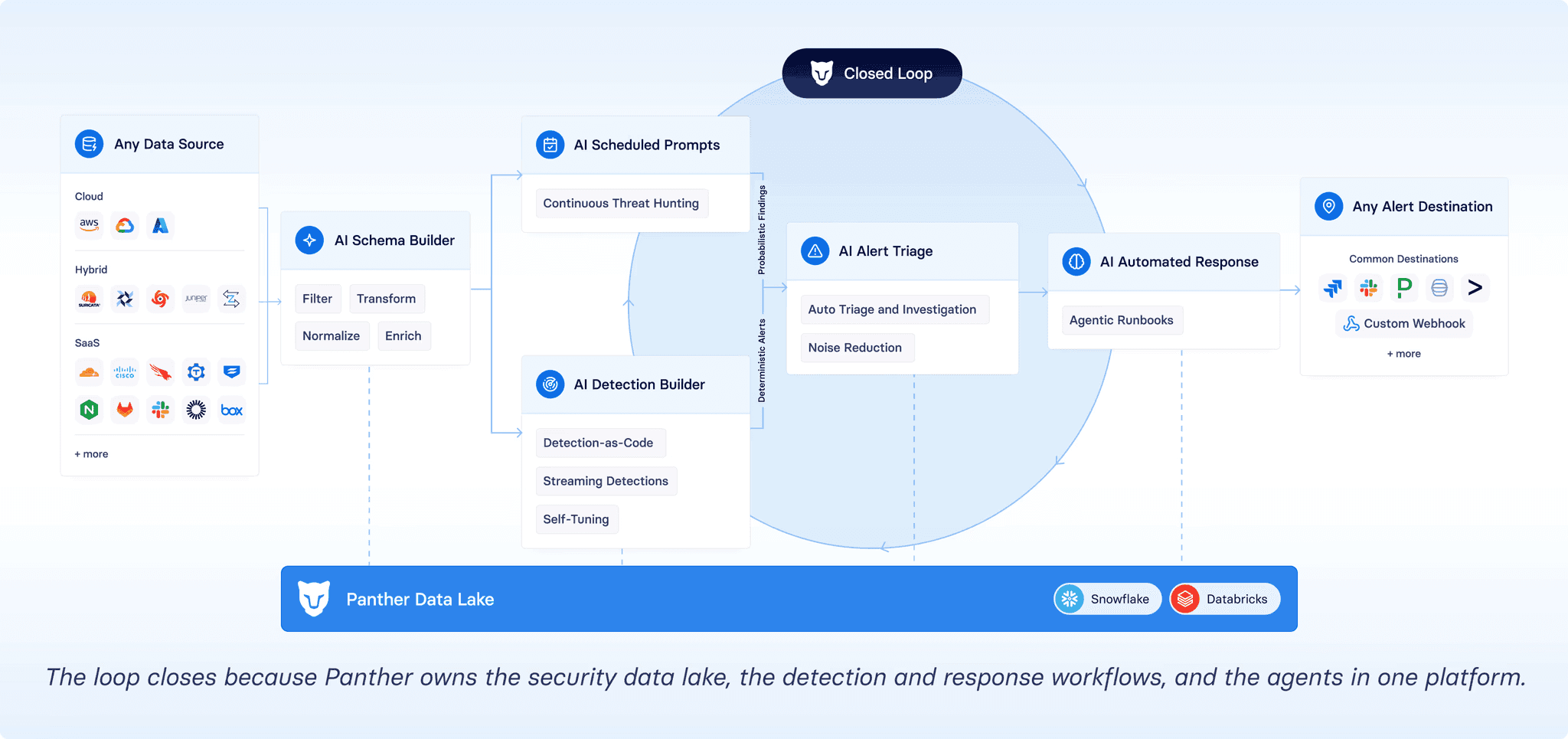
Panther is a cloud-native SIEM built for detection-as-code workflows on AWS infrastructure.
Panther stands out among SIEM tools because it handles detection rules that break, drift, or leave with the engineer who wrote them. The platform treats detection rules like infrastructure code. You can write them in Python, SQL, or YAML, version them in Git, and test them in CI/CD before they hit production. When a broken detection fires false positives at 2 AM, you revert to the previous version instead of clicking through a web UI to try to remember what changed.
This approach delivers measurable results. Docker cut false positive alerts by 85% while tripling log ingestion. Snyk reduced alert volume by 70% through intelligent tuning and correlation.
Key Features
Detection-as-code framework — Write security rules in Python, SQL, or YAML with Git version control, plus an AI Detection Builder for non-coders.
Panther AI — For schema building, threat hunting, alert triage and summarization, detection authoring, full-context explanations, and agentic response.
Security data lake on Snowflake or Databricks with 100+ native connectors for cloud, SaaS, and endpoint sources, plus automatic schema inference for custom logs.
Real-time and scheduled detection — Stream processing triggers alerts within seconds of log ingestion, while scheduled queries handle correlation across longer time windows.
Customer-owned infrastructure — Panther can manage or you can run on your AWS account and Snowflake/Databricks instance, giving you full control over data residency, retention policies, and scaling without vendor-imposed limits.
PantherFlow query language or AI Search— Purpose-built security query language plus and an agentic search engine that simplifies complex investigations across your data lake.
Pros
Flexible detection logic using Python with loops, conditionals, and external libraries.
No vendor lock-in on scaling, can run on customer-owned AWS and Snowflake/Databricks.
Detections can be unit-tested before deployment, catching logic errors before they reach production.
Cockroach Labs cut OpSec expenses by over $200K while processing 5x more data; Zapier saves $400,000 annually while achieving a 3.5x increase in security log monitoring.
Use Cases
Engineering-led SOC teams — Organizations where developers contribute to security workflows and want detection rules in version control alongside application code.
AWS-heavy cloud environments — Teams managing complex AWS infrastructure who need native integrations with CloudTrail, GuardDuty, and S3 without heavy configuration.
High-volume data ingestion without cost surprise — Companies that ingested more data than expected on legacy SIEMs and want predictable, infrastructure-based cost scaling.
Compliance-driven industries — Organizations needing SOC 2, HIPAA, or PCI DSS coverage that want audit-ready pipelines without custom reporting work.
2. Splunk Enterprise Security

Splunk Enterprise Security is an enterprise SIEM platform with a correlation engine and a broad integration ecosystem.
Key Features
Universal Forwarder ingests anything — on-prem, cloud, hybrid
Dashboards and visualizations for leadership reporting
Cisco Data Fabric: federated search across S3, Snowflake, Azure, Delta Lake — no forced ingestion into Splunk
AI-powered capabilities — Triage Agent prioritizes alerts by risk.
Finding-based detections consolidate multiple related events into a single finding.
Pros
Correlation engine handles complex event relationships.
Large ecosystem with third-party integrations and community resources.
Pre-built Enterprise Security Content Update (ESCU) provides detection rules.
Cons
SPL mastery takes 3–6 months for new analysts, creating a steep learning curve.
Queries that run quickly on small datasets can take minutes at scale.
For lean SOC teams, dedicating headcount to SIEM operations rather than threat hunting represents a significant opportunity cost.
Use Cases
Large enterprise SOCs — Organizations with 10+ analysts, dedicated Splunk administrators, and the budget to support ongoing platform management.
Complex correlation requirements — Teams that need to build sophisticated multi-event correlation rules across diverse log sources.
Organizations with existing Splunk investments — Companies already running Splunk for observability who want to consolidate into a single platform.
3. Microsoft Sentinel
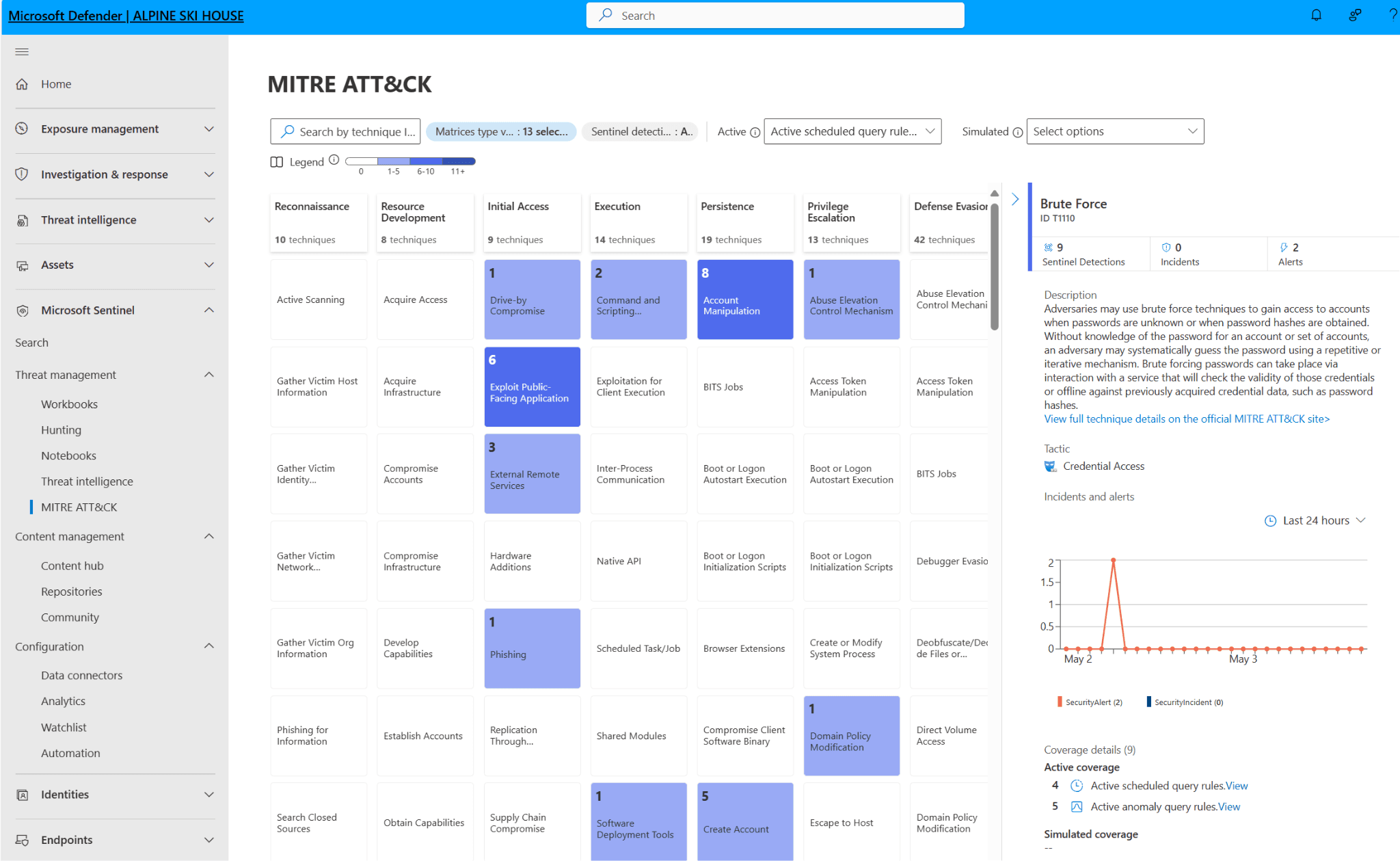
Microsoft Sentinel is a cloud-native SIEM and SOAR platform built on Azure for organizations in the Microsoft ecosystem.
Key Features
Dual-tier pricing architecture separating Analytics tier (fast querying) from Data Lake tier (low-cost storage).
Security Copilot integration — AI agents query your security data in natural language.
Azure integration connecting Defender, Office 365, and Azure Monitor without custom code.
Pros
Tight Azure ecosystem integration for Microsoft-heavy environments.
Combined SIEM and SOAR functionality in one platform.
Commitment tier pricing offers up to 52% savings over pay-as-you-go rates.
Use Cases
Microsoft 365 and Azure-first organizations — Companies where the majority of log sources are Microsoft products (Office 365, Azure AD, Defender) and who benefit from zero-config native connectors.
Teams consolidating on Microsoft security stack — Organizations wanting to unify Defender XDR, Entra ID, and SIEM in a single pane of glass.
Regulated enterprises in Microsoft environments — Healthcare, financial services, and government organizations running heavily on Azure that need compliance reporting without custom pipelines.
4. Google Security Operations (SecOps)
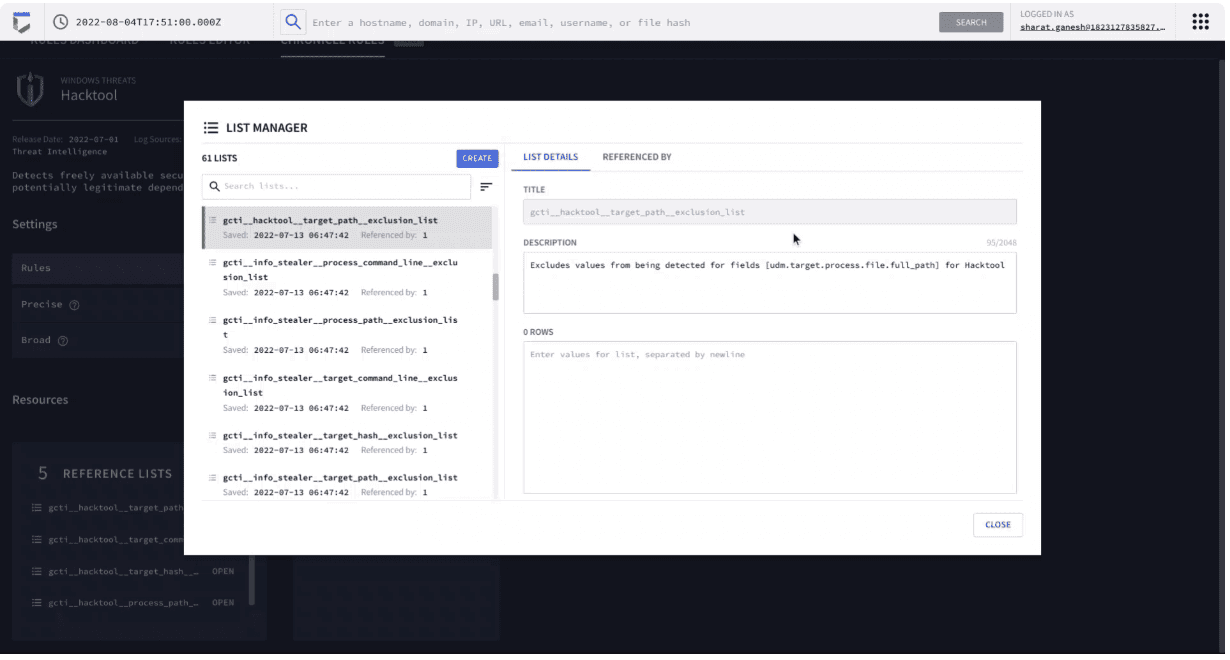
Google Security Operations (formerly Chronicle) is a cloud-native SIEM built on Google's infrastructure for large-scale log processing.
Key Features
Zero deployment footprint with cloud-native SaaS architecture.
Continuous retroactive enrichment updates historical data with new threat intelligence.
Raw log scan capabilities for searching unparsed security telemetry.
Pros
Handles petabyte-scale data volumes.
Fast data processing using Google's infrastructure.
Use Cases
Petabyte-scale log environments — Organizations managing extremely high log volumes (media companies, telcos, large SaaS platforms) that need Google-scale infrastructure underneath.
GCP-committed organizations — Teams running significant workloads on Google Cloud who want native integrations with Cloud Logging, Cloud Audit Logs, and Google Workspace.
Threat intelligence-driven SOCs — Teams that rely heavily on continuous threat intel enrichment to contextualize historical data retroactively.
5. Elastic Security
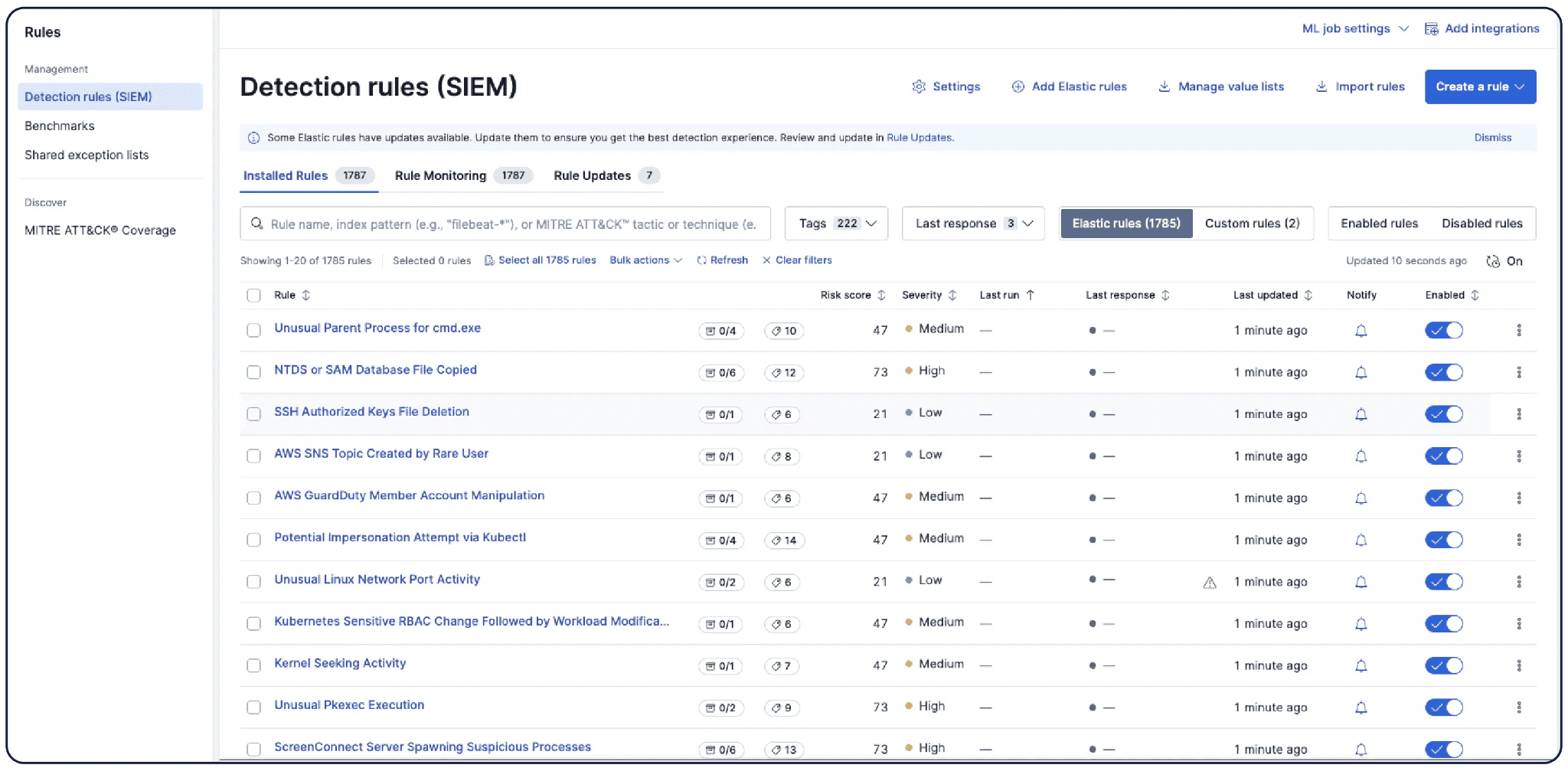
Elastic Security is an open-source SIEM built on the Elastic Stack with kernel-level telemetry and endpoint security capabilities. Advanced security features require paid subscriptions.
Key Features
Kernel-level telemetry captures call stacks, TCP connect events, and DeviceIoControl driver events.
Endpoint security capabilities, including ransomware protection and OSQuery integration.
Pros
An open-source foundation allows customization.
Consistent performance across data volumes.
Use Cases
Existing Elastic Stack users — Engineering and DevOps teams already using Elasticsearch, Kibana, or Logstash for observability who want to extend into security without a net-new platform.
Teams with strong infrastructure automation skills — Organizations comfortable managing and tuning Elastic clusters who want maximum flexibility over their detection pipeline.
Cost-sensitive mid-market teams — Companies that want open-source licensing as a cost control lever before committing to premium enterprise features.
6. IBM QRadar
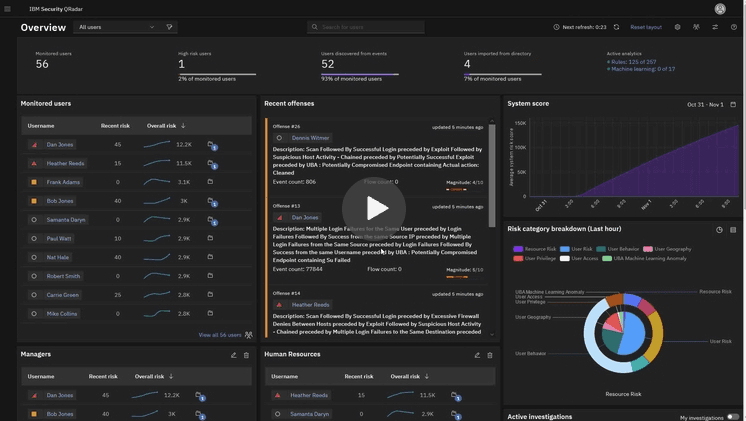
IBM QRadar is one of the most established enterprise SIEM platforms on the market, offering a mature correlation engine, behavioral analytics, and broad compliance coverage. It has been a staple in large regulated environments for over a decade and continues to evolve with AI-powered threat intelligence through IBM's X-Force integration.
Key Features
Advanced correlation engine — Builds real-time correlation rules across events, flows, and asset data to detect multi-stage attacks.
X-Force Threat Intelligence — Integrates IBM's global threat intel feeds directly into detection and triage workflows.
User Behavior Analytics (UBA) — Identifies anomalous user activity and insider threats using machine learning baseline models.
Flow-based analytics — Ingests network flow data (NetFlow, IPFIX, J-Flow) alongside log data for full east-west traffic visibility.
Compliance reporting — Pre-built reports for HIPAA, PCI DSS, FISMA, and GDPR reduce manual audit preparation work.
QRadar on Cloud — Fully managed SaaS option for teams that want IBM to handle infrastructure.
Pros
Mature correlation engine with a decades-long ruleset that covers known attacker patterns across a wide range of industries.
Network flow ingestion; QRadar adds full packet and flow visibility for east-west traffic analysis.
Deep compliance coverage across regulated industries, with pre-built mappings for major frameworks.
Cons
The interface feels dated compared to newer cloud-native platforms, which can slow analyst workflows.
Initial deployment and tuning is complex, often requiring IBM Professional Services or a specialized partner.
Performance at scale requires hardware investment that most SaaS-first teams are not equipped to manage.
Use Cases
Regulated enterprise environments — Banking, healthcare, and government organizations with strict compliance mandates that need pre-built framework coverage and audit-ready reporting.
Network-heavy security programs — Organizations that need to analyze east-west traffic alongside log data and want flow-based threat detection as a first-class capability.
Mature SOCs with dedicated administrators — Teams with the headcount and budget to tune and maintain a complex platform over the long term.
IBM ecosystem shops — Organizations already invested in IBM security products (IBM QRadar SOAR, IBM Guardium) who benefit from native integrations.
7. Exabeam
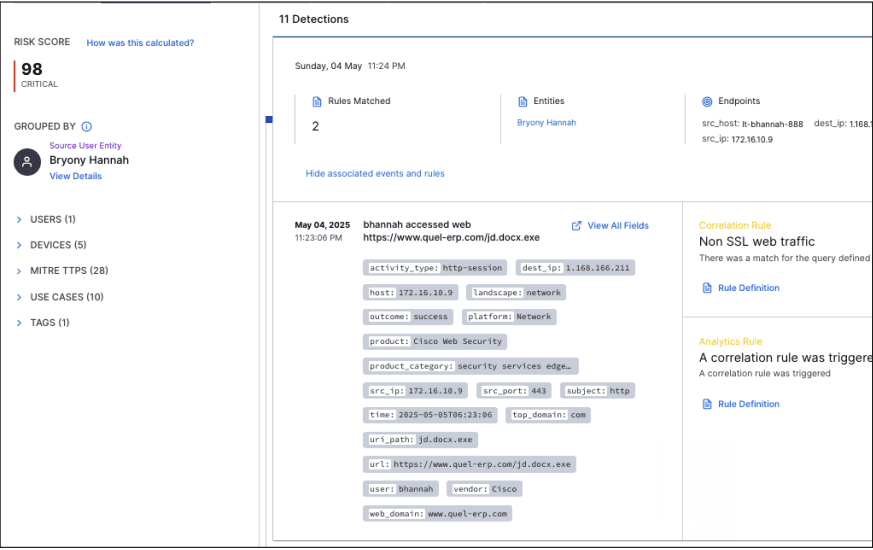
Exabeam is a cloud-native SIEM platform differentiated by its behavioral analytics and smart timeline technology. Built around User and Entity Behavior Analytics (UEBA), Exabeam maps attacker behavior onto a timeline that shows exactly how a threat unfolded — from initial access to lateral movement — without requiring analysts to manually correlate events.
Key Features
Smart Timeline — Automatically reconstructs attacker sessions into a chronological sequence of events, significantly reducing analyst investigation time.
Advanced UEBA — Uses machine learning to build baseline behavior profiles for every user and entity, flagging deviations that indicate compromised accounts or insider threats.
Threat Intelligence — Ingests multiple TI feeds and overlays them against behavioral findings, adding external context to insider threat detections.
Automated Investigation — Exabeam Nova uses AI-driven playbooks to automate investigation steps, reducing the analyst workload for common alert types.
Pros
Smart Timeline dramatically reduces investigation time by presenting attacker sessions as a narrative rather than raw log lines.
UEBA capabilities are among the strongest in the market for detecting compromised credentials, insider threats, and lateral movement.
Intuitive interface that most analysts can navigate without extended training.
Cons
Initial setup can be time-consuming, and tuning behavioral baselines requires several weeks of data collection before the system produces reliable detections.
Out-of-the-box integrations sometimes require professional services to configure correctly, adding to onboarding cost.
Reporting and dashboard customization is more limited than some competitors — teams with complex reporting requirements may find it frustrating.
Use Cases
Identity-centric security operations — Teams where the majority of investigations start with a user account or compromised credential, and who need fast session reconstruction.
SOCs moving away from legacy SIEMs — Organizations tired of complex SPL or KQL queries that want behavioral analytics to do the heavy correlation lifting automatically.
Mid-to-large enterprises with user behavior requirements — Companies that need to demonstrate UEBA coverage for compliance or cyber insurance requirements.
8. Sumo Logic
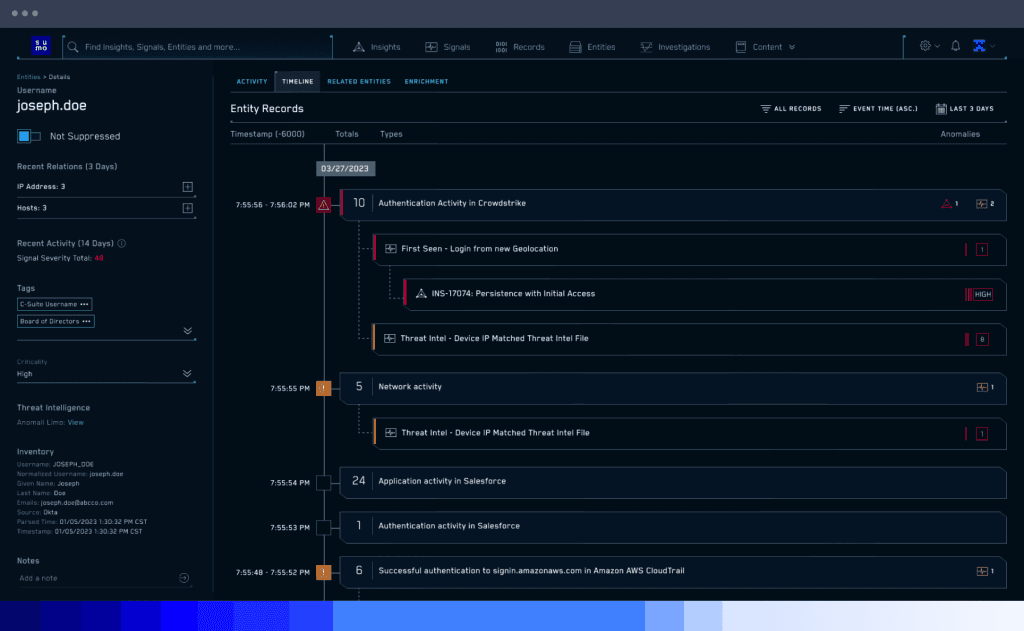
Sumo Logic is a cloud-native platform that unifies log management, metrics monitoring, and security analytics in a single product. Unlike dedicated SIEM platforms, Sumo Logic is designed to serve both DevOps observability and security use cases, making it an attractive option for engineering-led organizations that want to avoid running separate toolchains for monitoring and security.
Key Features
Unified log management — Single platform for application logs, infrastructure metrics, distributed tracing, and security telemetry, reducing tool sprawl for DevSecOps teams.
Cloud SIEM — Layered security analytics with correlation rules, threat intelligence integration, and UEBA built on top of the core log management platform.
Continuous Intelligence — Real-time streaming analytics with machine learning anomaly detection across all ingested data, not just security events.
Global Intelligence — Crowdsourced threat benchmarks drawn from Sumo Logic's customer base, providing context on whether activity is anomalous relative to peers in the same industry.
Pros
Unified platform for DevOps and security eliminates the need for separate observability and SIEM tools, reducing both cost and context-switching.
Easy integration with modern cloud-native stacks — AWS, GCP, Azure, Kubernetes, and most major SaaS platforms have native connectors.
Global Intelligence benchmarking gives analysts external context on whether anomalies are industry-wide patterns or organization-specific signals.
Cons
Sumo Logic's query language has a steep learning curve for analysts coming from SQL-based platforms.
Cloud SIEM is a bolt-on layer rather than a purpose-built SIEM engine; teams with complex detection requirements may find the correlation capabilities less mature than dedicated SIEM platforms.
Credit-based pricing can be unpredictable — bills increase rapidly as data volumes grow, especially for teams without strict ingest governance.
Use Cases
DevSecOps teams — Engineering organizations that want security analytics and application observability on the same platform, enabling developers and security analysts to share data and dashboards.
Cloud-native startups and scale-ups — Fast-growing companies that need a unified monitoring and security platform without the operational overhead of managing separate tools.
Multi-cloud environments — Companies with workloads spread across AWS, GCP, and Azure who want a single ingestion point that handles all major cloud providers natively.
9. Securonix

Securonix is a next-generation SIEM platform built on the Snowflake Data Cloud, combining advanced machine learning, UEBA, and a security data lake into a single platform. It is particularly well-suited for regulated industries that need long data retention, data sovereignty controls, and sophisticated behavioral analytics at scale.
Key Features
Snowflake-native data lake — Stores all security data in a customer-owned Snowflake instance, providing 365 days of hot data for fast search and investigation without query throttling.
Advanced UEBA — Machine learning models identify anomalous behavior across users, entities, and peer groups, significantly reducing false positive volume.
Threat Chain™ — Correlates individual security events into attack sequences, automatically linking related alerts into a single investigation-ready threat chain.
Data Enrichment — Enriches raw security events with contextual information (asset criticality, user role, geolocation) to help analysts make faster triage decisions.
Open XDR — Integrates with endpoint, cloud, identity, and network telemetry sources into a unified detection layer across the entire kill chain.
Pros
365 days of hot, queryable data is a significant advantage over platforms that tier older data into cold storage, where investigation can be slow or costly to access.
Securonix's machine learning models are consistently praised by customers for reducing false positive alert volume, allowing analysts to focus on genuine threats.
The Snowflake-native architecture gives customers full data control — you own the data, can query it with your own tools, and avoid vendor lock-in on the storage layer.
Cons
The Snowflake data tier is a separate cost — at moderate scale, Snowflake compute and storage adds 30–60% on top of the Securonix license, making total cost harder to predict.
Initial setup is complex and time-consuming, often requiring professional services engagement for deployment and initial tuning.
Parsing new data sources can be challenging, with some customers reporting difficulty onboarding non-standard log formats without professional services support.
Use Cases
Regulated industries with data sovereignty requirements — Financial services, healthcare, and energy companies where the customer-owned Snowflake data plane satisfies compliance mandates and internal data governance policies.
Organizations with long retention requirements — Teams that need 12+ months of searchable security data for forensic investigations, regulatory audits, or threat hunting programs.
Multi-cloud environments with GCP or AWS — Companies running on Google Cloud, AWS, and major SaaS platforms who need a platform with native connectors and no cloud-first bias toward a single provider.
Enterprise SOCs focused on behavioral analytics — Large organizations where the primary detection challenge is separating subtle insider threats and credential abuse from background noise at high data volumes.
10. Rapid7 InsightIDR

Rapid7 InsightIDR is a cloud-native SIEM and XDR platform that bundles log ingestion, endpoint detection (EDR), user behavior analytics, and deception technology into a single per-asset subscription. It is designed for mid-market to enterprise security teams that want broad detection coverage without managing multiple point products.
Key Features
Bundled EDR + SIEM — The Insight Agent provides endpoint telemetry alongside log ingestion, giving analysts correlated endpoint and network visibility from a single platform.
UEBA and deception — Honeypot users and honeynet assets generate high-confidence alerts when attackers interact with them, providing low-noise early warning indicators.
MITRE ATT&CK integration — Detection rules are mapped to ATT&CK techniques, helping analysts understand attacker tactics and measure detection coverage visually.
Automated investigation — InsightConnect (SOAR) integrates with InsightIDR to automate common response playbooks, reducing analyst workload for repeated alert types.
Threat intelligence from Metasploit — Rapid7 surfaces threat intelligence drawn from Metasploit's global research network, providing real-world attacker context to detection rules.
Pros
Deception technology (honeypots and honeyusers) generates extremely high-confidence alerts at minimal configuration cost — any interaction with a honeypot is a high-priority signal.
Broad out-of-the-box detection coverage with pre-built rules mapped to ATT&CK, reducing the time to baseline coverage for teams without a mature detection engineering program.
Bundling EDR and SIEM into a single platform simplifies procurement and reduces the integration work required to correlate endpoint and log data.
Cons
Advanced customization of detection rules is more limited than code-first platforms like Panther, which can constrain sophisticated detection engineering programs.
Users have reported concerns about new capabilities being pulled out as separately priced add-ons, effectively reducing the value of existing subscriptions over time.
Log source support, search capabilities, and API integrations lag behind dedicated SIEM platforms for complex enterprise environments.
Use Cases
Mid-market organizations consolidating security tools — Teams that want to replace separate SIEM, EDR, and UEBA vendors with a single platform that handles all three, simplifying procurement and integration overhead.
Teams without mature detection engineering programs — Organizations that want strong out-of-the-box MITRE ATT&CK coverage without investing in custom rule development from day one.
Asset-heavy IT environments — Organizations where the security perimeter is defined primarily by endpoint and server assets (rather than cloud API traffic), making per-asset pricing a natural fit.
Pick the Right SIEM Tool for Your SOC Team
When evaluating SIEM platforms, focus on the capabilities that directly impact your team's daily work. For example:
How do you write and manage detection rules?
Can you test changes before they hit production?
How quickly can you investigate alerts?
What happens to your detections when engineers leave?
Match each platform's architectural philosophy to your team's reality. Consider how detection rules are created and maintained, whether the platform scales with your data volume without proportional cost increases, and how much infrastructure management falls on your team versus the vendor. The right choice depends on your cloud environment, your team's technical skills, and how much control you need over your security data.
For teams that want to treat security detections like software, with version control, unit testing, and CI/CD workflows, Panther's detection-as-code approach delivers measurable results.
Tealium achieved a 9X increase in ingestion while reducing false positives by 70%.
Reduce false positives with precise logic and context-rich alerts. Panther lets you write detections in Python, SQL, YAML, or use natural language to auto generate detections, test with unit tests and historical data replay, and enrich alerts with business context.
Explore Panther's Detection Engine.
Share:
RESOURCES