
The average SOC receives over 4,000 alerts per day, and analysts spend nearly three hours per shift just triaging them. Analysts go through each one, deem them harmless or known, and close them out. But most of these alerts are noise: legitimate cloud activity, scheduled maintenance, developers testing at odd hours. The queue keeps growing, but only a few of them are worth investigating.
The alerts that don't get triaged pile up, get bulk-closed without investigation, or sit in the backlog where real threats hide alongside the noise. AI SOC platforms exist to reduce that backlog; they autonomously triage alerts, correlate signals across your security stack, and investigate suspicious activity. They also surface findings with the context your team needs, so analysts can focus on genuine threats rather than drowning in false positives.
Key Takeaways
AI SOC platforms go beyond traditional SIEMs by autonomously triaging alerts, correlating signals across tools, and conducting investigations. They reduce the time per alert from 15 to 30 minutes to minutes, enabling teams to achieve full alert coverage rather than ignore most alerts.
The right platform depends on your team's maturity, existing stack, and data ownership needs. A three-person team and a 50-person SOC need fundamentally different capabilities, and where your data lives matters more than most buyers realize.
Agentic AI is moving from pilots to production. The industry is shifting from static playbooks to AI agents that reason, adapt, and act dynamically.
Demand transparency before you buy. Ask every vendor to walk through exactly how their AI triages a real alert: what data it consulted, how it reached its conclusion, and what audit trail exists. Platforms that can't show their reasoning can't earn trust or satisfy compliance requirements.
What Is an AI SOC Platform?
An AI SOC platform is a security operations tool that uses AI agents to autonomously triage alerts, investigate threats, and recommend or execute responses. This goes beyond having a chatbot answer questions about your logs. These platforms take action, correlating data across your security stack and conducting investigations that would otherwise require analyst time.
Traditional SIEMs collect logs, generate alerts based on rules, and then wait for humans to investigate each alert manually. This model worked when enterprise environments generated manageable alert volumes. Today, it creates an impossible workload, with enterprise environments generating thousands of alerts daily.
When analysts face hundreds of alerts per shift, decision-making suffers because context switching reduces efficiency and increases errors. After seeing 500 false positives from the same misconfigured rule, analysts start ignoring that alert type entirely, even when it's legitimate. Untriaged alerts from Monday become Tuesday's backlog.
The 10 Best AI SOC Platforms of 2026
The AI SOC platforms below each take a different architectural approach. Some extend existing SIEM infrastructure with AI layers, others build from the ground up around AI-native workflows. When evaluating the AI SOC platforms, consider how each platform's strengths align with your team's existing capabilities, infrastructure investments, and operational priorities.
Platform Comparison at a Glance
Platform | AI Approach | Detection Model | Deployment | Key Differentiator | Best For
|
|---|---|---|---|---|---|
Panther | Autonomous triage + agentic investigation; AI Detection Builder | Detection-as-code (Python, SQL, YAML); real-time stream processing | Cloud-native (customer-owned AWS + Snowflake/Databricks) | Full data ownership; transparent AI reasoning; Git-versioned detections | Engineering-led SOCs; AWS-heavy environments; regulated industries |
Microsoft Sentinel | Security Copilot AI; SOAR automation via Logic Apps | KQL analytics rules; UEBA behavioral baselines; MITRE ATT&CK mapping | Cloud-native (Azure) | Native Microsoft/Azure ecosystem; free ingestion for Microsoft log sources | Microsoft/Azure-centric organizations |
CrowdStrike Falcon Next-Gen SIEM | Charlotte AI autonomous triage; Security Data Insights | Unified endpoint + SIEM correlation; single lightweight agent | Cloud-native (SaaS) | Seamless EDR-to-SIEM pipeline for existing Falcon customers | Teams already running Falcon EDR wanting platform consolidation |
Splunk Enterprise Security | Triage Agent; AI Assistant; automated code analysis | SPL correlation rules; Detection Studio; ESCU content library | Cloud or on-premises | Deepest ecosystem and integration options; granular SPL control | Large enterprises with dedicated Splunk admins and SPL expertise |
SentinelOne Singularity | Purple AI Athena; autonomous containment; verdict enrichment | Endpoint-native telemetry extended to cloud, identity, and SIEM | Cloud-native (SaaS) | Autonomous machine-speed response; rollback of malicious changes | Teams wanting autonomous endpoint-to-SIEM response with minimal manual work |
Palo Alto Cortex XSIAM | 2,900+ ML models; AI-driven case management; Cortex AgentiX | Unified XDR correlation across endpoint, network, cloud, and identity | Cloud-native (SaaS) | Consolidates SIEM + XDR + SOAR + ASM into one platform | Enterprises consolidating security stack; Palo Alto ecosystem customers |
Darktrace | Self-learning AI; behavioral anomaly detection; Antigena autonomous response | Unsupervised ML on network/entity behavior; no rules or signatures | On-premises appliance, virtual sensor, or SaaS | Detects unknown threats without rules; strong OT/IoT coverage | Organizations with OT/ICS environments; teams needing unknown threat detection |
Vectra AI | AI-driven threat signal correlation; aggregated risk scoring by impact + certainty | Agentless network detection; lateral movement and credential misuse focus | Cloud-native (agentless) | Agentless deployment in hours; Leader in Gartner NDR Magic Quadrant | Teams needing rapid deployment; hybrid/multi-cloud environments |
ReliaQuest GreyMatter | 6 agentic personas; 200+ agent skills; autonomous Tier 1 + Tier 2 investigation | Open XDR across 400+ integrations; natural language detection creation | Cloud-native (SaaS) | Eliminates Tier 1/2 analyst work; $3.5M average SIEM cost reduction | Enterprises reducing SOC headcount costs; SIEM rationalization projects |
Arctic Wolf | Aurora Agentic SOC; Swarm of Experts agent model; human-in-the-loop oversight | MDR-backed detection; managed risk; 24/7 concierge SOC | Managed service (SaaS + sensors) | Fully managed agentic SOC; 15× faster case resolution; 10-day deployment | Mid-market teams without in-house SOC; organizations wanting full outsourcing |
1. Panther
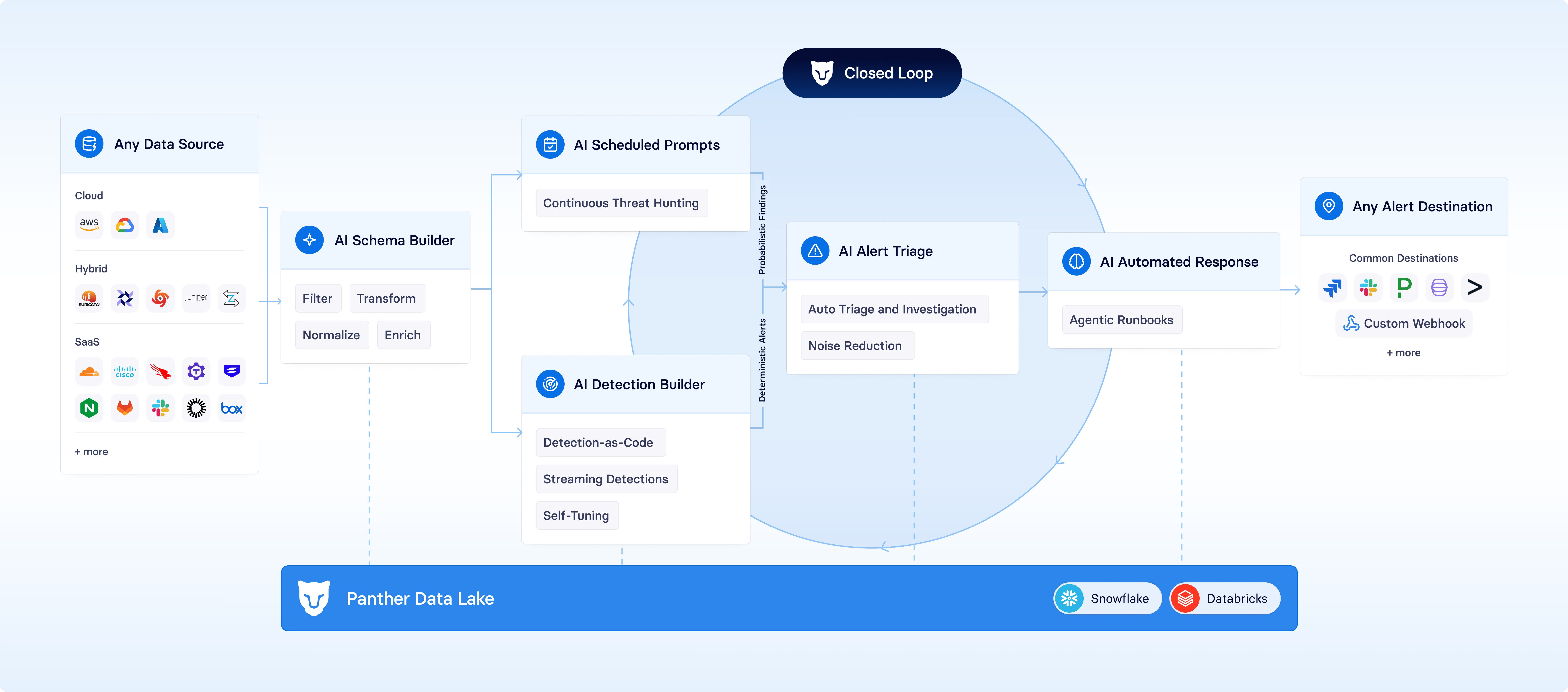
Panther is an AI SOC platform built for modern security teams, combining detection-as-code with AI-powered triage, investigation, and response. Its open security data lake gives teams full data ownership, a critical differentiator for organizations that need complete control over their security data.
Unlike platforms that lock your data in vendor-controlled environments, Panther's architecture ensures your security telemetry stays in infrastructure you own. This means no vendor lock-in, full auditability, and the flexibility to run custom analytics beyond what any single platform provides.
Key Features
Panther's AI SOC autonomously triages every alert by building context through enrichments, correlating related activity, writing pivot queries, and synthesizing findings into a distilled summary with a risk judgment and recommended next steps. This triage compresses what used to take 15 to 30 minutes of manual investigation into minutes, allowing security teams to reach 100% alert coverage rather than ignoring most alerts.
It also provides conversational access to the entire SIEM from data pipelines and schemas to detections, alerts, and raw log data, so analysts can threat hunt and investigate without requiring a query language. The AI Detection Builder lets analysts create and tune detection rules using natural language, generating complete Python detections with test cases and metadata ready for review.
Panther's real-time stream processing fires detection rules as data arrives, eliminating batch processing delays. Detection rules support Python, SQL, and YAML, with integrated testing and CI/CD pipelines for teams that want code-driven workflows.
Pros
Transparent AI triage with a summary showing what data the agent consulted, which pivot queries it wrote, and how it reached its risk judgment.
Panther supports over 100 security log types across more than 50 different categories.
All data is highly structured at ingest time by design, giving AI agents a clean foundation for accurate correlation, enrichment, and analysis.
AI agents share synthesized learning across the detection, alerting, and co-pilot layers. Context built during triage transfers into detection engineering and threat hunting.
Use Cases
Engineering-driven security operations — Teams that manage detection rules in Git alongside application code, run unit tests in CI/CD before deploying to production, and want full version history when a rule needs to be rolled back.
Full alert coverage for lean teams — Security teams of one to ten engineers who cannot afford to manually triage thousands of daily alerts, and need AI to handle Tier 1 investigation autonomously.
Regulated environments requiring data residency control — Healthcare, financial services, and government organizations where security data must stay in customer-owned infrastructure to meet compliance mandates.
High-volume cloud-native environments — Companies running large AWS footprints (CloudTrail, GuardDuty, VPC Flow Logs) that need scalable detection without per-GB cost surprises.
2. Microsoft Sentinel
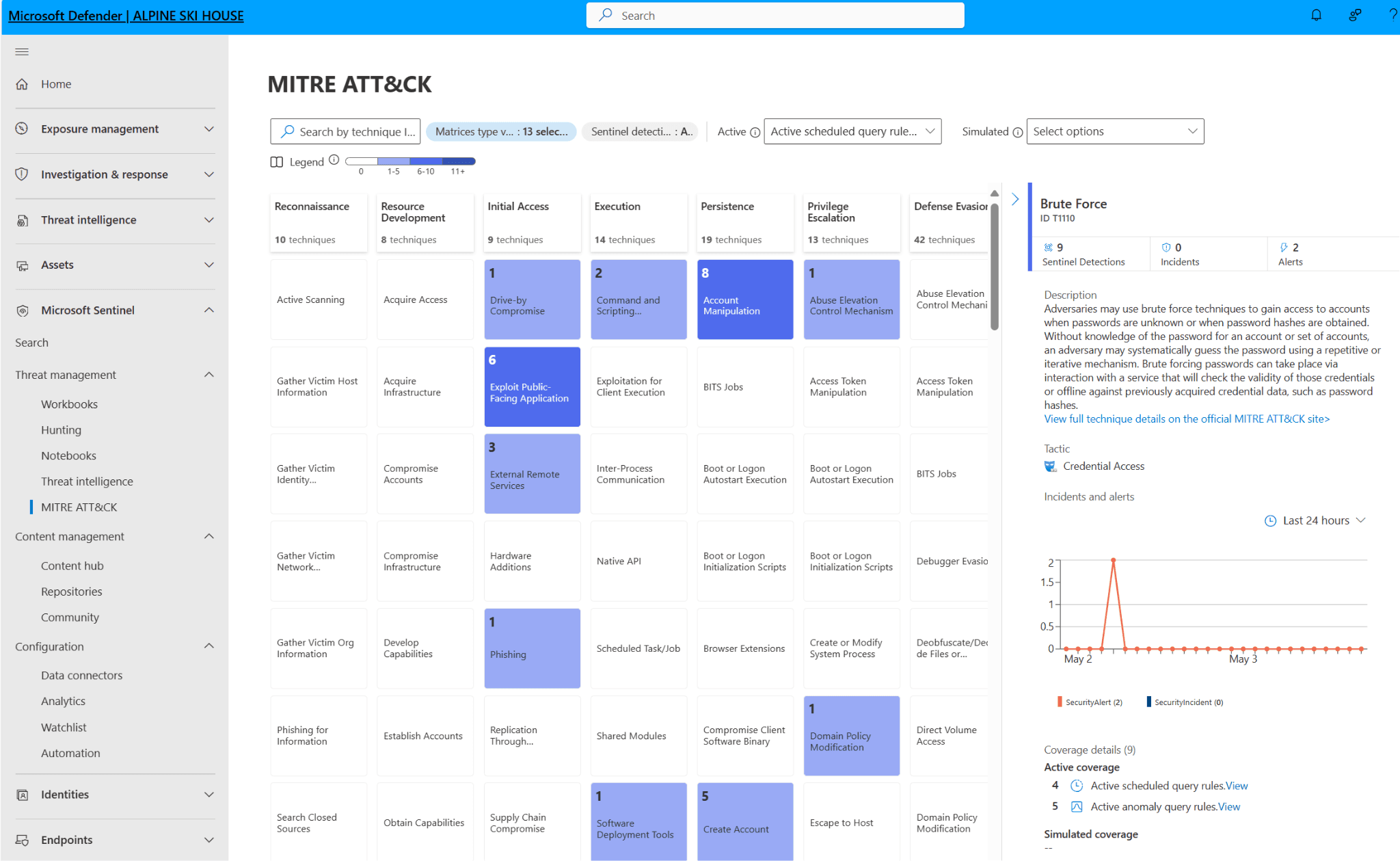
Microsoft Sentinel is Microsoft's SIEM and SOAR platform, built on Azure and designed to unify security data across Microsoft's ecosystem. It integrates with Defender, Entra ID, Azure Monitor, and Microsoft 365.
Key Features
Security Copilot provides AI-assisted hunting query generation, incident summarization, and guided investigation workflows. The platform includes built-in SOAR functionality through Azure Logic Apps for automated playbook execution. AI-powered analytics rules detect threats across ingested data, and the platform supports automated incident creation and enrichment.
Pros
UEBA behavioral analytics that aggregate and sequence entity actions into human-readable patterns, mapped to MITRE ATT&CK tactics, to surface anomalous user and entity activity that rule-based detections miss.
Native integration across the Microsoft ecosystem: Defender, Entra ID, Azure Monitor, Microsoft 365.
Free ingestion for Office 365 audit logs, Azure activity logs, and Microsoft threat protection alerts.
Use Cases
Microsoft 365 and Azure-first organizations — Companies where the majority of alerts originate from Defender, Entra ID, and Office 365, and who benefit from zero-configuration native connectors and free ingestion for Microsoft log sources.
Consolidating SIEM and SOAR under one vendor — Teams that want to eliminate a separate SOAR tool by using Azure Logic Apps playbooks alongside Sentinel for a single-vendor detection-and-response workflow.
Teams with Security Copilot investments — Organizations already paying for Microsoft Security Copilot who want to maximize its value through deep Sentinel integration for natural-language hunting and incident summarization.
3. CrowdStrike Falcon Next-Gen SIEM
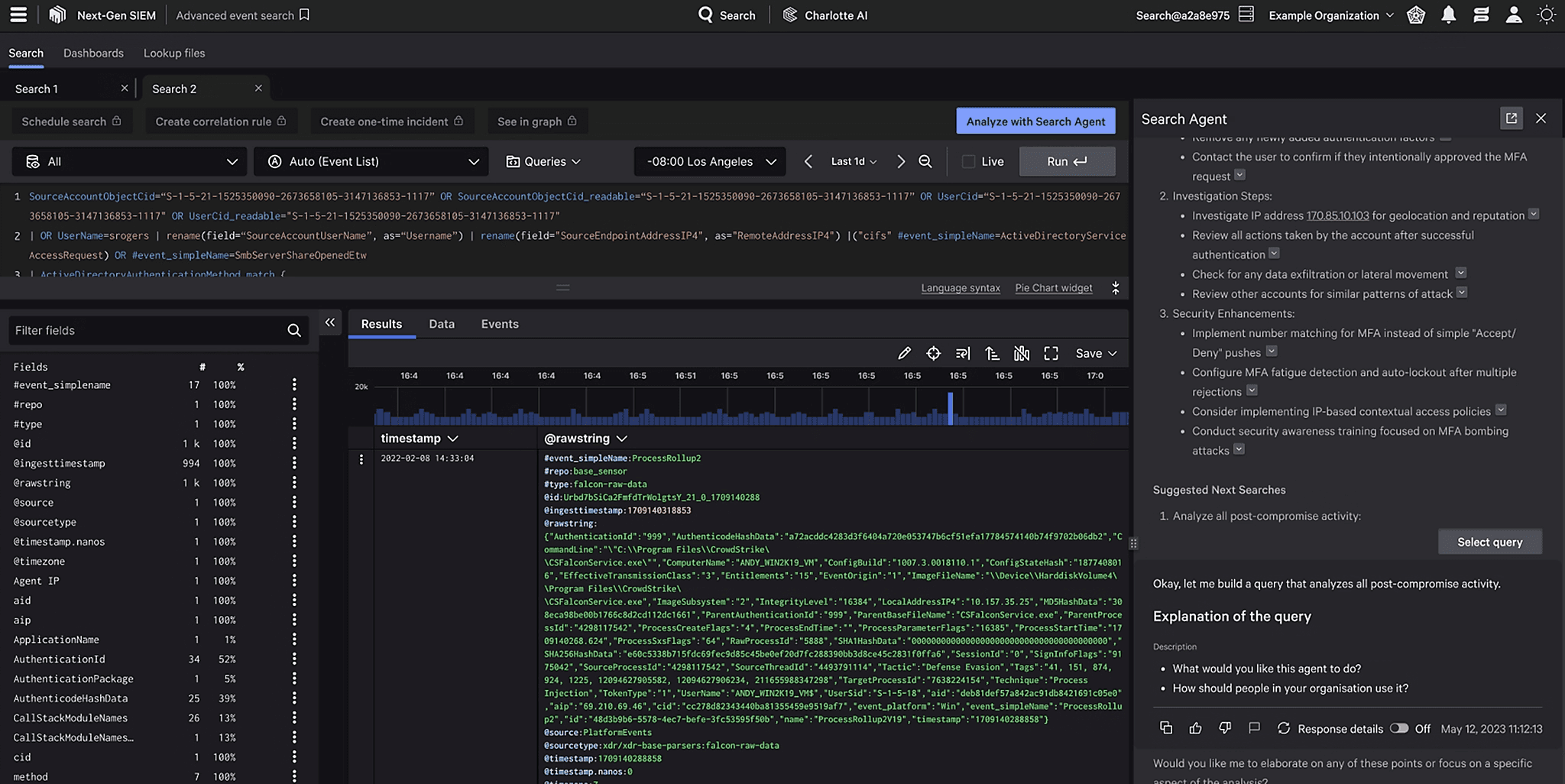
CrowdStrike Falcon Next-Gen SIEM extends CrowdStrike's endpoint detection platform into broader SIEM territory. The platform targets organizations that want to consolidate their endpoint and SIEM capabilities under one vendor, with Charlotte AI providing the autonomous investigation layer.
Key Features
Charlotte AI handles autonomous alert triage, generates investigation summaries, and provides conversational query capabilities through Security Data Insights. The AI assists with optimizing detection rules and normalizing data across sources.
Pros
Unified visibility across cloud, endpoint, and identity data with a single lightweight agent.
High-speed search outperforms legacy SIEM query times.
For existing CrowdStrike EDR customers, SIEM capabilities require minimal additional deployment.
Use Cases
Existing Falcon EDR customers expanding to SIEM — Organizations already paying for Falcon Prevent or Insight who want to consolidate endpoint telemetry and log management under one platform without deploying a new agent.
Teams prioritizing endpoint-centric threat hunting — SOCs where the majority of investigations start at the endpoint and need fast correlation between process execution, network connections, and log events in a single query interface.
Vendor consolidation programs — Security programs looking to reduce the number of vendor relationships by combining EDR, identity protection, and SIEM into a single Falcon platform contract.4. Splunk Enterprise Security
4. Splunk Enterprise Security

Splunk Enterprise Security is one of the longest-running SIEM platforms in the market. The Premier Edition bundles SIEM, SOAR, UEBA, and AI Assistant capabilities, with recent updates focusing on agentic AI for SOC automation.
Key Features
The agentic SOC capabilities include a Triage Agent for autonomous alert prioritization that analyzes and categorizes incoming alerts without human intervention. Its attack analyzer handles automated code analysis for suspicious files.
Pros
A deep integration ecosystem with thousands of pre-built apps, add-ons, and data inputs.
A mature security orchestration platform with hundreds of pre-built playbooks and deep action support across security tools.
SPL gives experienced analysts granular control over complex searches, transformations, and correlations that simpler query languages can't match.
Use Cases
Large enterprises with mature detection engineering programs — Organizations with dedicated Splunk administrators and detection engineers who need the full flexibility of SPL to build custom correlation logic across complex, multi-source environments.
Heavily regulated industries needing deep audit trails — Financial services, healthcare, and government organizations where the breadth of Splunk's pre-built compliance reports and the depth of SPL for custom audit queries justify the platform cost and complexity.
Teams consolidating on Splunk across observability and security — Organizations already running Splunk for IT operations and application monitoring who want to unify their security data in the same platform rather than introduce a separate SIEM.
5. SentinelOne Singularity
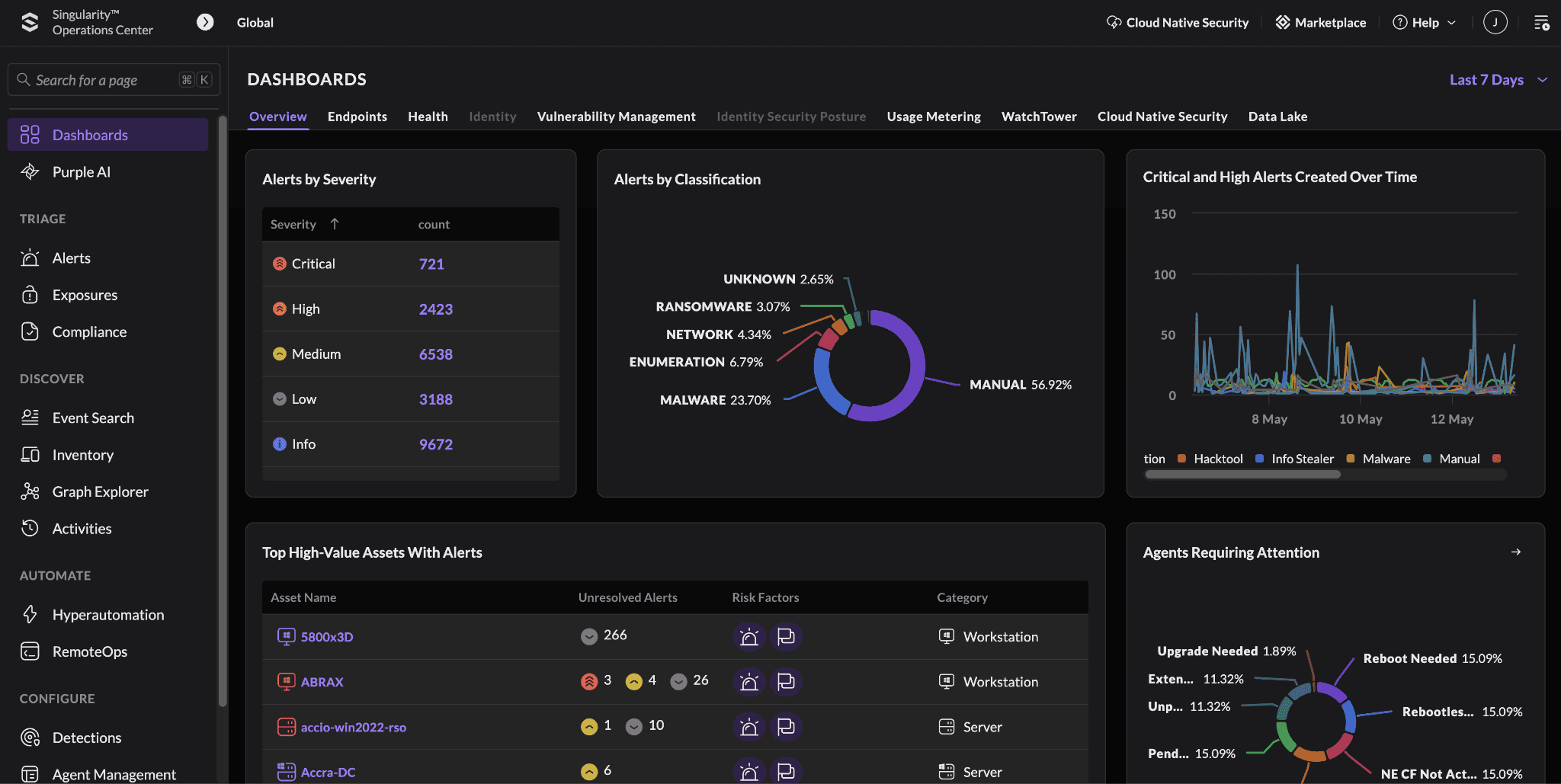
SentinelOne Singularity originated as an autonomous endpoint protection platform and has since expanded into broader security operations, including AI SIEM capabilities. The platform emphasizes machine-speed response, automatically isolating endpoints, rolling back malicious changes, and remediating threats without waiting for human approval.
Key Features
Purple AI Athena offers endpoint protection, cloud security, and data analytics. It provides autonomous alert investigation that analyzes and enriches incidents, and verdict enrichment that incorporates threat intelligence.
Pros
Purple AI Athena enables conversational threat hunting through natural language.
The autonomous response engine executes containment actions, isolating compromised endpoints and rolling back changes in real time.
The Singularity platform correlates telemetry across endpoint, cloud, and identity sources.
Use Cases
Teams that need machine-speed autonomous response — Organizations where the window between compromise and lateral movement is too short for human-in-the-loop response, and who need an AI that can isolate and remediate without waiting for analyst approval.
Endpoint-heavy environments transitioning to SIEM — Companies that already deploy SentinelOne for endpoint protection and want to extend into log management and broader SIEM coverage without a net-new platform deployment.
Teams without a large detection engineering staff — Organizations that want strong out-of-the-box coverage and autonomous response rather than investing heavily in custom detection rule development.
6. Palo Alto Cortex XSIAM
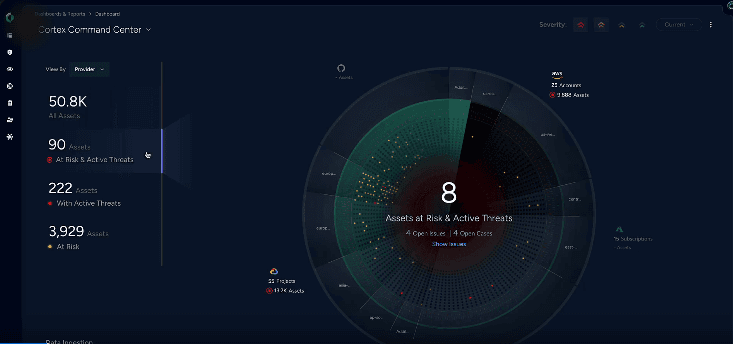
Cortex XSIAM (Extended Security Intelligence and Automation Management) is Palo Alto Networks' answer to the fragmented enterprise security stack. Rather than adding AI as a layer on top of a traditional SIEM, XSIAM is purpose-built to replace SIEM, XDR, SOAR, and Attack Surface Management (ASM) with a single consolidated platform. With over 2,900 ML models running against ingested data and 13,300+ up-to-date detections, XSIAM claims up to 99% alert noise reduction — compressing thousands of daily alerts into a handful of prioritized cases.
Key Features
AI-driven case management — XSIAM correlates thousands of raw alerts into a small number of prioritized cases, each surfaced with a full attack story including root cause, attacker timeline, and recommended response actions.
Cortex AgentiX — Agentic AI framework that enables security teams to deploy, manage, and customize AI agents for specific SOC workflows, from triage automation to threat hunting playbooks.
Unified data engine — Ingests telemetry from endpoint (Cortex XDR), network (Palo Alto NGFW), identity, cloud, and third-party sources into a single normalized data layer, providing XDR correlation without managing separate connectors.
Pros
Platform consolidation is the headline benefit — replacing separate SIEM, XDR, SOAR, and ASM tools with a single platform reduces vendor complexity and can lower total cost of ownership for organizations paying for all four separately.
Tight integration with Palo Alto NGFW logs and Cortex XDR endpoint telemetry means organizations already in the Palo Alto ecosystem get a significant data quality advantage.
XSIAM's attack story presentation gives analysts context-rich cases rather than individual alerts, reducing investigation time for common attack patterns.
Use Cases
Stack consolidation initiatives — Enterprises running separate SIEM, XDR, SOAR, and ASM tools that are paying for overlapping capabilities and want to reduce vendor count, integration maintenance, and context switching for analysts.
Palo Alto ecosystem organizations — Companies already running Palo Alto NGFW and Cortex XDR who want to maximize their existing investment by adding SIEM and SOAR capabilities within the same platform and data model.
Large SOCs with dedicated platform administrators — Enterprise security teams with the headcount and budget to work through XSIAM's complexity and build out custom agentic workflows over time.
7. Darktrace
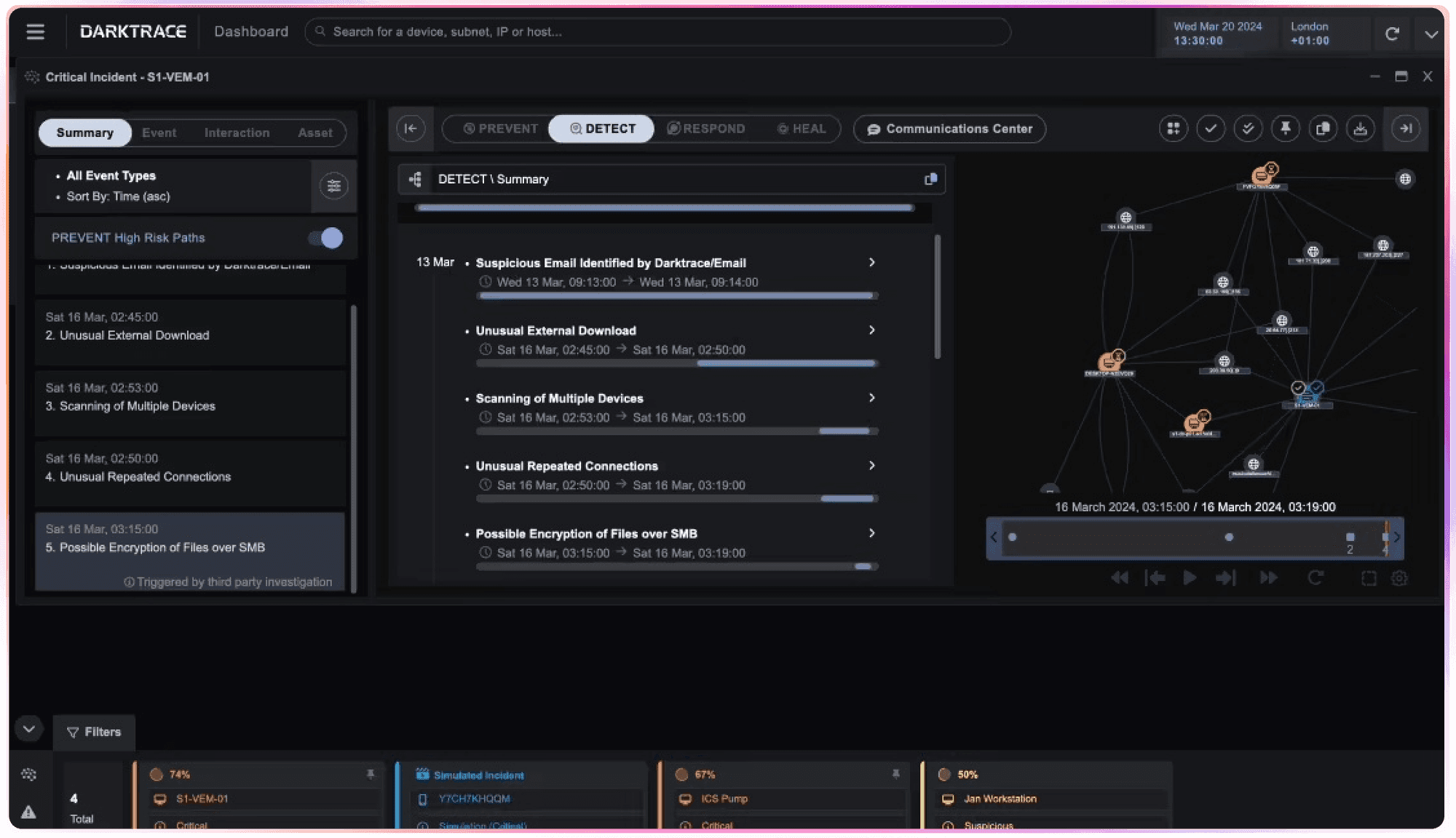
Darktrace takes a fundamentally different architectural approach to threat detection. Where most AI SOC platforms layer machine learning on top of rule-based SIEM infrastructure, Darktrace is built entirely on unsupervised machine learning. It has no rules, no signatures, and no threat intelligence feeds. Instead, it learns what "normal" looks like for every user, device, and entity in your environment and fires when behavior deviates from that baseline. This makes it uniquely capable of detecting novel threats that rules and signatures would miss.
Key Features
Self-learning AI (Enterprise Immune System) — Continuously models normal behavior for every entity in the environment, detecting subtle anomalies that deviate from established patterns without requiring predefined rules or prior knowledge of the attack.
Antigena autonomous response — When a threat exceeds a confidence threshold, Antigena takes targeted containment actions (blocking specific connections, enforcing normal behavior patterns) without shutting down legitimate activity or waiting for analyst approval.
Cyber AI Analyst — Automatically investigates security incidents, correlating related events across the environment and generating human-readable investigation summaries that compress hours of analyst work into minutes.
OT/ICS visibility — Deep coverage for operational technology environments, including industrial control systems and IoT devices, where traditional SIEM tools often struggle to model normal behavior.
Pros
Detects unknown and novel threats that evade rules and signatures. The unsupervised ML approach means Darktrace fires on behavioral anomalies that no prior threat intelligence would have predicted.
Self-learning reduces the need for manual rule writing and tuning, which is a significant operational cost reduction for teams without large detection engineering staff.
Strong OT/ICS coverage is a genuine differentiator, few competitors provide the same depth of visibility into industrial control systems and IoT environments.
Use Cases
OT and ICS environments — Manufacturing, energy, utilities, and critical infrastructure organizations where industrial control systems and IoT devices need behavioral monitoring that traditional SIEM tools cannot provide.
Organizations facing novel and zero-day threats — Companies in high-risk sectors (defense, financial services, critical infrastructure) where adversaries are likely to use novel techniques that rules and signatures haven't seen before.
Environments with limited security staff — Organizations that cannot sustain a large detection engineering program to write and maintain rules, and need self-learning AI to handle the detection burden autonomously.
8. Vectra AI
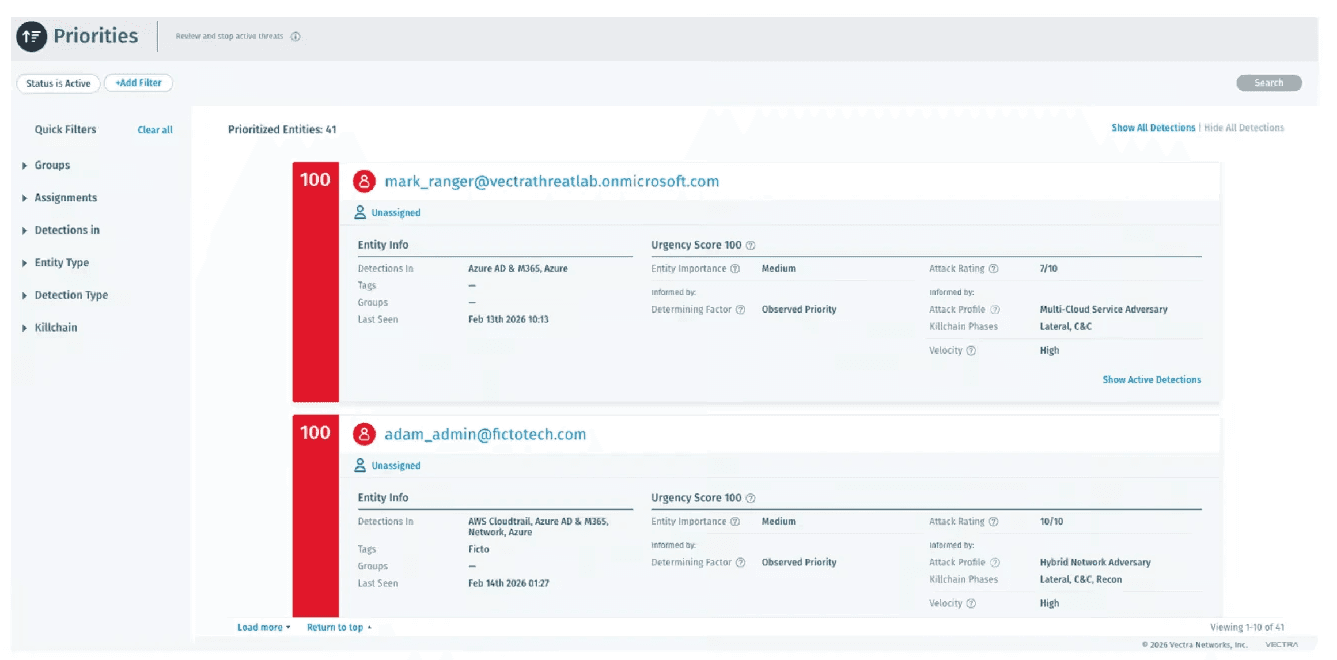
Vectra AI is a network detection and response (NDR) platform that has expanded into broader AI SOC territory. It focuses on detecting attacker behavior — particularly lateral movement, credential misuse, and privilege escalation — across hybrid and multi-cloud environments. Vectra's core differentiator is its agentless deployment model: it analyzes network metadata and cloud API telemetry rather than requiring endpoint agents, delivering coverage in hours rather than weeks.
Key Features
Attack Signal Intelligence — AI correlates and scores threats based on two dimensions: certainty (how confident the AI is that the behavior is malicious) and impact (how critical the affected asset is to the organization). This dual-axis scoring surfaces the highest-priority threats regardless of alert volume.
Integration with existing SIEM and SOAR — Vectra is designed to feed enriched, prioritized threat signals into existing Splunk, Microsoft Sentinel, or other SIEM platforms rather than replace them — making it a complementary layer rather than a full platform replacement.
SOC automation — Reduces manual triage by automatically grouping related detections into prioritized investigations and surfacing only the signals that warrant analyst attention.
Pros
Agentless deployment means Vectra can be operational in hours, covering both managed endpoints and unmanaged devices (IoT, BYOD, cloud workloads) that agent-based platforms miss.
The certainty × impact scoring model reliably surfaces the highest-priority threats without requiring analysts to manually review every alert, significantly reducing triage time.
Integration-first architecture means Vectra adds value on top of existing SIEM investments rather than requiring a full platform replacement.
Use Cases
Rapid deployment without agent rollout — Organizations that need detection coverage quickly — following a breach, during a migration, or in an M&A environment and cannot wait weeks to deploy endpoint agents across the environment.
Hybrid and multi-cloud detection gaps — Teams whose existing SIEM handles log correlation well but has blind spots in network-level lateral movement detection and cloud API behavior analysis.
Augmenting an existing SIEM investment — Organizations running Splunk or Microsoft Sentinel that want to add network-level behavioral detection without replacing their current platform or retraining analysts on a new query language.
9. ReliaQuest GreyMatter
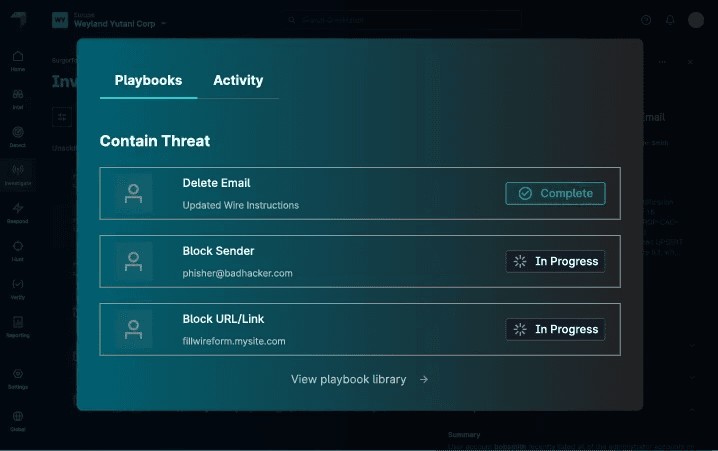
ReliaQuest GreyMatter is an agentic AI security operations platform that takes aim at one of the SOC's most persistent problems: analyst capacity. Rather than asking analysts to work faster through better tooling, GreyMatter aims to eliminate Tier 1 and Tier 2 analyst work entirely — deploying 6 agentic AI personas with 200+ agent skills across 400+ integrations to autonomously investigate every alert and achieve threat containment in under 5 minutes.
Key Features
Agentic AI investigation — Six specialized AI agent personas (each with distinct roles across detection, investigation, containment, and intelligence) work in concert to investigate alerts end-to-end without human intervention for standard Tier 1 and Tier 2 cases.
Open XDR across 400+ integrations — GreyMatter works across your existing security stack rather than replacing it — ingesting and correlating data from SIEM, EDR, firewall, identity, email, and cloud tools through 400+ native integrations.
Autonomous containment — When a threat is confirmed, GreyMatter can autonomously execute containment actions (isolating endpoints, disabling accounts, blocking IPs) across connected tools in under 5 minutes.
Pros
The agentic AI framework genuinely eliminates Tier 1 and Tier 2 work at scale, allowing small security teams to achieve the output of a much larger SOC without additional headcount.
Open XDR philosophy means GreyMatter works with your existing tools — organizations don't need to rip and replace their SIEM or EDR to benefit from agentic automation.
Autonomous containment in under 5 minutes is a meaningful capability for organizations where lateral movement speed outpaces human response times.
Use Cases
SOC capacity expansion without headcount growth — Security programs that are struggling with analyst burnout and alert backlog, and want to expand effective SOC capacity through agentic automation rather than hiring additional analysts.
Enterprises with complex, multi-tool security stacks — Organizations running 20+ security tools that need a platform to correlate findings across all of them without requiring data centralization into a single SIEM.
Regulated industries needing rapid containment SLAs — Financial services, healthcare, and technology companies with aggressive incident response SLAs that need sub-5-minute autonomous containment to meet regulatory requirements.
10. Arctic Wolf
Arctic Wolf takes a fundamentally different approach to the AI SOC: rather than selling software that your team operates, it delivers a fully managed agentic SOC as a service. The Aurora Agentic SOC deploys a "Swarm of Experts" model across Oversight, Authoritative, and Process agent tiers to automate SOC workflows while keeping humans in the loop for validation and oversight. For organizations without the internal security staff to operate a complex AI platform, Arctic Wolf removes that operational burden entirely.
Key Features
Aurora Agentic SOC — Three-tier swarm of AI agents (Oversight, Authoritative, and Process Agents) manages the full SOC workflow from alert triage and investigation to escalation and containment with human concierge experts validating high-confidence findings.
Managed Detection and Response (MDR) — 24/7 SOC coverage monitoring endpoints, networks, cloud environments, and identity sources, with the Aurora Agentic SOC resolving cases 15× faster than the previous human-led model.
Managed Risk — Continuous vulnerability scanning and attack surface management that prioritizes remediation based on exploitability and business impact, not just CVSS scores.
Pros
Full managed service means organizations without in-house SOC staff get enterprise-grade 24/7 detection and response coverage without building or staffing a security operations center.
Aurora Agentic SOC is included at no additional cost for existing MDR customers. It's a platform upgrade, not a premium upsell, which is unusual for AI capability releases in this market.
10-day deployment timeline is significantly faster than building or migrating an in-house SIEM, making Arctic Wolf the fastest path to SOC coverage for organizations starting from scratch.
Use Cases
Organizations without in-house SOC staff — Mid-market companies in the 500–5,000 employee range that need enterprise-grade 24/7 detection and response coverage but cannot justify the cost of building and staffing an internal SOC.
Fast time-to-coverage requirements — Organizations that need SOC coverage up and running in days following a breach, ahead of a compliance audit, or after a key security hire departure and cannot wait months for an in-house platform deployment.
Industries with high compliance requirements but limited security staff — Healthcare providers, regional financial institutions, and manufacturing companies that need to demonstrate SOC coverage to regulators, auditors, or cyber insurers without the budget to staff it internally.
Pick the Right AI SOC Platform for Your Security Team
The AI SOC platform you choose shapes how your team spends every working hour: chasing false positives or investigating real threats. The right platform ensures that your team can reach full alert coverage instead of hoping that there's no credible threat hiding in the backlog.
1. Start with Your Team's Maturity
A three-person security team needs different capabilities than a 50-person SOC with dedicated detection engineers. Lean teams benefit from platforms with strong out-of-the-box detection rules and AI workflows that deliver value without extensive customization.
More mature teams may prioritize code-driven workflows, version control integration, and the flexibility to build highly customized detection logic.
2. Factor in Your Existing Stack
Microsoft-heavy organizations benefit from Sentinel's free data sources and native integration. Teams running CrowdStrike EDR gain from Falcon's bundled ingestion and endpoint-to-SIEM pipeline.
But don't stop at infrastructure fit. Consider your team's technical capabilities too. Organizations with Python fluency thrive with code-driven platforms that bring software engineering practices to security operations. Teams earlier in their detection engineering journey benefit from AI-assisted rule builders and guided investigation workflows.
3. Clarify Your Data Ownership Requirements
Some platforms store your data in vendor-controlled environments. You can only run the analytics they support; you're subject to their retention policies, and migrating away could mean losing historical context. Open data architectures keep your security telemetry in the infrastructure you own and operate.
For organizations in healthcare, financial services, government, or any sector with stringent compliance requirements, data ownership isn't optional.
The platforms in this guide represent different philosophies: some optimize for specific vendor ecosystems, others for raw automation speed. If your team values code-driven workflows, full data ownership, and AI that works across the entire detection and response lifecycle, Panther pairs detection-as-code with AI-powered triage and an open security data lake, ensuring your security data stays in infrastructure you control while delivering the autonomous triage capabilities modern SOCs require. Book a demo to see how it handles your alert volume.
The Future of AI SOC Platforms
AI SOC platforms are evolving fast. Three trends are reshaping how security teams operate, and each one should factor into your buying decision.
1. Agentic AI Is Moving from Pilots to Production
Traditional SOAR platforms offered incremental gains through static playbooks, but agentic models reason, act, observe, and adjust as evidence changes. They are essentially managing investigations dynamically rather than following a script. The expectation is that AI automation will autonomously handle the bulk of Tier 1 alerts, managing everything from initial triage and enrichment to categorization and even basic containment actions.
2. The Analyst Role Is Evolving, Not Disappearing
As SOCs adopt human-agent teaming, analysts begin supervising autonomous workflows instead of manually executing every investigative step. They orchestrate how agents collaborate, set boundaries, and ensure system behavior reflects the SOC's mission. SOC teams will evolve from alert processors into AI SOC supervisors. The analysts best positioned for this transition are those developing skills in prompt engineering, edge-case detection, and threat hunting.
3. Model Context Protocol (MCP) Is Becoming the Connective Tissue for AI Agents
The MCP standardizes how AI agents interact with external tools and data sources, enabling them to move fluidly across SIEMs, EDR platforms, and cloud environments. But MCP also expands the attack surface. Security teams adopting MCP-enabled agents need to treat the protocol itself as an attack vector, not just an integration layer.
The SOC of the future will look fundamentally different from today's. The teams that start building around agentic workflows, human-agent teaming, and open data architectures now will be the ones ready for what comes next.

Panther AI triages alerts 50% faster while your analysts stay in control
Our platform analyzes alerts, builds context from your logs, and suggests actions. Every decision requires analyst approval with a complete audit trail.
Share:
RESOURCES